Iran claims control 500km beyond Hormuz
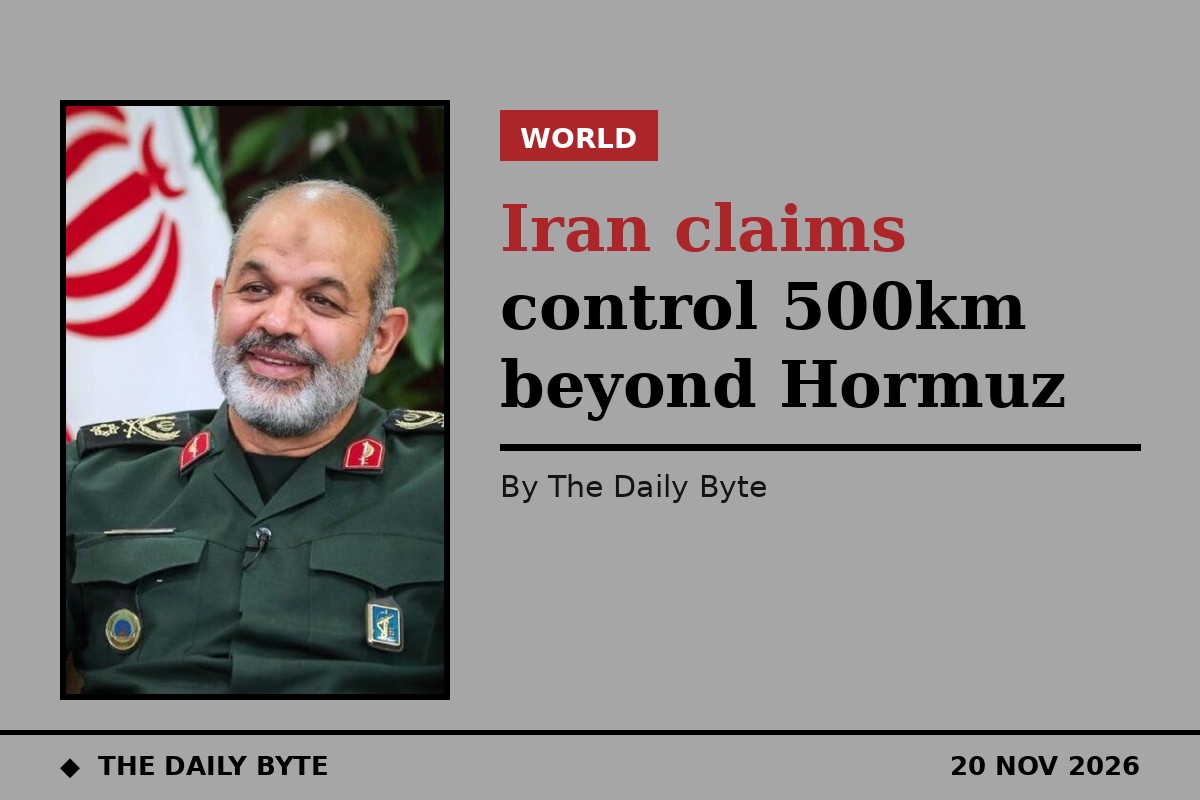
Iran's Revolutionary Guards chief has said Iranian forces control waters more than 500 kilometres beyond the Strait of Hormuz, and warned that those responsible for attacks on Iran will find no safe haven anywhere in the world.
Major General Ahmad Vahidi, commander-in-chief of the Islamic Revolutionary Guard Corps (IRGC), made the remarks at the closing ceremony of the “Pioneers of Liberation” conference in Tehran on Friday. “The world will no longer be a safe haven for the murderers and criminals who have committed crimes in Iran,” he said, referring to the United States and Israel.
General Vahidi described the conflict with the US and Israel since 28 February as a battle whose outcome had frustrated the attackers. He said attempts to seize Iranian islands and coastal areas had failed, and that planned operations in the country's north-west and south-east had not materialised because of the readiness of local communities and military forces.
Naval reach “500 kilometres and farther”
On the Strait of Hormuz, through which about a fifth of the world's oil and liquefied natural gas normally passes, General Vahidi said the operational presence of Iran's naval forces had expanded to 500 kilometres and farther into international waters. “The reluctance of foreign forces to approach within 500 to 600 kilometres of Iran is due to the capabilities and deterrence of our naval units,” he said.
He said Iran controlled the Persian Gulf, the Strait of Hormuz and nearby open waters, and that enemy ships avoided coming within 500 to 600 kilometres because of the strength of Iran's navy and air forces. The claims could not be independently verified, and US Central Command has rejected Iran's account of control over the waterway, saying American forces have cleared explosives from the shipping routes.
Tanker attacks and a restricted waterway
General Vahidi's comments follow a series of attacks on commercial shipping in the strait. On Thursday, the IRGC said two large oil tankers carrying four million barrels of oil had been hit by naval mines, and another vessel was struck later the same day. Iran has restricted ship movements through the strait since the US-Israeli military campaign began in February, and the United States later imposed a counter-blockade.
Tensions have also grown after Iran attacked US military sites in Kuwait and Bahrain over the past week, following reports that American forces had struck Iranian targets on Qeshm Island. Kuwait said it intercepted drones aimed at the Ali Al Salem Air Base and condemned the attack as a grave breach of international law.
General Vahidi became IRGC chief in August, after his predecessor, Mohammad Pakpour, was killed on the first day of the US-Israeli war against Iran in February. He has repeatedly warned that any further aggression would be met with a forceful response, and on Friday he said revenge was Iran's right.
Washington in no rush on new strikes
President Donald Trump told Reuters on Thursday that he would discuss possible new military action after the start of the year, saying his administration had time to consider its next steps. He has not authorised another major operation, and diplomacy between Washington and Tehran has made little progress, despite mediation efforts involving Qatar and Oman.
Iran has said the Strait of Hormuz will remain closed until Washington meets its conditions in a verifiable manner, and that it will not discuss the nuclear issue until the situation around the waterway is resolved. Qatar's Foreign Ministry has described the closure as an international crisis and called for collective action and diplomatic engagement.
Sources: Press TV; AsiaOne.


