Iran: Hormuz stays shut until US meets demands
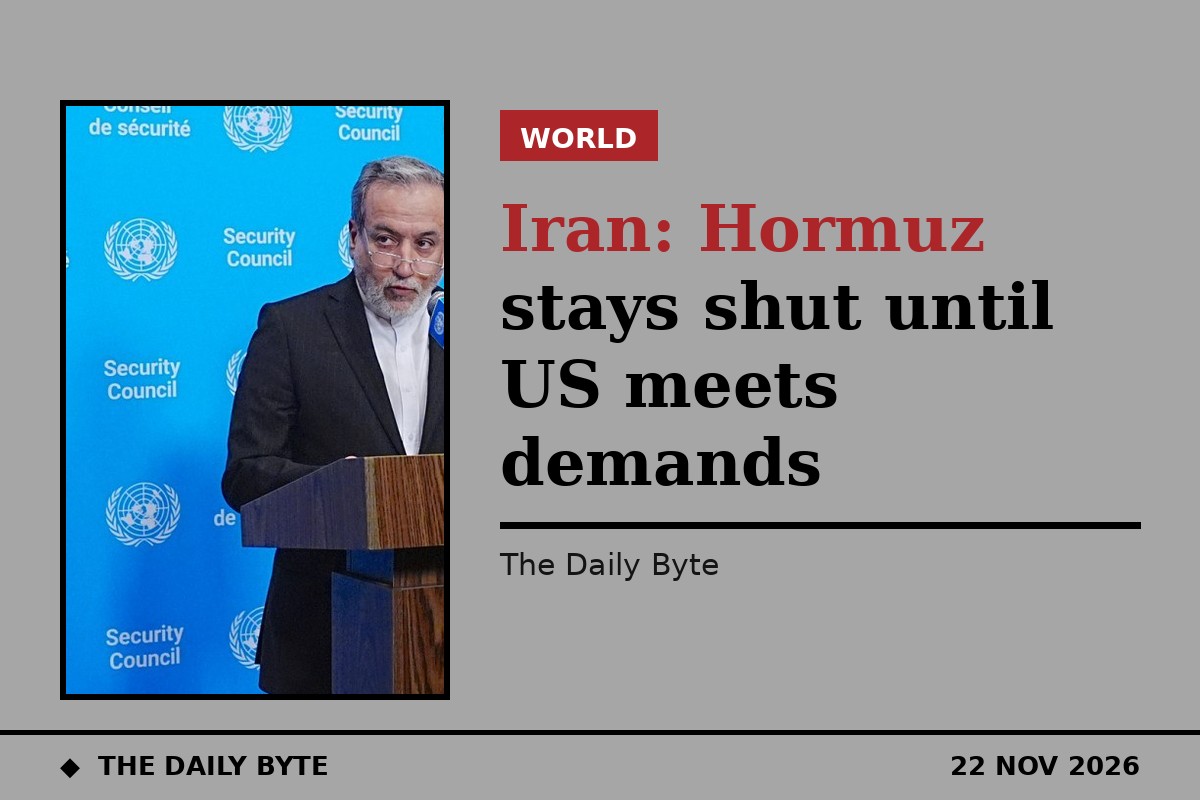
Iran will not discuss reopening the Strait of Hormuz until the United States meets its demands, Foreign Minister Abbas Araghchi said on Saturday, as Qatari mediators held fresh talks in Tehran aimed at finding a diplomatic way out of the Gulf crisis.
Speaking at a ceremony marking Oman’s National Day, Araghchi said reopening the waterway was “not difficult” if Washington accepted what he called Iran’s reasonable conditions, which he said were in line with international law. At the same time, he made clear that Tehran sees no point in talking about the strait while those conditions remain unmet.
“Our position is clear. As long as Iran’s demands are not met, the discussion on the Strait of Hormuz and its opening is pointless,” he said, according to the semi-official Tasnim news agency. “We have always said we are ready for talks, just as we are ready to defend ourselves.”
What Iran is asking for
Iran’s conditions have included ending the war on all fronts, unfreezing Iranian assets, lifting oil sanctions and ending the US counter-blockade of Iranian ports. Araghchi said there would be “no solution” unless Washington acknowledged its mistakes and fulfilled its previous commitments.
He also described the US blockade of Iran as “completely illegal” and urged that regional talks and mediation be given time, saying he hoped for “a rational way to lift the blockade”. Iran moved to close the strait again on 12 July, four days after the US resumed attacks on the country, and has restricted shipping through the waterway since the war began on 28 February, when the US and Israel attacked Iran. The strait normally carried about a fifth of the world’s oil, and the US has imposed a naval blockade on Iranian ports in response.
Qatari mediators in Tehran
A Qatari delegation arrived in Tehran on Friday evening and held two hours of talks with Iranian officials, Deputy Foreign Minister Kazem Gharibabadi said, according to Tasnim. Araghchi described such visits as routine, saying mediators between Iran and the US regularly travel to relay ideas and proposals.
“We are in contact with mediators, including the Qataris, both in person and virtually, and are holding the necessary discussions to see whether another opportunity can be given to diplomacy,” Gharibabadi said on Saturday. He added that the talks had not yet become formal negotiations, but that if they did, the technical details of Iran’s nuclear programme would be discussed, while Iran’s position is that its enriched uranium must not leave the country.
Gharibabadi also said Iran regards the US economic blockade as an act of war and will “take any action necessary” to break it.
Pressure at home and abroad
President Masoud Pezeshkian said on Saturday that Iran is facing a “silent economic war” that is “tougher than a war with missiles”, according to the state news agency IRNA. He told a meeting of investors and producers that the government was working to avoid power cuts over the winter.
On the same day, the commander of the Islamic Revolutionary Guard Corps, Major-General Ahmad Vahidi, toured an underground missile facility, accompanied by Brigadier General Majid Mousavi, who heads the IRGC Aerospace Force. Tasnim reported that Vahidi was briefed on the force’s readiness and recent developments in its missile programme.
For his part, US President Donald Trump told Fox News on Saturday that he wants a “permanent” deal that stops Iran from getting a nuclear weapon, describing Iranian officials as “very, very difficult”. Araghchi also said he had requested an emergency meeting of foreign ministers from the Organisation of Islamic Cooperation to discuss the situation in Gaza.
For now, neither side has set a date for reopening the strait, and the Qatari mediation has produced no breakthrough. The waterway remains the central bargaining chip in a conflict that has already disrupted shipping and pushed up global energy prices.
Source: DDC News, reporting Al Jazeera. Further detail: IwPost.


