Iran MPs Push NPT Exit as Araghchi Holds Doctrine Line
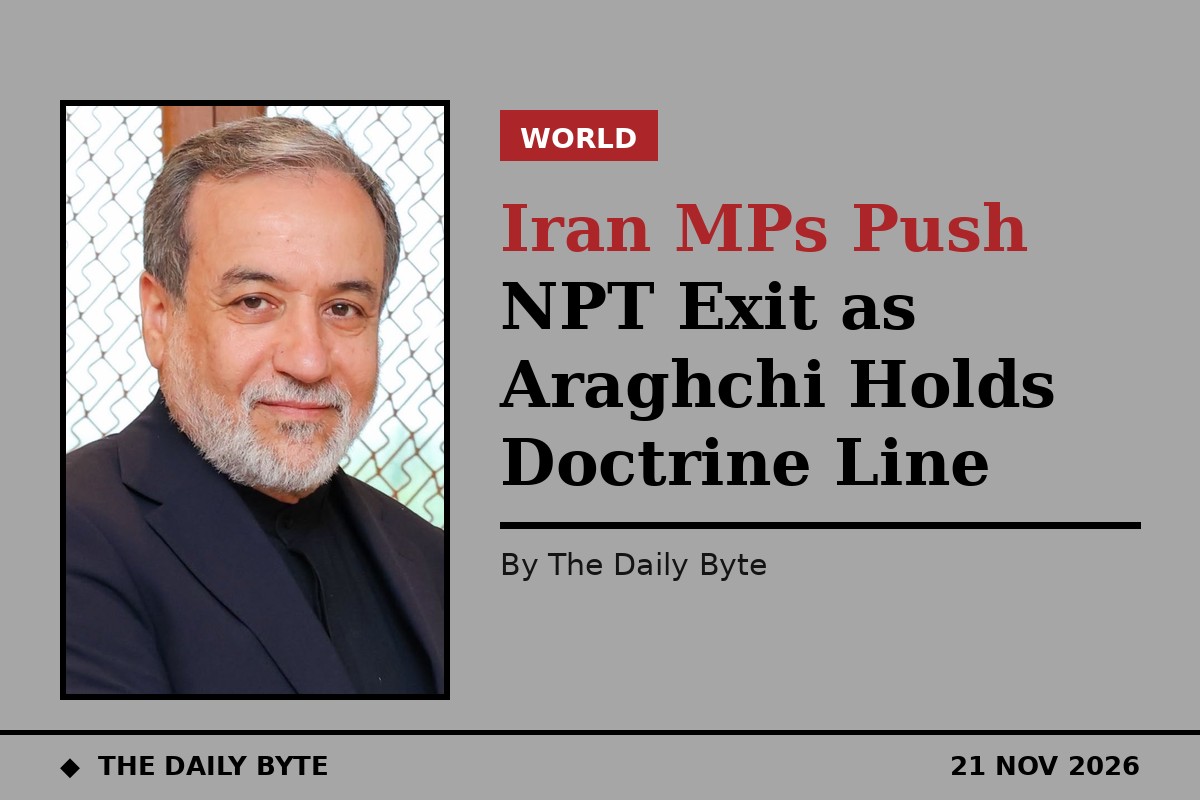
Iranian lawmakers stepped up calls on Saturday for Iran to leave the Nuclear Non-Proliferation Treaty, arguing that membership of the treaty did not protect the country's nuclear sites from attack. Foreign Minister Abbas Araghchi, responding in an interview published the same day, insisted that Tehran's official nuclear doctrine had not changed.
Legislator Mahmoud Nabavian made the call in a post on X on Saturday, writing: "Now that we have paid the heavy costs of war and sanctions, it is time for the Iranian nation to withdraw from the NPT treaty and change the nuclear doctrine."
Abolfazl Zohrevand, a member of parliament's National Security and Foreign Policy Committee, told the TASS news agency that Iran had "actually fallen out of the NPT". He said the country had been "pushed out of the Agency and the NPT" by strikes on its nuclear facilities and the killing of its nuclear scientists, and that public opinion supported withdrawal. He pointed to Article 10 of the treaty, which allows a member state to leave.
Ebrahim Rezaei, another member of the same committee, said 10 proposals for withdrawal had been registered in parliament and were under consideration, according to the Fars news agency. Mohammad Javad Haj Ali Akbari, a cleric and politician, described a review of the doctrine as a "national demand" during his Friday sermon, state broadcaster IRIB reported. The hardline Paydari Front made the same call on 24 October.
Araghchi calls the debate serious but holds the line
Araghchi addressed the debate in an interview with the government newspaper Iran, published on Saturday. He called the argument over the doctrine "serious and strategic" and said both sides had strong arguments. The case for change, he said, had "strong logic", because NPT membership and international safeguards had not prevented attacks on Iran's nuclear sites.
But he stressed that no decision had been taken. "Up to this moment, our doctrine has not changed and our official positions remain the same," he said, adding that leaving the present framework "would not have simple consequences".
Asked whether China and Russia would support a change, Araghchi said the two countries, both of which have strategic cooperation agreements with Iran, were opposed to changing the doctrine, according to reports of the interview. One account of the interview noted that it was not clear whether he meant they opposed a change or held different views from each other.
On the separate question of Iran's enriched uranium, Araghchi said a formula could be found, but the material would not leave the country. That echoes a position set out earlier this month by Mohsen Rezaei, secretary of the Supreme National Security Council. The International Atomic Energy Agency estimates that Iran holds 440.9 kilograms of uranium enriched to 60 percent, a short technical step from the roughly 90 percent needed for a weapon.
What leaving the treaty would involve
The NPT, which entered into force in 1970, has 191 member states. Countries without nuclear weapons agree not to seek or acquire them, while keeping the right to peaceful nuclear energy under IAEA safeguards. Article 10 allows a country to withdraw with three months' notice if it decides that "extraordinary events ... have jeopardised the supreme interests of its country". Iran signed the treaty in July 1968 and ratified it in February 1970.
Withdrawal would not by itself mean that Iran would build a nuclear weapon, and Tehran's stated position remains that its programme is peaceful. President Masoud Pezeshkian has said Iranian policy follows the religious edict of Supreme Leader Ali Khamenei against weapons of mass destruction.
The IAEA has not had access to key Iranian nuclear facilities since the 12-day war in June 2025, when the United States and Israel struck sites including Fordow, Natanz and Isfahan. Last month the agency's board expressed "grave concerns" about what it called Iran's continued non-compliance with its NPT obligations, a finding Tehran called baseless and politically motivated.
War and diplomacy continue in parallel
The debate comes in the ninth month of the war that began when the United States and Israel attacked Iran on 28 February. President Donald Trump has said the war will be "wrapped up" soon and that Iran "cannot have a nuclear weapon". Qatari mediators returned to Tehran on Friday to revive diplomacy, while Tehran says it will only discuss its nuclear programme once its conditions, including an end to the US naval blockade and the lifting of sanctions, are met.
For now, the calls from parliament remain demands rather than decisions. Iran's leaders have not answered the latest withdrawal calls directly, although the foreign ministry said in June that lawmakers were preparing a bill and that the government would coordinate with parliament at later stages. Until parliament acts, Araghchi's position stands as the official one: the doctrine has not changed.


