Iran Offshore Oil Stocks Near Exhaustion
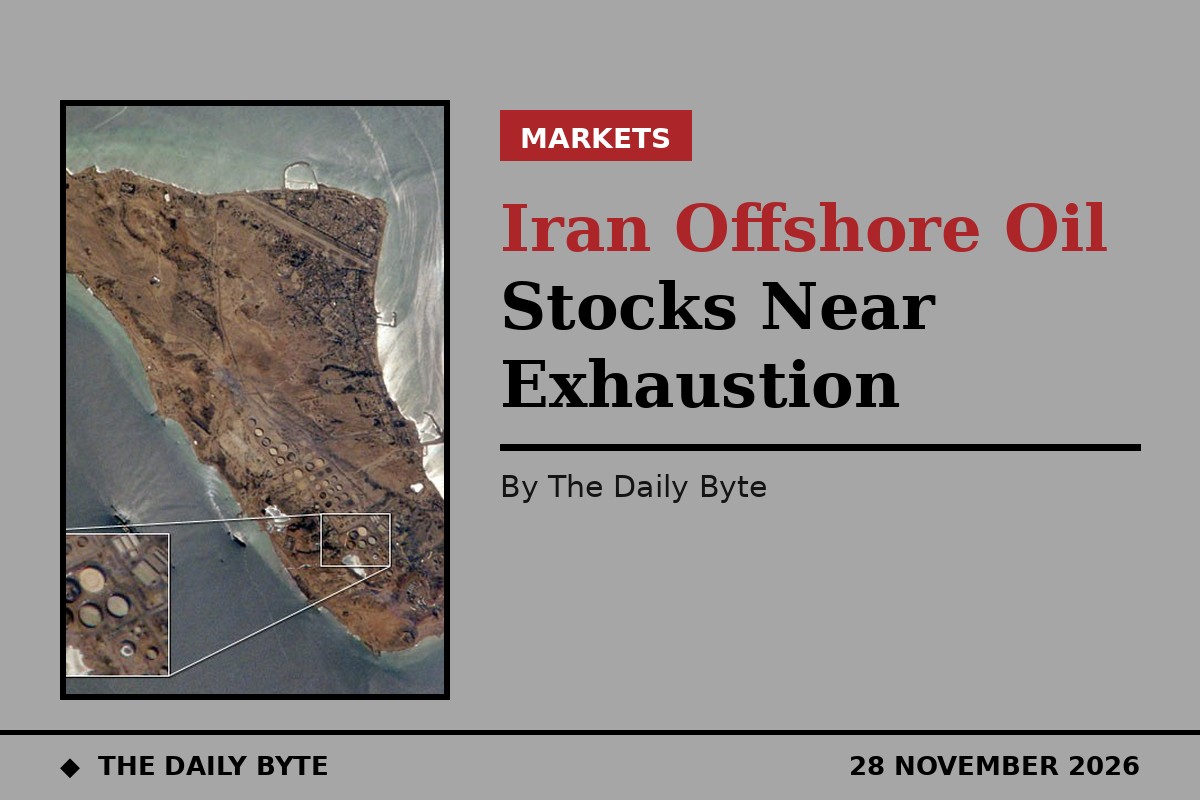
Iran's offshore oil stocks are near exhaustion after months under a United States naval blockade, according to industry tracking data published on Saturday. Energy intelligence firm Kpler estimates that the volume of Iranian crude held at sea has fallen from about 150 million barrels before the blockade began in April to roughly 866,000 barrels by mid-October, a figure reported by the Wall Street Journal and summarised by Yahoo Finance.
Maritime monitors give a similar picture using different measures. United Against Nuclear Iran (UANI) puts the remaining floating crude at between zero and seven million barrels, and says it has tracked no crude tanker successfully crossing the blockade enforcement line since mid-July. Small shipments of liquefied petroleum gas have slipped through at times, the monitors say, but crude exports have effectively stopped.
What the trackers report
Kpler's late-October assessment, reported by Al Jazeera, found that Iranian crude and condensate floating outside the blockade zone had fallen from 88.8 million barrels on 14 July, the day the blockade was reimposed, to zero by mid-October. About 43 million barrels remain stranded inside the blockade area, where they cannot be delivered to buyers. Because Chinese buyers generally pay one to two months after a cargo is discharged, Kpler expects the cash from past sales to dry up around mid-December.
The figures measure different things, but they all point the same way. Production has fallen with the stocks. Kpler put Iranian output below two million barrels a day in the months before the assessment, against 3.45 million barrels a day in January and 3.59 million in February, before the war between Israel and the United States on one side and Iran on the other began on 28 February. The United States Treasury says Iran has loaded no oil onto vessels since 25 August.
A stalled export fleet
Satellite evidence published by Kpler on 25 November shows an export fleet going nowhere. Its assessment of 20 November counted about 44 million barrels aboard 37 tankers inside the Gulf and the Gulf of Oman, including 11 tankers holding 15 million barrels at anchor around Kharg Island, Iran's main export terminal. The island itself is idle: no tanker has been pictured at its crude jetties since 29 August, and onshore storage stood at 22.2 million barrels on 17 November, about 72 per cent of capacity.
Kpler's figures show crude and condensate exports of 2.23 million barrels a day in February falling to 0.26 million in May and recovering to 0.89 million in July, with no export loading at all since 24 August. The firm also found that 76 of 282 tankers and gas carriers that moved Iranian cargo since 20 August had manipulated their tracking signals. A small number of ship-to-ship transfers have been recorded inside the Gulf, including five between 12 and 18 November moving 1.9 million barrels of crude and fuel oil, but Kpler's analysts caution that these do not show the blockade being broken.
The mid-December cliff
Kpler expects Iran's revenue from crude oil and condensate exports to fall to zero by mid-December, for the first time in the country's history, according to RFE/RL. The firm previously estimated that the blockade was costing Tehran between 200 million and 250 million dollars in lost oil revenue every day. Its senior commodity analyst, Homayoun Falakshahi, was quoted as saying: "There's no more oil to discharge to China anymore."
The squeeze is already visible in Tehran's budget planning. In a directive on 3 November, President Masoud Pezeshkian's administration set out two scenarios for next year: sanctions and the blockade continue, or restrictions ease. Mohammad Ghasemi, deputy for coordination of planning and budget, told local media that the government must prepare for circumstances in which oil revenue reaches zero. Oil still accounted for about one-third of planned government funding in the 2026-27 budget proposal, and year-on-year inflation stood at nearly 89 per cent in the month ending 22 October.
The cost on both sides
The blockade is also expensive for Washington. At a Senate hearing this week, Democratic Senator Elizabeth Warren cited independent estimates that the operation costs about 32.5 million dollars a day, a figure the acting Navy secretary, Hung Cao, confirmed. Bloomberg has reported that the operation ties up more than 30 per cent of the United States Navy's warships, and the Pentagon put the overall cost of the Iran war at 48.3 billion dollars as of 13 November.
United States Secretary of State Marco Rubio told his Group of Seven counterparts in Paris on Tuesday that the blockade, sanctions and border disruption could continue without a clear endpoint in sight, according to US media reports. OPEC+ meets on Sunday, 29 November, with Reuters reporting that the group is expected to hold its first-quarter 2027 production targets steady.


