Iran Rejects Gulf Payout Call, Demands Reparations Itself
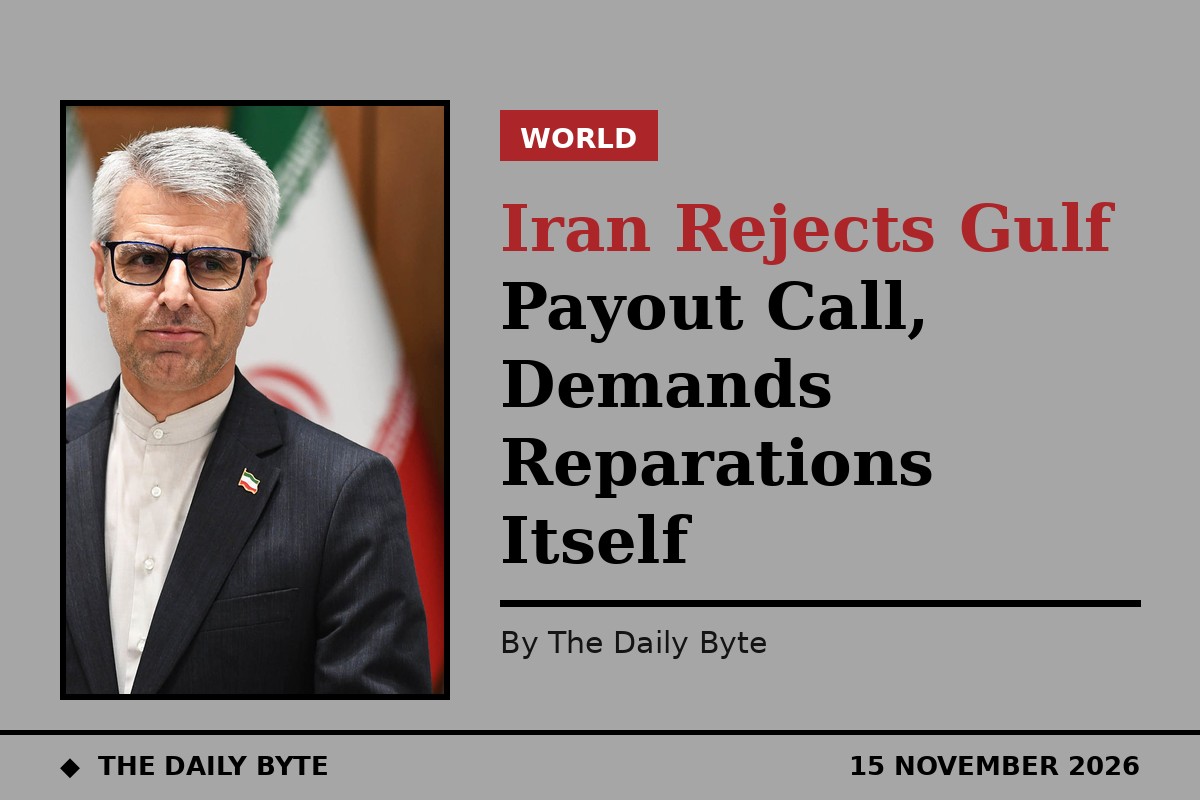
Iran has firmly rejected demands by Gulf Arab states that Tehran pay compensation for damage caused by Iranian missile and drone attacks during the recent regional conflict, arguing instead that countries which supported military operations against Iran should themselves pay reparations.
Foreign Ministry spokesman Esmaeil Baghaei made the remarks at his weekly press conference in Tehran on Sunday, responding to demands raised by Gulf Cooperation Council (GCC) Secretary-General Jasem Mohamed Albudaiwi at a United Nations Security Council meeting in New York on Friday.
The Security Council meeting, convened at Bahrain’s request, focused on Iranian attacks against Gulf countries and their consequences for regional security.
More than 7,000 missiles and drones, GCC says
Addressing the Security Council, Albudaiwi said Iran had launched more than 7,000 missiles and drones against Gulf states since 28 February. He said the GCC considered Iran fully responsible for the attacks and the resulting damage, injuries and losses suffered by countries in the region.
The Gulf organisation called on the Security Council to require Iran to provide full compensation for the damage caused by its attacks, in accordance with international law and Human Rights Council Resolution 61/1.
Baghaei rejected the demand outright. “We are the ones entitled to claim compensation, and we have documented all the instances in which regional countries played a role in assisting the United States and the Zionist regime in their actions against Iran,” he said, according to Iranian state media. He added that the findings had been formally communicated to the countries concerned through diplomatic channels.
He said Tehran did not take the GCC member states’ claim for compensation seriously, describing it as baseless, and warned those states not to “reopen the old wounds”, including what he described as their provision of multi-billion-dollar financial aid, weapons and military support to the regime of former Iraqi leader Saddam Hussein during the 1980s war on Iran.
“Accomplices” charge against Gulf states
Baghaei said regional countries that “actively participated in the military aggression” against Iran and made their territories available for use by the “aggressors” could not demand reparations. He said countries that allowed the attackers to use their airspace, territorial waters and land to launch attacks against Iranian territory must be regarded as “accomplices and collaborators”, sharing responsibility for what happened on Iranian soil.
“Given that these same countries actively participated in military aggression against a neighbouring country by allowing the aggressors to use their airspace, territorial waters, and land to launch attacks against Iranian territory, how can they possibly speak of seeking compensation from Iran?” he asked.
The spokesman said there was “clear evidence” that losses and damage inflicted on Iran during the 40-day war originated directly or indirectly from certain countries in the region, and that under international law and UN General Assembly Resolution 3314, any country that played a role directly or indirectly in the military aggression was considered an accomplice and bore responsibility.
He stressed that Iran’s own measures were “purely defensive in nature and targeted exclusively US military bases and assets that had been used to launch attacks” against the country, and that Iran had taken no action against the Gulf states’ sovereignty.
IAEA cooperation “unlikely to improve”
At the same briefing, Baghaei said cooperation with the International Atomic Energy Agency (IAEA) would not improve as long as the current situation persisted. He was responding to a confidential IAEA report released ahead of a meeting of the agency’s Board of Governors next week.
Baghaei said the IAEA had acknowledged that US-Israeli attacks on Iranian nuclear facilities had disrupted the agency’s activities in Iran, but had failed to explicitly identify the “military aggression” as the principal cause. “As long as this situation persists, we cannot expect a transformation in cooperation between Iran and the agency,” he said. He accused the IAEA of issuing one-sided reports, saying such an approach had harmed its reputation and credibility, and added that Iran would remain committed to its obligations under the Treaty on the Non-Proliferation of Nuclear Weapons as long as it remained a party to the treaty.
Baghaei was also asked about Sunday’s drone strike by the Islamic Revolution Guards Corps on a US air defence radar at the Al-Riffa helicopter base in Bahrain. He said Iran’s armed forces would leave no attack unanswered. “No act of aggression by the United States will go without a response. We have demonstrated this in practice, and we will continue to respond in the same manner in the future,” he said.
The exchange has intensified an already serious diplomatic dispute between Iran and several Gulf countries, with both sides presenting competing claims about responsibility for the conflict and its consequences. The 7,000-strike figure is the GCC’s own tally and has not been independently verified.
Source: IANS via The Freedom Press


