Iran and Russia join forces to beat US Caspian blockade
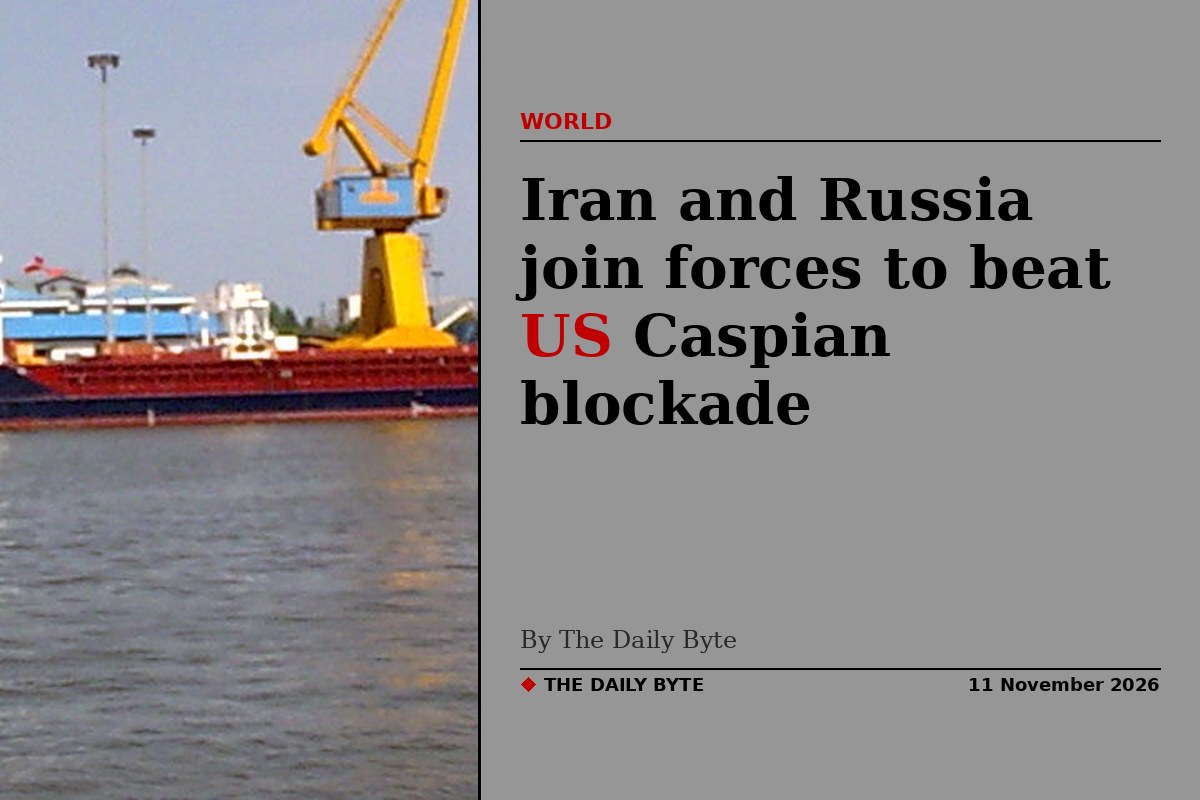
Iran is coordinating with Russia to counter a new US military task force set up to stop weapons reaching Iran across the Caspian Sea and overland, Tehran said on 10 November. The announcement, made by deputy foreign minister Kazem Gharibabadi, turns a little-known stretch of water into the newest front in the eight-month war between the United States, Israel and Iran.
Gharibabadi said on X on 10 November that he had met the Russian ambassador to Iran to discuss ways of countering Task Force Iron Gate, the US Central Command (CENTCOM) unit formed on 7 November. The Institute for the Study of War, which reported the meeting in its daily update, said the two countries were cooperating to keep weapons shipments moving despite the US effort.
What Task Force Iron Gate does
CENTCOM announced the task force on 7 November, describing it as a team of about 20 civilian and military staff based in Tampa, Florida. Its job is to coordinate with other US government agencies to stop Iran moving advanced weapons, dual-use technology, sanctioned material and illicit revenue across its land borders and the Caspian Sea. Its commander, Admiral Brad Cooper, said it “reinforces the success of our ironclad blockade against Iran at sea” and would further constrain Iran’s ability to “finance terrorism, rebuild weapons factories, and replenish their military.”
The naval blockade, in force in its current form since July, has prevented Iran from exporting more than $25 billion in crude oil, according to CENTCOM. The new task force extends that pressure inland and northwards, to the routes Tehran has used to get around the blockade at sea.
Why the Caspian route matters
A Reuters investigation published on 29 October found that Iran had built a secret network to import at least $2 billion in hardware, explosives and heavy-duty trucks since January 2025. The material entered Iran by cargo ship across the Caspian Sea from Russia, by truck from Central Asia and by freight plane from China, the investigation found. The Institute for the Study of War noted that Iran had used its Caspian trade routes with Russia to import Russian arms before and during the war, and that Ukraine struck one such shipment in July 2026.
The Caspian is the one sea route the US Navy cannot patrol: it is a landlocked body of water shared by Iran, Russia, Azerbaijan, Kazakhstan and Turkmenistan, and no US warship can enter it. That geography is precisely why Washington is leaning on sanctions, diplomacy and intelligence rather than interdiction at sea — and why Tehran is leaning on Moscow.
A widening contest with Moscow
The meeting follows a visit to the Kremlin on 5 November by Iran’s top security official, Mohsen Rezaei, who met President Vladimir Putin to discuss regional security and a possible Russian gas pipeline to Iran. Neither Tehran nor Moscow has published details of what Gharibabadi and the Russian ambassador agreed, and there is no public evidence yet of any specific countermeasure.
What is clear is that both sides now treat the Caspian as a strategic prize. For Washington, closing it would cut one of Iran’s last reliable supply lines. For Tehran and Moscow, keeping it open preserves a channel that neither the US Navy nor its Gulf allies can easily touch.
The task force is small — about 20 people in Tampa — but its target is large: nearly 6,000 kilometres of Iranian land border and some 740 kilometres of Caspian coastline. Whether 20 desks can close that space, or whether Iran and Russia can keep it open, is now one of the war’s open questions.


