Iran security chief tells US to accept seven conditions
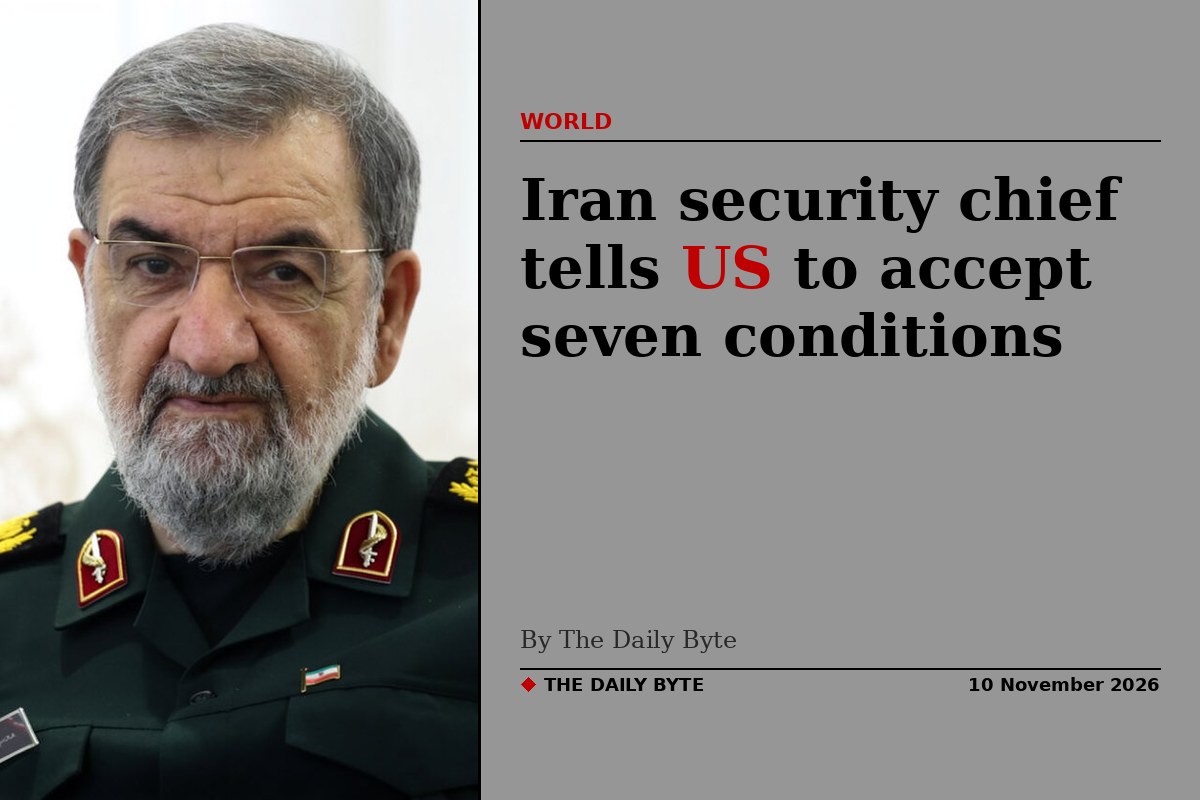
Iran's security chief has told the United States to accept Tehran's seven conditions for ending the war and reopening the Strait of Hormuz, dismissing reports of negotiations as "fake news".
Major General Mohsen Rezaei, secretary of Iran's Supreme National Security Council, issued the statement on social media on Monday, in the first public Iranian response to a weekend of American signals that new strikes may be off the table for now.
"The war on Iran has already wrecked the US government. But Washington flails like a desperate gambler," Rezaei wrote. "FOLD YOUR HAND. STOP manufacturing FAKE NEWS about imaginary talks. Stop denying the West Asian NEW ORDER. Time to SURRENDER to the seven conditions Iran has repeatedly set out," he added, according to Press TV.
What are the seven conditions?
The conditions, first formally conveyed to Washington through Qatari and other regional mediators in September, centre on ending hostilities on all fronts, including what Tehran calls the US-Israeli aggression against the Axis of Resistance in Lebanon, Gaza and Yemen. They also cover the release of Iran's frozen assets, the complete lifting of the naval blockade, the removal of economic and political sanctions, the withdrawal of US naval and air forces from the region, payment of war reparations, and an end to threats and insults.
Rezaei said that until the conditions are met, the Strait of Hormuz will remain closed under Iranian control, managed in coordination with Oman through new arrangements that safeguard regional security rather than serving foreign interests.
Trump signals no new strikes for now
The statement came as US President Donald Trump offered his clearest indication yet that intensified diplomacy could avert another major round of fighting. Trump told CNN on Sunday that renewed US military attacks were "highly unlikely" if Tehran made progress toward an agreement on its nuclear programme and reopening the Strait of Hormuz, and told CBS's 60 Minutes that he was "not looking to" escalate the war.
Trump went further on Monday after meeting Qatar's prime minister, saying he did not believe additional military action against Iran was necessary for now. But he made clear the military option remains available if circumstances change.
Secretary of State Marco Rubio struck a more cautious note on Sunday, saying he "wouldn't say we're on the verge of a breakthrough". CNN reported that Iran and the United States have quietly been negotiating a sensitive agreement that could avert a return to all-out war, with Qatar mediating and circulating a framework document that both Washington and Tehran are amending.
What each side wants
Trump is seeking to eliminate Iran's nuclear programme, which Tehran sees as a matter of national sovereignty. CNN also reported that Iran wants compensation from the US for the killing of Supreme Leader Ali Khamenei and his top military commanders in airstrikes at the start of the US-Israeli war on Iran in late February, and that hundreds of kilograms of highly enriched uranium remain hidden somewhere in Iran.
The war began on 28 February, and the Strait of Hormuz, through which a large share of the world's oil trade passes, has been at the centre of the confrontation ever since. Whether Rezaei's latest statement hardens Tehran's public position or simply restates it for a domestic audience, it underlines how far apart the two sides remain in public, even as mediators work behind the scenes.


