Iran Still Holds Up to 2,500 Missiles, US Figures Show
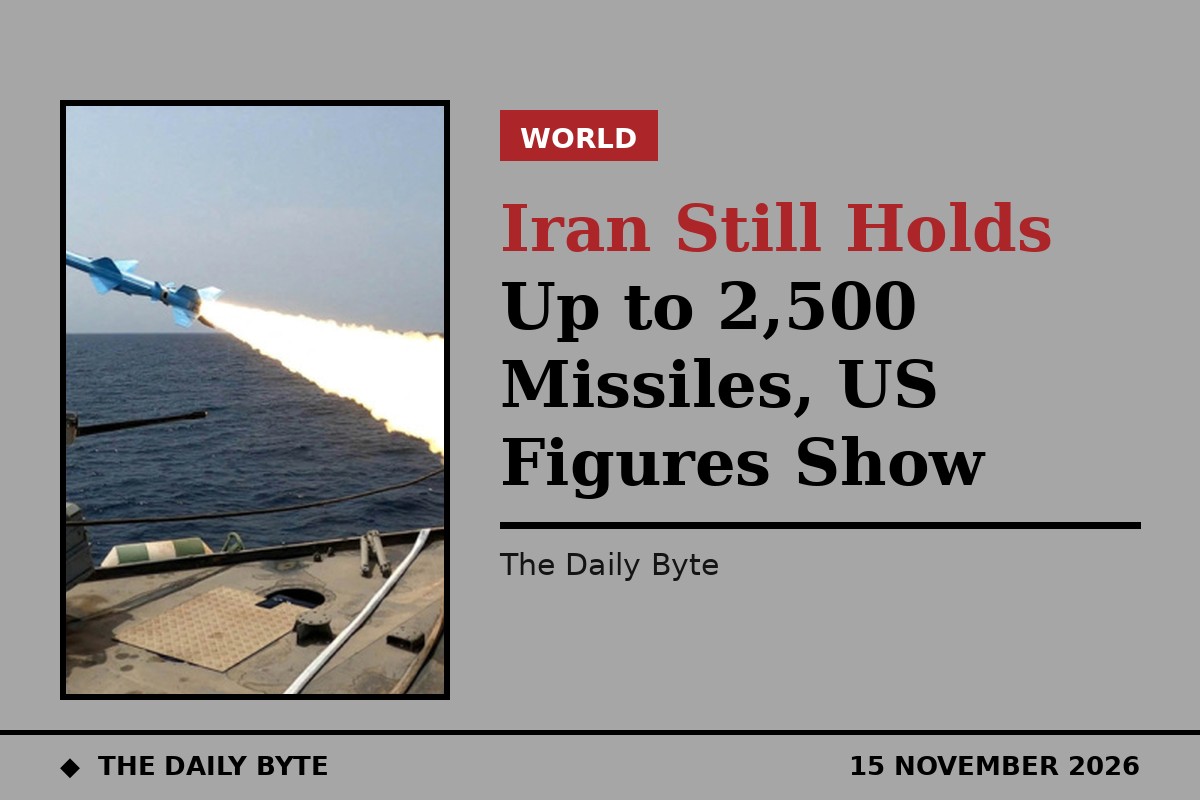
Iran still holds between 1,500 and 2,500 missiles despite months of American and Israeli strikes on its weapons infrastructure, the US intelligence community assesses, according to a report published on Sunday.
The Wall Street Journal, citing US officials, reported that the estimate leaves Tehran with significant capacity to attack US and allied targets if all-out war resumes. The officials attached a low level of confidence to the figure, because it is difficult to determine how many missiles are ready to launch and how many remain in storage.
Countering claims the arsenal is destroyed
The findings undercut claims by President Donald Trump that Tehran’s military capabilities have been largely destroyed. Defence Secretary Pete Hegseth told reporters on Tuesday that Iran’s defence-industrial base was “gone”, along with more than 80% of the country’s nuclear-industrial base.
Israeli military officials similarly assess that Iran has more than 1,500 ballistic missiles, though estimates vary among officials across the region because of the difficulty of pinpointing exact numbers.
Simone Ledeen, a former US deputy assistant secretary of defence for the Middle East, said even the lower estimate of 1,500 missiles would mean Iran had rebuilt more than half of its prewar stockpile. She said Iran had fully rebuilt its arsenal between the 12-day war in June 2025 and the start of the current conflict in February.
Hard to count
Estimating how many missiles Iran holds is difficult because of the secrecy surrounding the programme, the many producers Iran relies on, and uncertainty over how many new missiles it can build from finished components stockpiled underground, said Jim Lamson, a visiting research fellow at King’s College London and former CIA analyst specialising in the Iranian military.
In April, the Journal reported that Iran retained thousands of short- and medium-range ballistic missiles that could be retrieved from underground sites. In September, it reported that Iran had resumed production of ballistic missiles from finished stockpiled components.
Tehran also keeps significant numbers of drones and short-range missiles, extending its reach across the region. Iranian missile and drone attacks have continued to expose weaknesses in US military installations, radar systems and early-warning infrastructure across the Middle East, the report said.
The assessment also underlines how hard it is for outside powers to measure Iran’s true strength. Underground storage, dispersed production and secrecy mean any public figure is at best an estimate, and both Washington and Tehran have reasons to talk their positions up or down.
Washington has so far chosen to keep up economic pressure on Tehran through sanctions and a blockade rather than launch another major offensive.


