Iran Summons Qatar Envoy as Doha Rejects Attacks
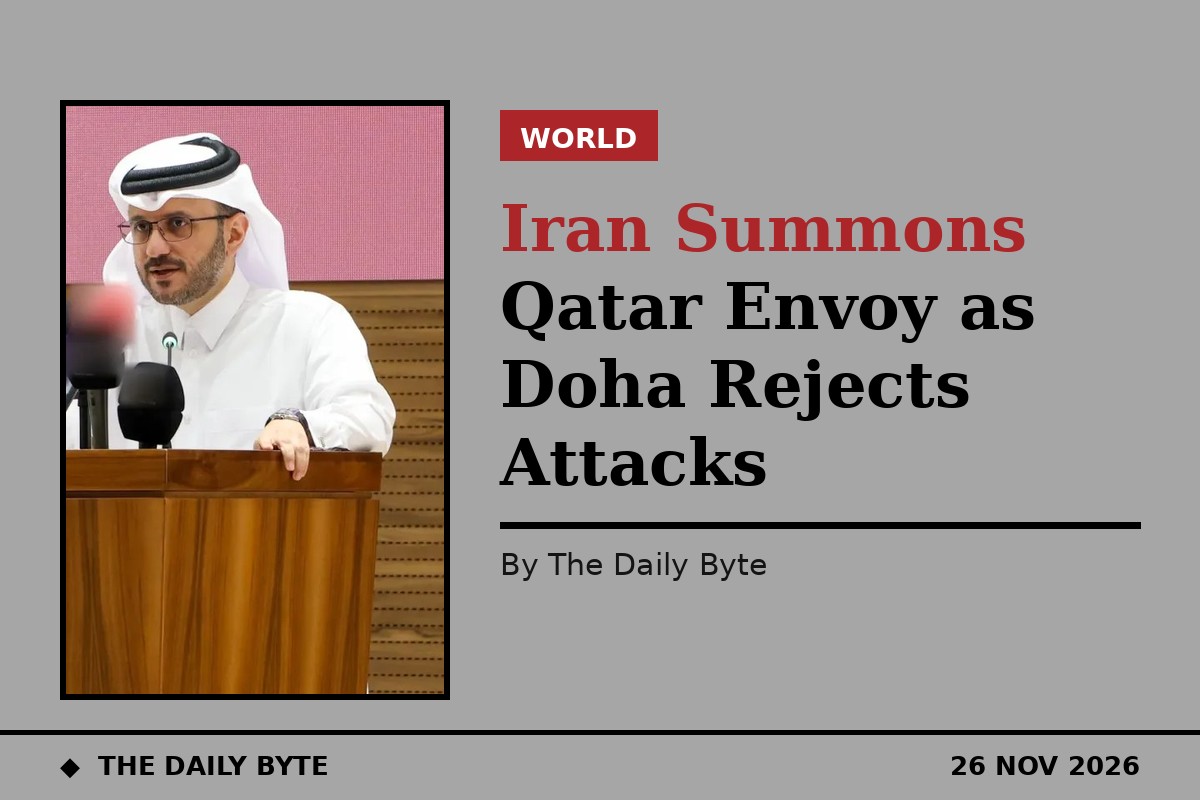
Iran has summoned Qatar's charge d'affaires in Tehran to protest against a joint Qatari-German statement condemning Iranian attacks on Qatar and other countries in the region. Qatar replied a day later that it will not accept any attacks on its territory, in any form.
Iran's Foreign Ministry announced the summons on Monday 23 November. Foreign Ministry spokesman Esmail Baghaei told a news conference that Tehran viewed the statement with surprise and regret and rejected the accusations it contained as completely baseless and unacceptable. He said Qatar's charge d'affaires was summoned in the ambassador's absence and formally notified of Iran's protest.
Baghaei called Qatar's position unexpected and said Iran had targeted only US bases on Qatari territory. He questioned why Qatar had joined Germany, a country outside the region, in issuing the declaration, saying the decision required an explanation.
The joint statement at the centre of the row
Qatar and Germany issued the joint statement on Saturday 21 November, at the close of a state visit to Germany by the Emir of Qatar, Sheikh Tamim bin Hamad Al Thani, on 20-21 November.
The declaration condemned Iranian attacks on Qatar and other regional states as a flagrant violation of sovereignty, territorial integrity, international law and the UN Charter. It denounced Iranian threats against commercial vessels and any move to close the Strait of Hormuz or obstruct navigation through it. It also called on Iran to meet its obligations under the Nuclear Non-Proliferation Treaty, never to develop or acquire nuclear weapons, and to end its support for Yemen's Houthis.
Qatar: we will not accept any attacks
Qatar responded on Tuesday 24 November. Majed al-Ansari, adviser to the prime minister and official spokesman for the foreign ministry, told a media briefing in Doha that Qatar would not accept any aggression against its territory in any form, and that its sovereignty was the decisive factor in its positions towards all parties in the region.
Al-Ansari said Doha was handling the dispute through diplomatic channels and through communication with its counterparts in Tehran, and that it remained committed to resolving differences with Iran through dialogue. He stressed that Qatar was determined to protect its sovereignty and independence, while adding that diplomatic solutions were the only way to end the crisis.
Mediation between Washington and Tehran continues
Al-Ansari also confirmed that Qatari mediation between the United States and Iran continues, and that Doha, as mediator, wants the discussion to stay inside the negotiating room, revealing details only once an agreement is reached.
He warned that any military escalation in the region would have negative effects on mediation efforts and on the chances of reaching an understanding between the two sides, and called on all parties to exercise restraint and support the diplomatic option. He said creating the conditions for a comprehensive agreement required restoring freedom of navigation in the Strait of Hormuz.
The remarks followed talks in Washington by Qatar's prime minister and foreign minister, Sheikh Mohammed bin Abdulrahman Al Thani, with US Secretary of State Marco Rubio and Vice President J.D. Vance, which discussed efforts to bring the two parties back to the negotiating table.
Al-Ansari also renewed Qatar's call to build a collective regional security system that takes into account the security concerns of all parties, saying it was the only way to ensure the region's security and stability, and that keeping the region away from the brink of war required addressing key issues, foremost among them the Palestinian issue.
The exchange is the latest sign of strain between Tehran and Doha, even as Qatar continues to act as the main mediator between the United States and Iran. Qatar was itself struck by Iranian attacks during the war, and it joined the United Arab Emirates and Saudi Arabia in condemning Iranian attacks on Bahrain earlier in November.


