Iran Tanker Convoy at Kharg Island Tests US Oil Blockade
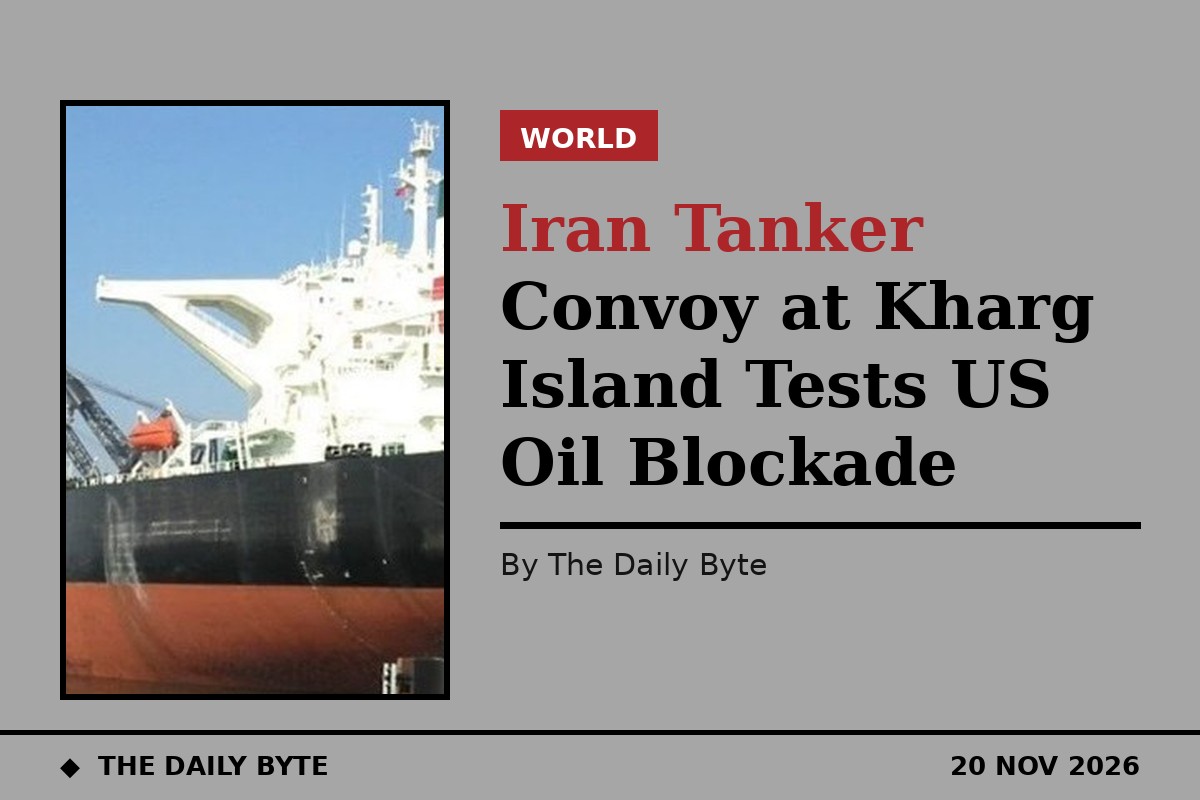
Reports say Iran has gathered more than 14 oil tankers at Kharg Island in the northern Gulf, in what some accounts describe as a convoy preparing to test the United States naval blockade of Iranian oil exports. The claims, which surfaced on Thursday and Friday, have been met with scepticism by the ship-tracking specialists whose work first drew attention to them.
No Iranian government official has confirmed a departure date, and the picture remains confused: one tracking firm first suggested exports were resuming, then publicly pushed back against the idea that a convoy was imminent. What is not in doubt is that Tehran is under severe economic pressure, with oil loadings halted for two months and its foreign minister saying on Friday that the blockade must be broken.
What the reports claim
According to the reports, the tankers gathered near Kharg Island have crews aboard, are flying Iranian flags, and have in many cases switched off their automatic identification systems, the transponders that broadcast a vessel's position. The accounts say Tehran plans to send them in convoy towards the Sea of Oman and on to Asian markets, including China.
The speculation appears to trace back to a report by the Fars News Agency, which is linked to the Islamic Revolutionary Guard Corps, calling for Iran to resume shipments. That report was then picked up and amplified into claims that 14 tankers had been loaded at Kharg, with crews assigned and Iranian flags raised.
Fars backed the call with a threat, saying that any disruption of Iranian oil exports would bring a new round of attacks on the oil facilities of the United Arab Emirates, Saudi Arabia, Qatar, Kuwait, Oman and Bahrain.
A transfer already under way
Separately, a cargo of Iranian crude was transferred between two tankers in the Gulf this week, in what monitors say is the first such ship-to-ship transfer since the United States reinstated its blockade of Iranian ports in mid-July.
The US-sanctioned Suezmax tanker Olym transferred about 200,000 barrels of Iranian crude to the medium-range tanker Hao Fan on Tuesday, according to the campaign group United Against Nuclear Iran and data analytics firm Kpler. The transfer took place just south of Kharg Island, with both vessels' transponders switched off, and the Hao Fan was reported to be spoofing its location to appear near Oman's Shinas coast.
The United States military responded on Wednesday by widening the scope of its blockade, warning that any tanker receiving cargo at sea from a vessel under the blockade would itself be treated as evading it. The American operation has brought Iranian oil exports to a halt, forcing production cuts and cutting off a key source of revenue.
Doubts over the convoy
The convoy claims should be treated with caution. TankerTrackers, the ship-tracking firm whose social media posts helped start the speculation, first wrote that Iran appeared to be preparing to ship oil again, then corrected the record as the story grew, writing: "Wishful thinking. That's definitely not what's going on."
Analysts at Windward have also pointed out that Iran does not need the tankers anchored off Kharg Island to challenge the blockade, since those vessels would still have to pass through the Strait of Hormuz. Windward calculates that 31 laden sanctioned tankers are already past the strait, holding in the Arabian Sea within a day of the blockade line, carrying an estimated 4.9 million barrels on four crude tankers, along with liquefied petroleum gas and refined products nearby.
Windward says Iran has already used LPG tankers to test the blockade, tracking 11 such vessels that attempted to challenge the line in September and October.
Why Tehran is under pressure
Kharg Island handles around 85 to 90 per cent of Iran's crude oil exports, so the blockade strikes at the heart of the country's finances. October was the second month in a row in which Iran made no oil loadings at all, according to Kpler data cited by Reuters, after loading about 2 million barrels of crude and condensate a day when the war began. Reports say it was the first time since 1979 that Iran had not loaded any oil, and that production levels are also falling.
Iran's Foreign Minister Abbas Araghchi told reporters on Friday: "We are making every effort regarding oil exports and negotiations. The blockade must be broken."
The pressure at sea comes as the political picture in Washington remains unsettled. The US Senate voted 51-48 on 19 November to reject a war powers resolution that would have restricted further military action, and President Donald Trump has said he will not rush a decision on further strikes, indicating he will decide after the start of the new year.


