Iran Warns Bahrain Cleric Crackdown Deepens Divide
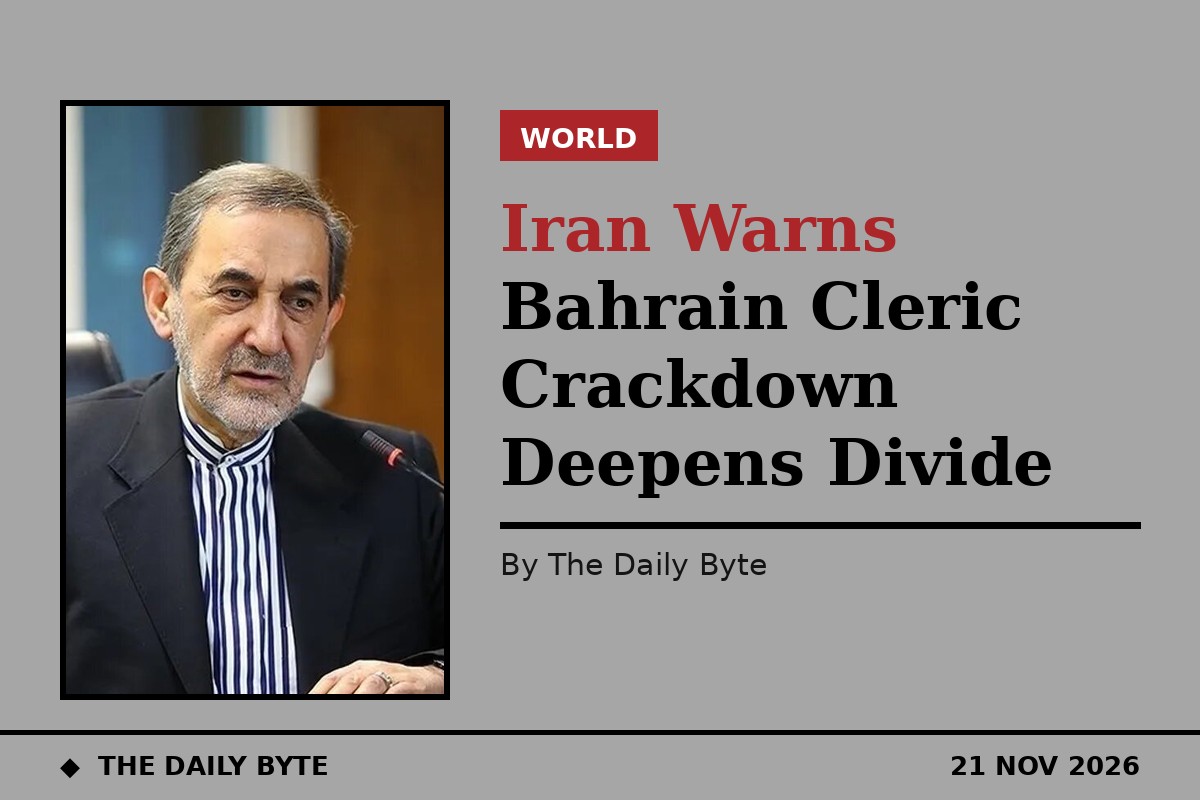
Ali-Akbar Velayati, a senior adviser to Iran's supreme leader, has warned Bahrain's rulers that their pressure on Shia clerics and suppression of civil demands will only deepen the divide between the government and society.
In a post on X addressing the Bahraini authorities, Velayati singled out Ayatollah Sheikh Isa Qassim, widely regarded as the spiritual leader of Bahrain's Shia community, saying coercion against the clergy would not restore stability.
"Forcing pressure on clerics, particularly Ayatollah Sheikh Isa Qassim, and the suppression of civil demands in Bahrain will only deepen the gap between the government and society," he wrote.
"The gap will not be repaired by the worn-out US security guarantees, nor by the mirage of normalization with Israel. In the authentic Islamic discourse, political legitimacy originates from the will of the people and will not endure without their consent," the senior adviser added.
The sentences behind the warning
Velayati's intervention follows a mass trial in Bahrain in which 69 defendants, including 60 Shia clerics and nine people working in religious affairs, were convicted on 16 November. Sixty-four were sentenced to life imprisonment and five to 15 years in prison. No defendant was acquitted, according to the Bahrain Institute for Rights and Democracy (BIRD).
Sheikh Isa Qassim was among those sentenced to life imprisonment. He has lived in Iran since 2018, BIRD said. Fifty-six defendants are in custody, including 47 clerics, while 13 clerics were tried in absentia. The trial began on 5 July, and the defendants were arrested in separate operations during May and June.
The court convicted the defendants of establishing and running a group linked to Iran's Revolutionary Guards that prosecutors said sought to overthrow the government, and of promoting Iran's doctrine of the Guardianship of the Islamic Jurist through mosques and religious gatherings. BIRD noted that only one of the 56 detained defendants faced an espionage charge, and warned that religious teaching, books, religious payments and contacts with religious authorities abroad had been used as criminal evidence.
The verdict had initially been set for 8 November, then postponed to 22 November, before being brought forward to the morning of 16 November at the Public Prosecution's request. Defence lawyers were told at around 5pm Bahrain time on 15 November. Protests took place that night across several Shia areas, including Sitra, Al Hamala, Bilad Al Qadeem, A'Ali, Karranah, Samaheej and Abu Saiba.
Torture claims and international concern
BIRD condemned the verdicts following what it called credible allegations of torture, coerced confessions and severe restrictions on the defence. Defendants described detention at undisclosed locations, interrogation without lawyers, prolonged blindfolding and handcuffing, forced standing, sleep deprivation and threats against their relatives. Some said they were pressured to sign lengthy statements they were not allowed to read, with identical passages appearing across different purported confessions.
The defence could not obtain copies of case files exceeding 6,700 pages and relied on handwritten notes made under severe time limits, while those in custody took part by video link. When lawyers sought recordings to test the accounts, they were told the footage had been deleted after one month. BIRD also raised concerns about the Special Investigation Unit, the government watchdog for torture allegations, saying it had not thoroughly investigated complaints.
In a joint statement dated 6 November, 20 human rights organisations, including BIRD, Amnesty International, Human Rights Watch and the World Organisation Against Torture, warned that the mass prosecution raised serious concerns of religious persecution. They called for fair trials, the exclusion of coerced confessions, the immediate release of those arbitrarily detained and the dropping of charges based on peaceful religious activities.
Bahrain's main Shia opposition group, al-Wefaq National Islamic Society, called 16 November a day of catastrophe and described the sentences as collective punishment and systematic persecution of the country's Shia community. BIRD also pointed to remarks by US Secretary of State Marco Rubio on 15 November identifying the Shia clerics of Iran and their expansionist mentality as the common denominator behind major problems in the Middle East, saying such rhetoric risked being read as a green light by the Bahraini authorities.
A Gulf state caught in a regional war
Bahrain is a Shia-majority island ruled by the Sunni Al Khalifa family and home to the United States Navy's Fifth Fleet. It has been drawn into the wider regional war, with Iran targeting sites in Bahrain on 18 November, according to AP reporting.
Velayati's remarks add a direct Iranian voice to the condemnation of the verdicts, framing the crackdown as a question of legitimacy rather than security. His reference to normalisation with Israel points to the Abraham Accords, under which Bahrain established relations with Israel, an agreement Tehran has consistently denounced.


