Iran warns tankers against 'fake American routes' through Strait of Hormuz
By aminah
·17 Nov 2026
·5 min read
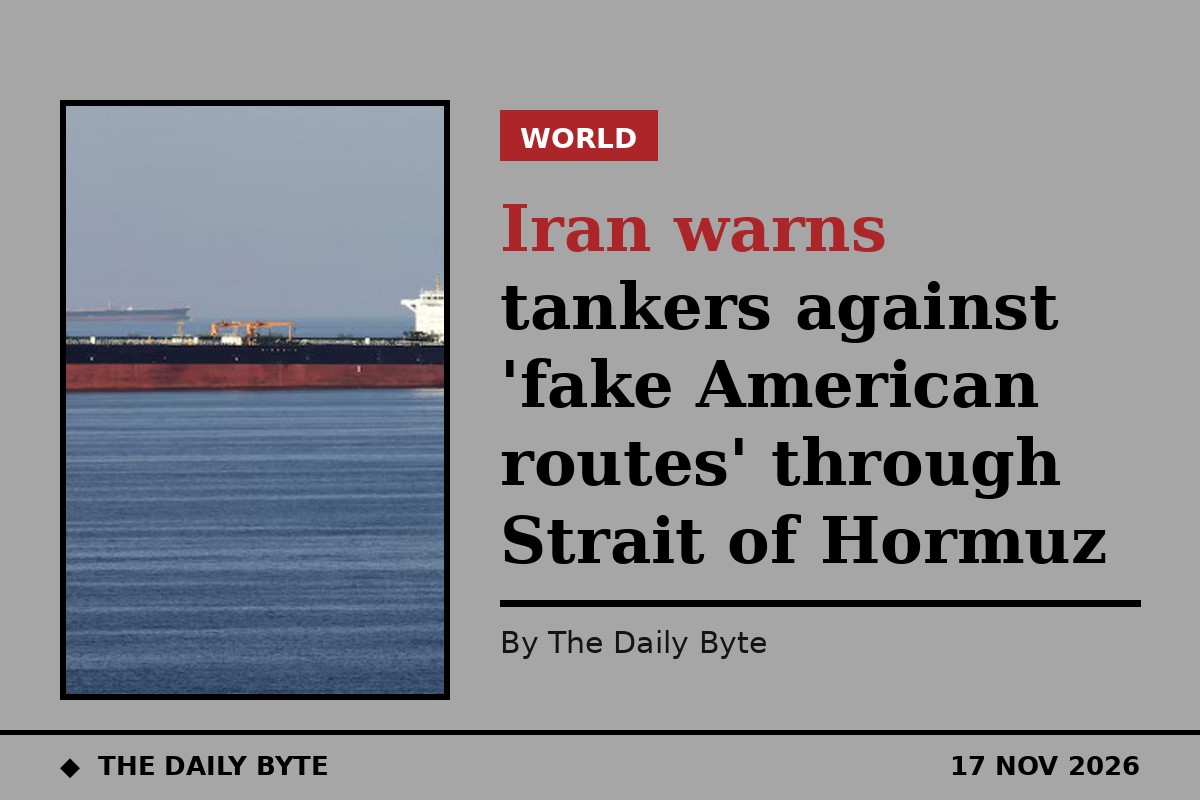
Iran's military has warned tankers against using what it calls "fake American routes" through the Strait of Hormuz, saying vessels that follow them face the threat of naval mines, fires and explosions. The warning, issued on Tuesday 17 November, is the latest sign that the narrow waterway at the mouth of the Gulf remains the most dangerous shipping lane in the world.
Brigadier General Mohammad Akraminia, a spokesperson for the Iranian Army, said the strait would not be reopened unless the United States agreed to seven conditions put forward by Iran, according to the Iranian news agency Tasnim. He urged shipping operators not to be "misled" into using routes that Tehran says have not been approved by its forces.
"The reality on the ground shows that crossing these routes exposes ships to the threat of naval mines, fires and explosions," Akraminia said. He added that maritime security could only be guaranteed through coordination with Iran's military and the Islamic Revolutionary Guard Corps (IRGC), and by following the routes they had designated.
## What Iran's army said
According to Tasnim, Akraminia said the regular Army was responsible for the eastern part of the strait, while the IRGC controlled the western section, and that vessels seeking safe passage should coordinate with both. He also said US military bases in the region remained legitimate targets and that any miscalculation would be met with a decisive response extending beyond geographical boundaries.
The warning follows a similar message from the IRGC Navy, which warned shipping companies against using the US-backed southern route through the strait, describing it as fully closed and a "minefield of fire", according to regional media cited by CNBC. Akraminia said the strait would not reopen until "the enemy accepts Iran's conditions".
Tehran has not published the seven conditions as a single authoritative list. They have been reported in fragments since August, and have been described as including demands relating to the US military presence in the region and the naval blockade on Iran. On 18 October, Foreign Minister Abbas Araqchi said Tehran's proposal to reopen the strait within seven days remained on the table.
## Tanker incidents in the strait
The warning comes after a series of incidents involving commercial vessels in and around the strait. On Monday, the United Kingdom Maritime Trade Operations agency reported that a tanker was struck by an unidentified projectile while leaving the strait, about seven nautical miles north of Khasab on the coast of Oman. The strike caused a fire in the engine room and left the vessel disabled, although all crew were accounted for. A maritime security monitor identified the vessel as the Panama-flagged tanker ON PHOENIX.
Iran's navy separately said four oil tankers had struck mines and caught fire in the eastern Strait of Hormuz over the previous 24 hours, and Iranian state television, cited by the Associated Press, reported that three tankers had caught fire after hitting naval mines. The IRGC has also claimed that six tankers were hit by mines or projectiles in the past 24 hours and that a supertanker carrying more than two million barrels of crude had sunk.
Those claims have not been independently verified. No vessel was named in the Iranian accounts, and the allied Joint Maritime Information Center reported no confirmed attacks in the same period. The figures should therefore be treated as Iran's account, not as confirmed losses. Iranian naval authorities separately said a tanker struck a mine on 16 November in an area they had designated as prohibited.
The US Maritime Administration has warned commercial shipping about elevated maritime-security risks in the Persian Gulf, the Strait of Hormuz and the Gulf of Oman, including the threat of attacks involving missiles, unmanned aircraft and other hostile activity.
## A third US carrier in the Gulf
The escalation in Tehran's rhetoric came as the USS Theodore Roosevelt arrived in the Gulf region on Sunday, bringing the US carrier presence to three, alongside the USS George H.W. Bush and the USS George Washington. The US military has described the deployment as scheduled.
Iran closed the strait following what it described as US aggression against the country last February, when the United States and Israel began attacks on Iran. Before the conflict, the strait carried about one-fifth of global energy supplies, and it remains a sticking point in negotiations aimed at ending the nine-month-old war, which have not yet yielded a breakthrough.
Meanwhile, Oman and Iran have discussed maritime security in the strait. Oman's Foreign Minister Badr Albusaidi and his Iranian counterpart Abbas Araqchi discussed developments in the strait at a meeting in Oman on Tuesday. Oman's Foreign Ministry said the ministers also discussed the importance of safeguarding the maritime corridor and ensuring the smooth flow of shipping and international trade.
## Frequently asked questions
**What is the "fake American route" Iran is warning about?**
Iran's army says the United States has promoted a southern route through the Strait of Hormuz that Tehran has not approved. Iran says vessels should instead coordinate with its army and the IRGC and follow routes they have designated.
**Have tankers actually been hit?**
The UK Maritime Trade Operations agency confirmed that a tanker was struck by an unidentified projectile on Monday and caught fire, with no casualties reported. Iran's claims that several other tankers struck mines have not been independently verified.
**Is the Strait of Hormuz open?**
Iran says the strait is closed and will reopen only if the United States accepts its conditions. The United States says it will guide vessels through the waterway, and shipping continues under heightened risk.
Sources: [Tasnim, via Jawawa](https://jawawa.id/newsitem/iran-warns-tankers-against-using-fake-us-route-in-strait-of-hormuz-saying-it-is-full-of-traps-1794923510) and [CNBC, via AmeriLedger](https://ameriledger.com/article/third-u-s-carrier-arrives-in-the-gulf-stoking-concerns-about-renewed).


