Iraq Shuts Kurdistan Crossings With Syria, Iran
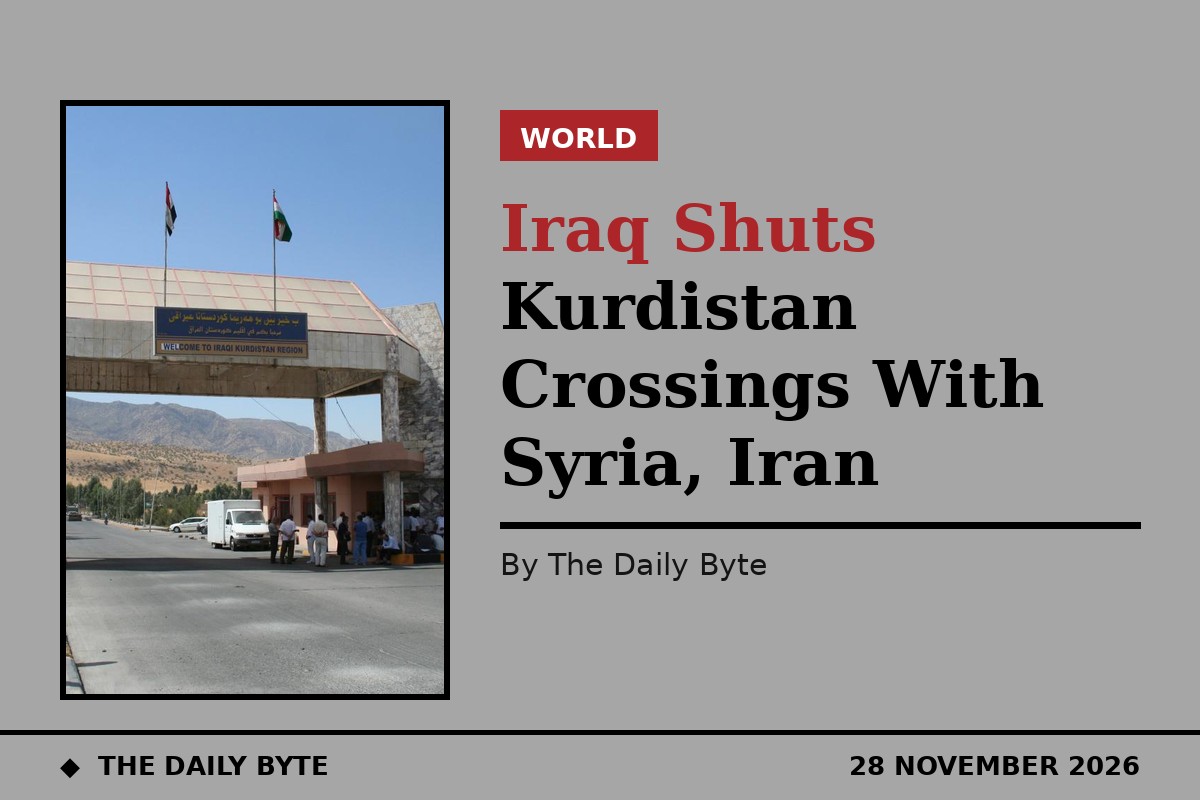
Iraq has closed two border crossings run by the Kurdistan Regional Government, in Baghdad's most direct move yet to take control of the semi-autonomous region's frontiers with Syria and Iran.
Iraqi border forces shut the al-Waleed crossing with Syria and the Bashta crossing with Iran, Reuters reported on Thursday 26 November, citing Iraqi state media. Both crossings sit in territory administered by the Kurdistan Regional Government (KRG), and both were run by Kurdish authorities until now.
The commander of Iraq's border forces told the Iraqi News Agency that the two crossings had been closed, as Baghdad moves to assert more control over the semi-autonomous region.
A court ruling cleared the way
The closures followed a ruling by Iraq's highest court on Wednesday allowing Baghdad to deploy federal forces along all of the country's international borders, including in the Kurdistan region.
A day earlier, Prime Minister Ali al-Zaidi had ordered federal authorities to take over crossings run by the KRG, as part of a broader push to strengthen central control over strategic assets, including oil fields controlled by Kurdish security forces.
The Federal Supreme Court's ruling removed the legal obstacle to that order. After the KRG objected to the takeover, the court ruled that Baghdad could deploy federal forces along all international borders, including in the region.
Part of a wider centralisation push
The two Kurdistan crossings were not the only ones shut on Thursday. Iraqi forces also closed the Sheikh Saleh crossing with Iran in Kermanshah province, the Mehr news agency reported, citing the governor of Salas-e Babajani county. About 300 trucks loaded with goods and building materials were left stranded and were to be rerouted through other crossings, Kermanshah's customs chief said.
The order behind the closures reaches beyond the Kurdistan region. Zaidi also ordered the federal oil ministry to take over oil fields held by Kurdish security forces in Diyala, Kirkuk, Salahuddin and Nineveh provinces.
Washington has been pressing Baghdad to tighten the frontier. On 8 November, Iraqi Foreign Minister Fuad Hussein said the US Treasury had formally asked Baghdad to close all its crossings with Iran except two, one in the Kurdistan region and one elsewhere in Iraq. "There are many official and unofficial crossings with Iran, and closing them all is difficult and affects our economy," he told Al Jazeera.
The closures also fit a pattern of recent weeks. Iraq closed the Chazabeh crossing, known in Iraq as Sheeb, on 21 October, citing inadequate preparations; it reopened on 10 November. The Somar crossing, known as Mandali, was closed on 13 November for what Baghdad called maintenance before the rainy season, and it is still closed.
Reaction in the Kurdistan region
Thousands of people protested in the Kurdistan region on Thursday, while supporters of the prime minister rallied in Mosul, in a sign of how divisive the moves have become.
Pro-Iran factions in Baghdad have pushed back. The Badr Organization's bloc in parliament condemned what it called American interference in Iraq's border policy and demanded the crossings reopen, while the Asaib Ahl al-Haq bloc asked why the government's technical explanations differed from the foreign minister's account.
The stakes go beyond the crossings themselves. Iraq and Iran share a border of about 1,600 kilometres, with nine official crossings and many unofficial ones, and trade between the two countries is worth $15 billion to $18 billion a year, according to the foreign minister, including about $4 billion in Iranian gas.
With its ports under a US naval blockade since July, Iran depends more than ever on land routes for imports, exports and cash, and Iraq is one of its largest export markets. Major crossings such as Mehran, which carries millions of Iranian pilgrims to Karbala each year, remain open.
Whether Baghdad can hold the line is an open question. The moves concentrate power in the central government, a goal that overlaps with US demands but is not the same thing, and Iran-aligned factions sit in parliament, in the governing coalition and in the Popular Mobilization Forces. Moving against them too fast risks unrest at home, and the KRG has already objected to the takeover of its crossings.


