Iraq restarts Kirkuk-Ceyhan oil pipeline after 12 years to bypass Strait of Hormuz
By The Daily Byte
·18 Nov 2026
·4 min read
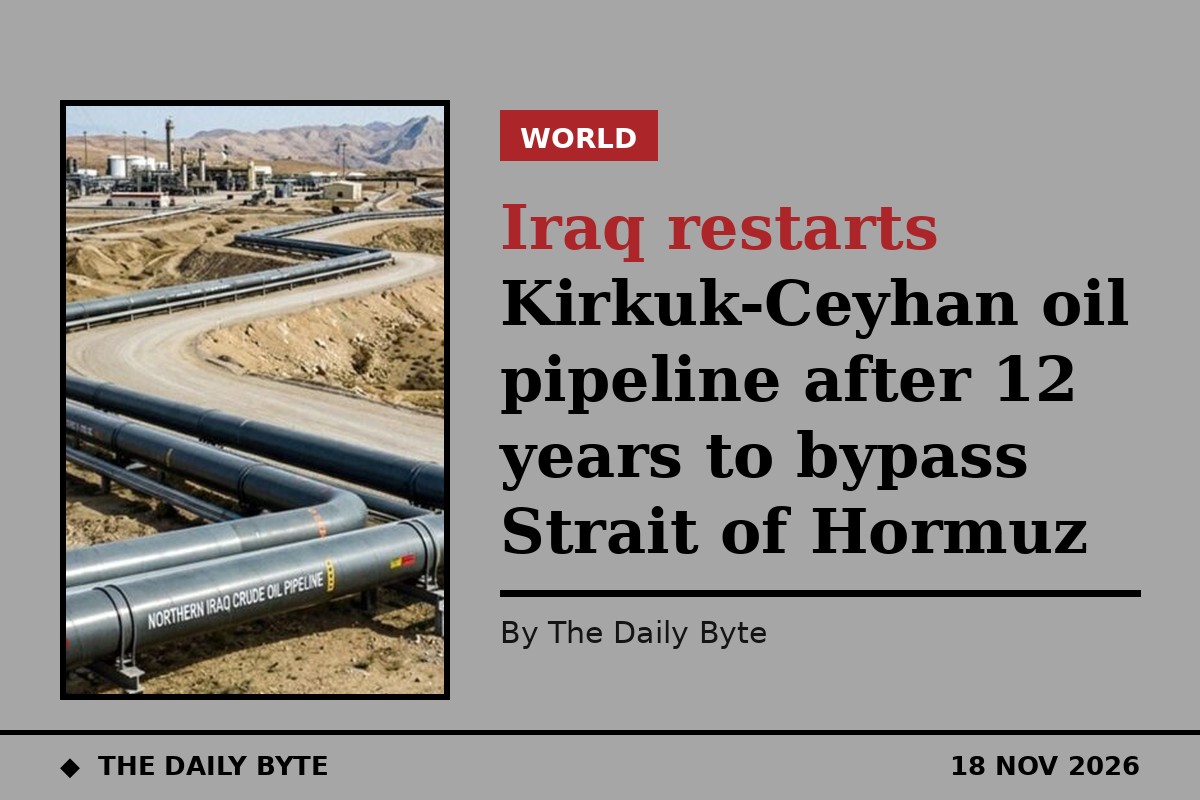
Iraq has resumed pumping crude oil for export through the Kirkuk-Ceyhan pipeline to Turkiye, reopening a route that has been shut for more than a decade and giving Baghdad an alternative to shipping its oil through the Strait of Hormuz.
Oil Minister Basim Mohammed Khudair said on Tuesday, 17 November, that flows had started at 120,000 barrels per day and would gradually rise to 500,000 barrels per day. The announcement was carried by Iraq's state news agency INA and reported by Reuters.
The 960-kilometre pipeline runs from the oilfields around Kirkuk in northern Iraq to the Mediterranean port of Ceyhan in Turkiye. Exports through it were halted in 2014 after repeated attacks by Islamic State militants. At its peak, the route once handled about 0.5 per cent of global oil supply, according to Reuters.
## Why the restart matters
The reopening gives Iraq, OPEC's second-largest producer, an additional export route for oil from the north of the country, alongside a pipeline from the Kurdistan region. It reduces Baghdad's reliance on its southern terminals and on shipments through the Strait of Hormuz, the narrow waterway between Iran and Oman that is Iran's usual outlet for Gulf oil.
That matters now because the strait has been disrupted by the war between the United States, Israel and Iran, which began in late February. Iran has effectively blocked normal tanker traffic through the strait, and there has been a surge in tanker attacks there this month. Iraq has been working to find alternative export routes since the disruption began.
Reuters noted, however, that the overall effect on Iraq's exports will depend on available supplies and on whether the volumes through Kirkuk-Ceyhan come on top of existing shipments, rather than replacing them.
## Cabinet backs rehabilitation
Hours after the Oil Ministry announced the restart, Iraq's Cabinet approved a recommendation to rehabilitate the pipeline. The decision was taken at a Cabinet meeting chaired by Prime Minister Ali al-Zaidi in the southern province of Najaf, according to a statement from his media office carried by INA.
The Cabinet approved a recommendation from the Ministerial Council for the Economy on rehabilitating the pipeline, although the statement did not set out the work involved or a timetable. The council had reviewed the ministry's crude export plan on Monday, including the resumption of Kirkuk exports through the pipeline to Ceyhan.
Khudair said the restart followed the successful completion of maintenance, rehabilitation and technical and operational tests on the line. He did not give a timeline for reaching the 500,000 barrels per day target.
## A new framework with Turkiye
In August, Iraq and Turkiye signed a one-year agreement to keep oil moving through the Kirkuk-Ceyhan pipeline, providing for transport capacity of up to 750,000 barrels per day as the two countries pursued a broader long-term arrangement. The deal was signed by Turkiye's state pipeline company BOTAS, Iraq's state oil marketer SOMO and the North Oil Company.
Iraq began re-exporting oil to Turkiye in September 2025 from the semi-autonomous Kurdistan region after a two-year dispute. Tuesday's announcement is different: it allows oil from Iraq's federal government to flow directly to Ceyhan, rather than through the Kurdish region's pipeline.
The restart is the first step in Baghdad's effort to reduce its dependence on Hormuz. Whether it becomes a lasting alternative will depend on the pipeline's reliability after 12 years out of service, on the rehabilitation work now approved by the Cabinet, and on how much crude the northern fields can supply.
Middle East Eye also reported the restart on 17 November, confirming the 120,000 barrels per day starting figure and the plan to reach 500,000 barrels per day after maintenance and testing.
## Frequently asked questions
### How much oil will the Kirkuk-Ceyhan pipeline carry?
Flows have started at 120,000 barrels per day, with a plan to rise gradually to 500,000 barrels per day, according to Iraq's oil minister. No timeline for reaching the higher figure has been given.
### Why was the pipeline shut for 12 years?
Exports were halted in 2014 after repeated attacks by Islamic State militants on the 960-kilometre line from Kirkuk to the Turkish port of Ceyhan.
### Why does the restart matter now?
It gives Iraq an export route that avoids the Strait of Hormuz, which has been disrupted by the war involving the US, Israel and Iran, reducing Baghdad's reliance on its southern terminals.


