Ireland Weighs Triple Lock Change as 90 Amendments Filed
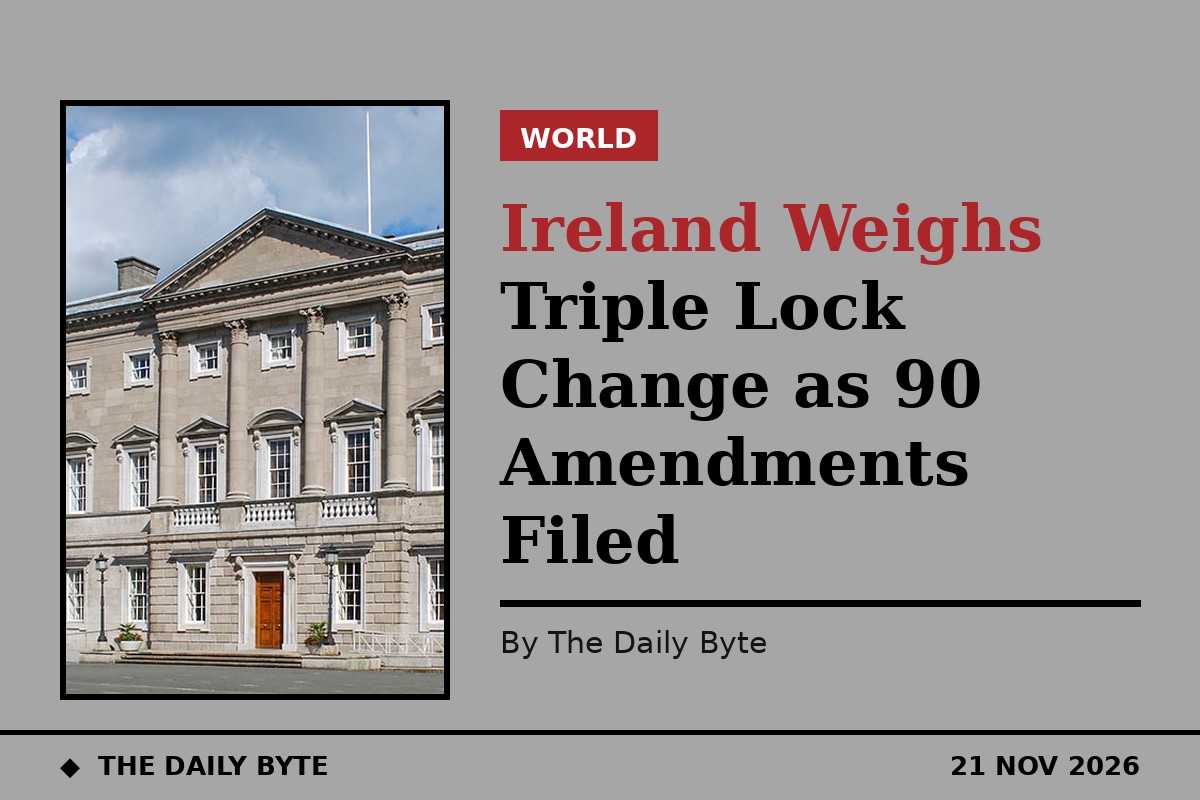
Ireland’s Defence Minister Helen McEntee will spend this weekend reviewing more than 90 amendments to the government’s Triple Lock legislation, including a backbench proposal that would keep a United Nations link in any future overseas deployment of Irish troops.
McEntee told reporters in Navan, County Meath, on Friday 20 November that she would go through the amendments over the weekend of 21 and 22 November, and engage with committee colleagues in the week of 23 November and possibly the week of 30 November. She said any decision on the amendments would come from her, and that she would not accept changes that would tie the government’s hands further.
“What I don’t want to do is replace that block with another potential block,” she said. She added that she was confident the bill could be progressed and enacted by the end of the year.
The Triple Lock currently sets three conditions before more than 12 Irish troops can join an overseas peace support operation: a United Nations mandate, government approval and a resolution passed by Dáil Éireann. The government’s Defence (Amendment) Bill 2026 would remove the UN mandate requirement, leaving only government approval and a Dáil vote — a double lock.
The O’Dea amendment
The most closely watched amendment comes from Fianna Fáil TD Willie O’Dea, a former defence minister and veteran Limerick deputy, backed by nine fellow Fianna Fáil TDs. Under his proposal, any future deployment would still have to be linked to a resolution of the United Nations General Assembly, though not the Security Council, and the minister would have to explain how the deployment matched the aims of that resolution.
Taoiseach Micheál Martin, speaking in Berlin, said he had discussed the idea with McEntee and Thomas Byrne, the Minister of State for European Affairs and Defence. He said O’Dea had raised amendments involving General Assembly resolutions at a parliamentary party meeting several weeks earlier, and that the government did not have a fundamental problem with the idea.
“I think this is something we can work on at committee stage to ensure the essence of that idea, which we don’t have a fundamental problem with, can be absorbed,” Martin said. He added that the government’s formulation was around being conscious of General Assembly resolutions, and that under O’Dea’s proposal it would become mandatory.
Tánaiste Simon Harris said McEntee would consider and work through all the amendments tabled, but he demurred from offering support for the O’Dea proposal when pressed in the Dáil by People Before Profit TD Paul Murphy. Murphy told the Dáil on Thursday 19 November that rejecting the amendment would show the bill had nothing to do with real peacekeeping.
Why the government wants the change
McEntee argues that the five permanent members of the UN Security Council — China, Russia, the UK, the US and France — can block a mandate from being renewed, which is why the Triple Lock is being changed. She has said the bill would let Irish troops join a new EU mission in Lebanon in a “force protection” capacity, covering both peacekeeping and peace enforcement, after a new European mission to support the Lebanese armed forces was agreed in recent weeks.
The bill passed its Second Stage in the Dáil on 21 October by 79 votes to 71, with every opposition party voting against it. On Wednesday 18 November, the government defeated a Sinn Féin motion calling for the changes to be put to the people in a referendum, by 84 votes to 77. Independent TD Barry Heneghan, who generally supports the government, voted for the referendum motion.
Sinn Féin leader Mary Lou McDonald has called changing the Triple Lock without a referendum a “profound betrayal”, while her party’s Pearse Doherty told the Dáil the government “does not have the guts to put this issue to the people”. Harris, in reply, said the Triple Lock was broken and that changing it was about taking back sovereignty, insisting that decisions about where Irish peacekeepers deploy should be made in Dublin, “not in the Duma or the White House”.
With more than 90 amendments to work through and the committee stage ahead, the shape of the final law — and whether any UN link survives in it — will be decided in the coming weeks. The government’s target remains enactment before the end of the year.