IRGC Warns US Bases in Europe Could Be Targeted by Iran
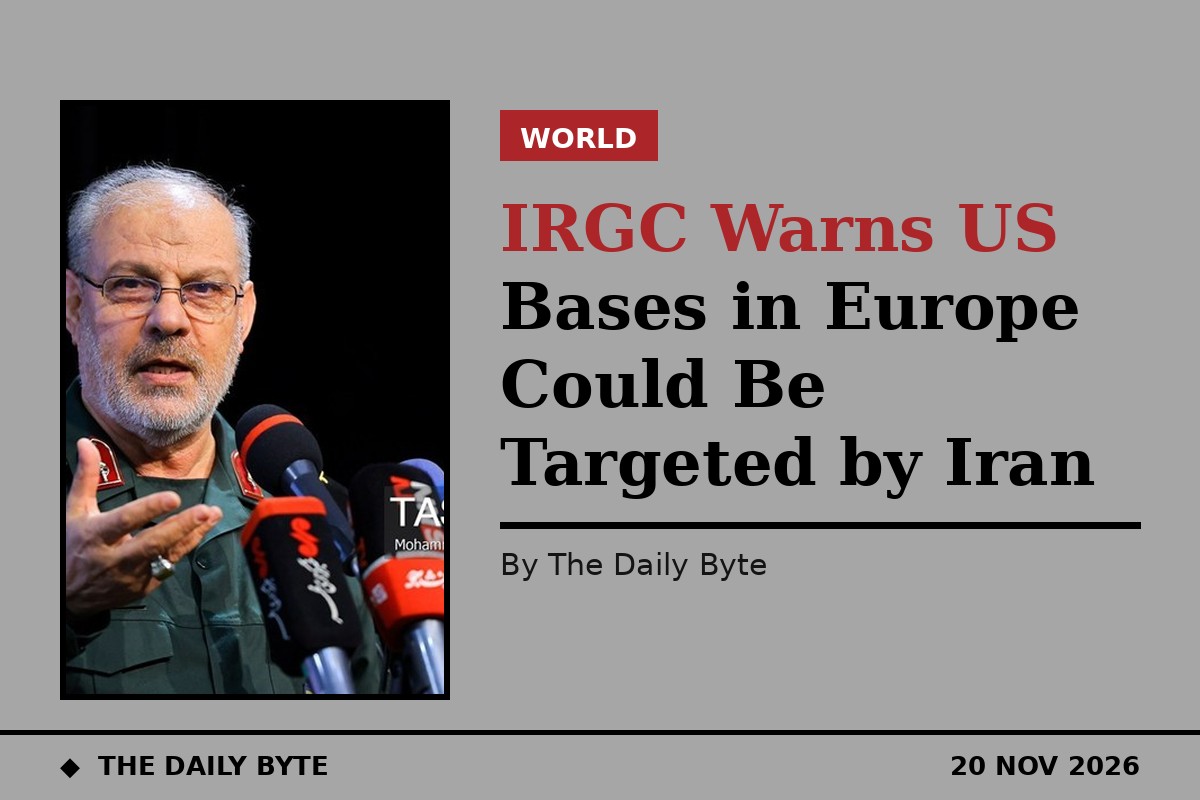
Iran's Islamic Revolutionary Guard Corps has warned that United States military bases in Europe could be targeted in retaliation if Washington launches a new attack on Iran, saying Tehran's missiles can operate without geographical limits if the country's leader orders it.
The warning was delivered on Thursday by IRGC spokesman Brigadier General Hossein Mohebbi, and reported by Iranian state-linked media on Friday, 20 November. It is the latest in a series of Iranian threats to widen any renewed conflict beyond the Middle East, and it comes as the US president weighs whether to order further strikes after the start of the new year.
What the IRGC spokesman said
"Our missile capabilities are such that, if the Leader of the Islamic Revolution gives the order, we can conduct operations without geographical limitations," Mohebbi told reporters, according to the Tasnim news agency.
He said a 2,000-kilometre limit on the range of Iranian missiles had previously been imposed by order of the late Leader, Ayatollah Seyed Ali Khamenei. That limit, he said, no longer binds Iran: "If the Leader of the Islamic Revolution gives the order, we also have the capability to target US bases in Europe. We have previously demonstrated our missile capabilities with a range of 4,500 kilometers, within the range of Diego Garcia Island."
Mohebbi added that if it became clear the United States had carried out military action against Iran from the bases of another country, anywhere in the world, that country would become a target. "We have no doubt about this," he said.
He also warned that if the United States attacked Iran's dams, it would face a similar response, and he rejected the idea that Iran was in a state of "neither war nor peace", saying the conflict would be settled either on the battlefield or by Washington accepting Tehran's terms.
The range claim
The 4,500-kilometre figure is central to the warning. Diego Garcia, the joint US-British base in the Indian Ocean, lies roughly 4,000 kilometres from Iran, and Tehran reportedly attempted, but failed, to strike the island in March. Mohebbi's claim that Iran has demonstrated a 4,500-kilometre range has not been independently verified.
Even the previous 2,000-kilometre limit would already have put parts of Europe within reach of Iranian missiles, including Greece and the Balkans. The new claim, if true, would extend that reach deep into Europe, covering American bases in countries including Germany, Italy and Britain.
Mohebbi also claimed that the recent war had exposed vulnerabilities in the American network of bases around Iran, naming Al Udeid in Qatar, Juffair and Isa in Bahrain, and Ali Al Salem and Ahmad al-Jaber in Kuwait. He asserted that several American installations had been destroyed or abandoned, and that US forces had been pushed hundreds of kilometres further away. Those claims have not been independently confirmed.
A warning repeated
Mohebbi's remarks echo a warning issued a week earlier by Mohsen Rezaei, secretary of Iran's Supreme National Security Council, who said on 11 November that every military base involved in an attack on Iran, "from West Asia to Europe", would be a legitimate target. Rezaei wrote: "No safe distance. No safe haven. No immunity."
Iranian state television has also warned that modified versions of the Khorramshahr ballistic missile could reach American bases in Europe, reportedly naming RAF Fairford in Britain as a potential target.
The warnings come in a context of open tension. The United States and Israel have been at war with Iran since late February, and the US Senate voted 51-48 on 19 November to reject a resolution that would have restricted further military action. President Donald Trump has said he is in no rush and will decide on further strikes after the new year, while Israel's prime minister is reported to be pressing for a renewed campaign.
Claims that remain unverified
It is important to separate what Iran has said from what has been proven. The claim of a demonstrated 4,500-kilometre missile range, the assertion that American bases have been destroyed or abandoned, and the claim that Iranian forces brought down a ninth MQ-170 reconnaissance drone intact are all Tehran's assertions, and none has been independently verified.
What is certain is the message Tehran wants heard: that any new American attack would not be answered only in the Gulf, and that countries hosting American forces could find themselves drawn in. For governments in Europe, that is a warning to weigh carefully, even while the capability behind it remains unproven.


