Iron ore holds near $92 as China steel output slows
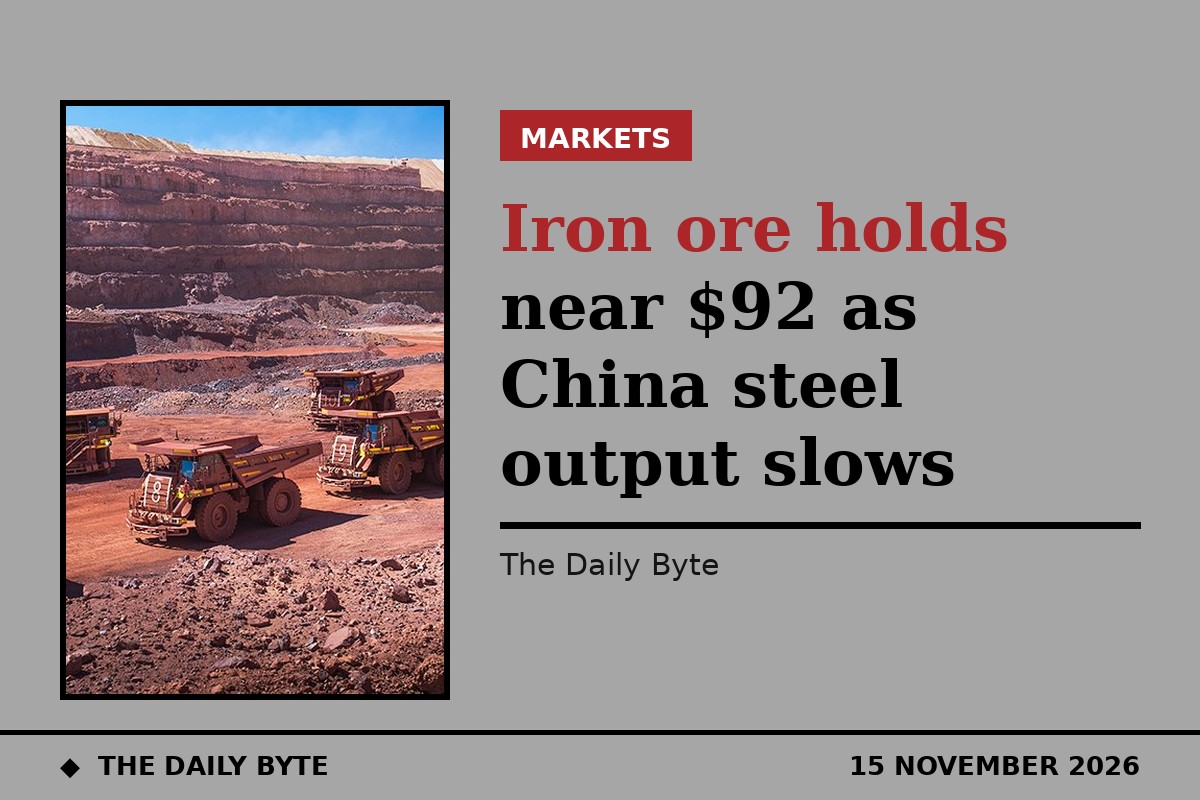
Iron ore is holding near $92 a tonne as Chinese steel mills cut output and port stocks keep building, with prices caught between weak demand and a cost floor that has so far held. The figures below are as of Wednesday, 11 November, and Thursday, 12 November 2026, the latest verified closes.
Iron ore for delivery to China was quoted at $92.15 a tonne on Wednesday, 11 November, down 0.42% on the day, for 62% iron fines on a cost-and-freight basis to Tianjin, Kalkine reported. That sits close to the Singapore Exchange's December contract, which traded at $92.50 a tonne early on 9 November.
Dalian futures pointed the same way. Iron ore futures fell to 671 yuan a tonne on 12 November, down 1.83% from the previous day and reaching over one-week lows, according to Trading Economics.
Steel output keeps falling
The demand signals are weaker than the price suggests. Average daily hot metal output, a measure of blast furnace activity, fell to 2.31 million tonnes as of 5 November, the fourth straight weekly decline and the lowest since late March, Kalkine reported.
Authorities in the Hebei steel hubs of Tangshan and Handan introduced emergency measures from 9 November ahead of forecast heavy pollution, which typically require steelmakers to curb production. The cities have now entered the autumn-winter air pollution control period, during which production restrictions weigh on demand for the steelmaking ingredient, Trading Economics reported.
Steel margins are also thin. Losses on long-process rebar widened to 130.61 yuan a tonne on 5 November, and hot metal output was falling as heating-season restrictions and seasonal softness in construction steel added pressure, Kalkine reported.
Stocks build at Chinese ports
Supply is not tightening to match the weaker demand. Imported ore stocks at 35 Chinese ports rose by 1.08 million tonnes to 149.13 million tonnes on 6 November, even though arrivals fell to their lowest since September, Kalkine reported.
That combination, falling output and rising stocks, is why prices have struggled to rally despite sitting near $90, a level traders treat as both a technical line and a possible cost threshold for higher-cost miners.
China's state buyer reshapes contracts
The main development in the market is commercial rather than physical. China's state buyer, China Mineral Resources Group, has reached supply agreements with BHP and Rio Tinto, while discussions with Fortescue continue, Kalkine reported. Rio Tinto reached a supply agreement covering November 2026 to May 2028.
The centralised buying gives the Chinese side more leverage over pricing, and it comes as industry estimates suggest about 170 million tonnes of output could become loss-making below $90 a tonne, which may explain why that level has acted as a price floor.
For now, iron ore is stuck in a narrow range: too much stock and too little steel output to rise, but production costs too high to fall far. The next test will be whether winter production curbs deepen or whether mills restock ahead of the Lunar New Year holiday in February 2027.
Sources: Kalkine; Trading Economics. Prices as of 11-12 November 2026.