Israel Targets Over $20bn in Defence Exports in 2026
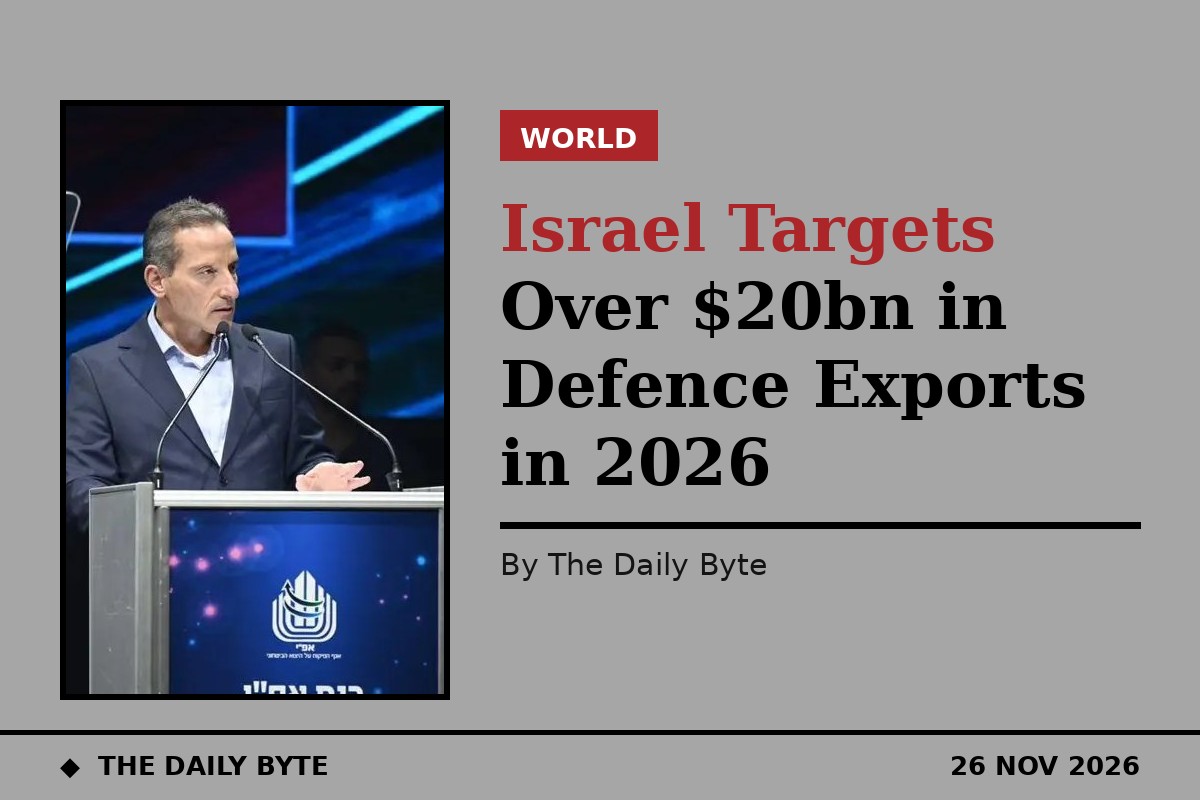
Israel is targeting more than $20 billion in defence exports in 2026, Defence Ministry Director General Maj. Gen. (res.) Amir Baram said at a conference marking 20 years since the establishment of the ministry’s Defence Export Controls Agency (DECA).
About 1,300 defence exporters now operate in Israel, according to figures presented by DECA deputy head Dov Sadeh. Around 200 new exporters were added to the agency’s registry in 2026, alongside approximately 400 newly registered products, reflecting the expansion of Israel’s defence industrial base and the growing role of its defence-tech sector.
The ministry has processed about 16,000 applications for marketing licences since the beginning of the year, and about 5,900 applications for new export licences. Europe accounted for about 44% of marketing licence applications and 40% of export licence applications, while Asia accounted for about 36% and 33% respectively.
Israel’s defence exports reached a record $19.2 billion in 2025, an increase of nearly 30% compared with the previous year and the fifth consecutive annual record. More than half of the export agreements were valued at $100 million or more.
Startups and the “eighth front”
Baram described the defence industry as the “eighth front” in the multi-front war, and said a strong, independent industry is essential to sustaining effective combat operations. “We want to harness the entrepreneurial, technological, and financial strength of the Israeli economy for the benefit of national security,” he said, arguing that Israel needs both the manufacturing capacity of established defence companies and the innovation and agility of smaller firms.
“Increasing defence exports is not merely an economic objective; it is a national security objective,” Baram said. “Without an independent, creative, and strong industry, it is impossible to sustain effective combat over time.”
The ministry is opening the sector to startups and private investment. The country’s defence-tech ecosystem has grown from approximately 160 companies in 2024 to nearly 350 active startups, with commercial technology companies increasingly adding defence applications to their products, driven in part by wartime demand for rapid technological solutions.
International interest is also reflected in a sharp increase in acquisitions of Israeli defence technology companies. A Frost & Sullivan report found that mergers and acquisitions in Israel’s aviation and defence sectors reached $3.26 billion in the first half of 2026, an 8.5-fold increase from $384 million in 2025. US-based buyers accounted for approximately 45% of the transactions examined, with particular interest in defence electronics, sensors, unmanned systems and robotics.
“A strategic asset”
Defence Minister Israel Katz called defence exports “a strategic asset for the State of Israel” and said the ministry is working with more governments to open new markets. He identified space as an area where Israel must maintain its technological edge.
“Israeli capabilities reaching every corner of the globe send a clear message to both our friends and our enemies: Israel is strong, independent, and a leader, and we will ensure it remains so,” Katz said.
As part of a broader reform, DECA has shortened application processing times by dozens of days, expanded digital processing and made the process more transparent for exporters. Baram warned that maintaining Israel’s defence advantage would also require changes to the way the country funds and procures military capabilities, including long-term procurement commitments to give manufacturers greater visibility into future demand.
The target was set as global defence spending rises and countries seek to expand their military capabilities, creating opportunities for Israeli companies working in autonomous systems, artificial intelligence, cybersecurity and advanced weapons technologies, and as the war between Israel, the United States and Iran continues into its ninth month.


