Israel and US Test 20 Anti-Drone Systems in Israel
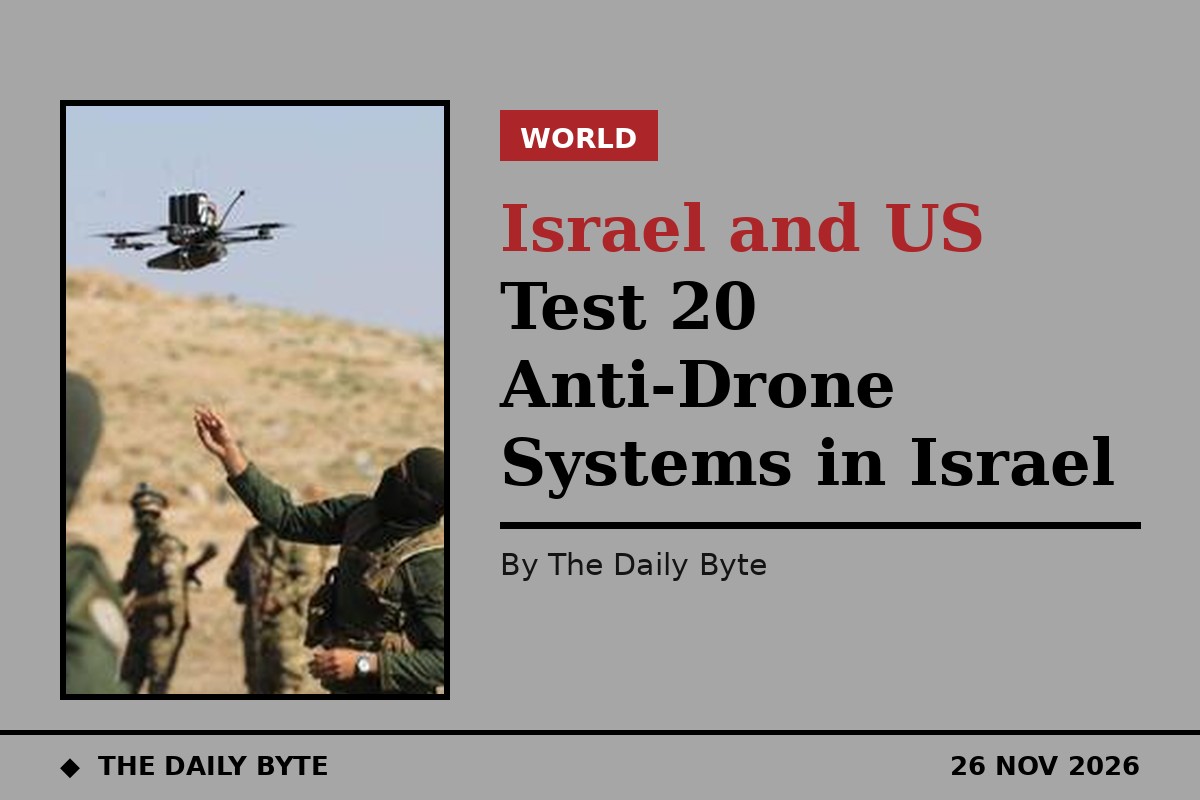
Israel and the United States have tested about 20 counter-drone systems in a joint campaign held in Israel for the first time, as both countries search for better ways to stop the cheap unmanned aircraft that have become one of the hardest threats on the modern battlefield.
Israel's Defence Ministry announced the campaign, called Black Sands, on Thursday. It was jointly led by Israel's Directorate of Defence Research and Development, known as DDR&D or MAFAT, and several US defence organisations.
The trials brought together military personnel from both countries and defence companies from both sides, to test systems against simulated drone threats in scenarios designed to reproduce the operational challenges each military faces.
Who took part
The American organisations involved included US Central Command, Special Operations Command Central, the Office of Naval Research, the Capabilities Development and Innovation office and Joint Interagency Task Force 401. The Israel Defence Forces' ground forces and air force also took part, alongside Israeli and American defence companies.
Danny Gold, the head of DDR&D, described the work as a way to combine Israel's operational experience with additional American capabilities and technology. Benny Aminov, who heads DDR&D's military research and development unit, underlined how fast drone threats evolve as civilian technology becomes widely available.
The ministry did not name the companies or systems involved, did not publish the results, and did not say whether any of the technologies would move on to procurement or operational use. It also did not say how many drones were used in the tests, or what types they were.
Why drones are so hard to stop
The campaign comes as relatively inexpensive drones continue to expose gaps in conventional air defences. Small, low-flying aircraft can be hard to detect and track, while explosive-laden drones and those controlled through fibre-optic cables have created new problems for forces on the battlefield.
Israel has faced that challenge directly in its confrontation with Hezbollah in Lebanon. Its defence establishment has increasingly turned to a combination of technologies, including detection systems, electronic warfare, interceptor drones and other kinetic solutions, rather than relying on a single system.
The search has also drawn international companies into the Israeli market. American defence technology company Anduril has been seeking to establish a presence in Israel with systems designed to detect, identify, jam and intercept drones, while Israeli companies including Israel Aerospace Industries, Rafael, Elbit, TSG and Ondas have also presented or developed counter-drone technologies.
The United States has its own expanding counter-drone procurement effort. In September, Israeli company Smart Shooter secured a US government contract with a ceiling of up to 150 million dollars for its rifle-mounted SMASH fire-control systems, intended to help troops engage drones. The agreement was awarded through Joint Interagency Task Force 401, one of the organisations involved in the Black Sands campaign.
Not the first Black Sands
Black Sands has an earlier history in the United States. A US military account of Black Sands 25.2 says that exercise ran from 20 to 31 October 2025 at Camp Lejeune in North Carolina and tested 12 technologies. The latest campaign, with about 20 systems, is separate from that earlier event, and is the first to be held on Israeli soil.
The announcement described an evaluation effort, not a contract award. Whether any of the systems moves from testing to procurement remains a separate question, one the announcement did not settle.


