Israeli strike kills 13 security personnel in Nabatieh
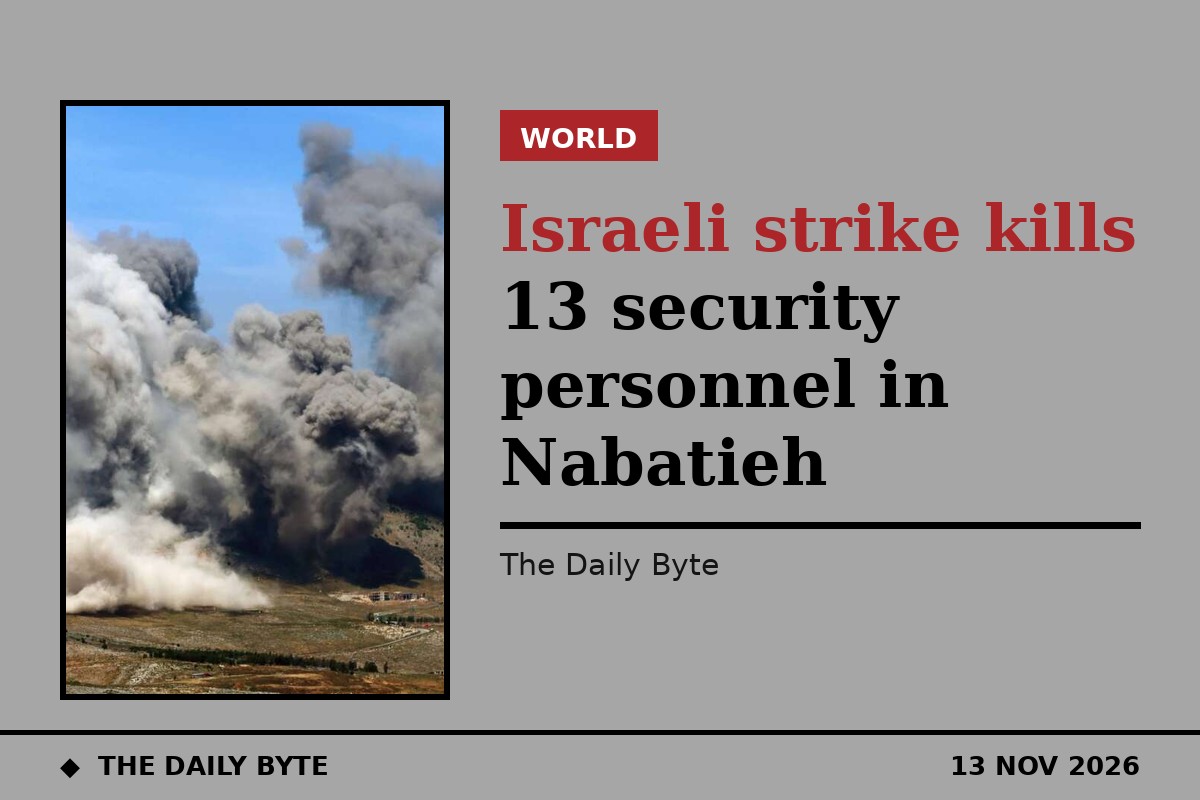
At least 14 people were killed in Israeli air strikes across southern Lebanon on Friday, including 13 security personnel who died when a government building in the southern city of Nabatieh was hit, Lebanon’s president said. The strikes came amid fears that the continuing violence could threaten the fragile ceasefire between the United States and Iran. Al Jazeera reported that President Joseph Aoun condemned the attacks and said targeting state institutions would not deter Lebanon from defending its sovereignty.
Lebanon’s State Security agency said the 13 dead were its own personnel, killed when Israeli warplanes struck its office near the government headquarters in Nabatieh. An AFP photographer at the scene saw extensive damage and a fire still burning. Prime Minister Nawaf Salam said in a statement: “This painful loss only strengthens our determination to achieve a ceasefire that will protect Lebanon and our people in the south.” AFP reported that Lebanon’s National News Agency described the assault on Nabatieh as the largest attack on the city since the current war began.
Strikes across the south and Hezbollah response
Al Jazeera’s correspondent in Tyre said Israel had been launching “non-stop” strikes across southern Lebanon since the morning, and warned the death toll was likely to rise as civil defence teams searched the rubble. An earlier strike on the southern town of Hannawiya killed one person and wounded another, while Israeli forces destroyed residential areas in Aita al-Shaab and attacked al-Majadel in the Tyre district. Homes were also blown up in the town of Hanine.
Hezbollah responded by firing rockets towards towns in northern Israel, including Kiryat Shmona, Metula and Misgav Am, and said it had targeted Israel’s Ashdod naval base with missiles. The group said its attacks would continue until the Israeli-American aggression against Lebanon stopped. Israel reported more than 30 rockets fired from Lebanon on Friday.
Hospitals spared, food crisis deepening
The World Health Organization said on Friday it had received assurances that two hospitals in Beirut included in an Israeli forced evacuation order would not be attacked. About 450 patients remain inside Rafik Hariri University Hospital and Al Zahraa Hospital, where evacuation is not feasible, according to Dr Abdinasir Abubakar.
The United Nations World Food Programme warned that the situation in Lebanon was fast becoming a food security crisis as well as a displacement crisis. Its Lebanon country director, Allison Oman, said food was becoming increasingly unaffordable because of rising prices and higher demand from displaced families, while the US-Israel war on Iran was disrupting supply routes.
Talks planned despite the escalation
Israeli Prime Minister Benjamin Netanyahu said on Thursday that he had ordered direct negotiations with Lebanon “as soon as possible”. A senior Lebanese official told Reuters that Lebanon intends to join a meeting next week in Washington with US and Israeli representatives to discuss and announce a ceasefire, although another senior Lebanese source told Anadolu that the planned talks would be preparatory rather than a negotiation.
The latest violence began days after Israel and the US launched their war on Iran on 28 February. According to Lebanon’s Health Ministry, at least 1,953 people have been killed and 6,303 injured in Israeli attacks across the country since 2 March. UNICEF warned that 33 children had been killed and 153 injured in recent strikes, adding to a total of 600 children killed or injured since 2 March, with nearly 390,000 children among more than one million displaced people.


