Israeli Strike Kills UNRWA Worker In Gaza's Jabalia
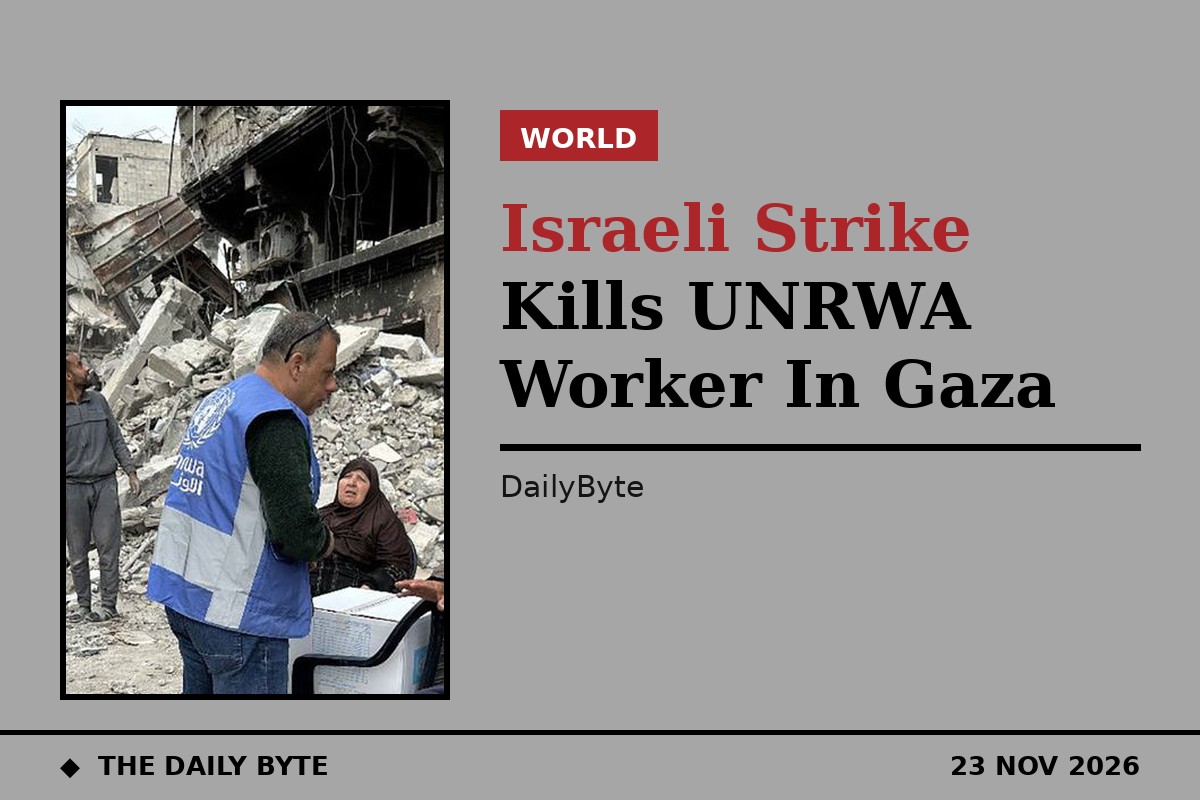
An Israeli airstrike killed a man working for the United Nations Palestinian refugee agency UNRWA in the Gaza Strip on Monday, 23 November 2026, the relief agency and local health officials said. The man, whom medics named as Adel Al-Helo, was working near a water well in the Jabalia refugee camp in the north of the enclave when the strike hit. Three other people were wounded in the same incident, according to UNRWA and medics.
The killing is the latest deadly incident in Gaza more than a year after a United States-backed ceasefire took effect in October 2025. That agreement halted major fighting in the shattered territory, but it has not stopped Israeli attacks on Gaza, nor has it secured the disarmament of Hamas, which remains a central and unresolved part of the deal. Aid workers say the continuing strikes make even routine humanitarian work dangerous.
What happened at the water well
According to Reuters, the strike hit a target on the street near the water well, which was manned by UNRWA staff and a guard. "The initial reports indicate that the strike hit a target on the street near the water well, which was manned by UNRWA staff and a guard. The staff were engaged in their regular duties associated with water well operations," an UNRWA spokesperson told Reuters.
The Israeli military said it was checking Reuters' request for comment. No further explanation of the target, or of why the strike was carried out at that location, had been given at the time of reporting. UNRWA, formally the United Nations Relief and Works Agency for Palestine Refugees in the Near East, is the main agency providing food, water, health care and shelter to Palestinian refugees in Gaza, and its staff have been among those killed repeatedly during the war.
Al-Helo's death was reported in the same incident as the wounding of three others, but the names and conditions of the wounded were not immediately released. Reports of the incident, including a separate account carried by AnewZ, confirmed the same core details: the victim's name, the location at Jabalia, the water well, and the three wounded.
A worker who kept the water running
Relatives quoted in reports of the strike said Al-Helo had worked for the agency for 35 years. "He went to run the water well to supply the residents of Jabalia camp with water," a relative said, according to syndicated reports of the incident. The account presents the work as ordinary and essential: operating a well so that families in one of Gaza's most crowded and heavily damaged camps could get water.
Jabalia, in northern Gaza, has been one of the areas most affected by the war, with repeated strikes, ground operations and severe damage to homes and infrastructure. Water has been a constant problem across the territory, where wells, desalination plants and distribution networks have been damaged or disrupted, and where aid agencies say clean water is often scarce. A strike at a well therefore carries a double cost: the life of the worker, and the risk to a water supply on which nearby residents depend.
The same day brought further deaths elsewhere in Gaza. According to AAP, Israeli airstrikes killed at least three people in Gaza on Monday, including the UNRWA worker, after a vehicle in western Gaza City was hit, killing two people and wounding others.
Violence despite the ceasefire
The October 2025 ceasefire was presented as a step towards ending the war, but the figures since then show how limited its effect on the ground has been. At least 1,600 Palestinians and five Israeli soldiers have been killed since the ceasefire took effect, according to respective Palestinian and Israeli tallies cited by Reuters. Israeli troops now control around two-thirds of Gaza, up from more than half at the time of the ceasefire, with Hamas controlling a sliver of territory along Gaza's coast.
The wider war has already killed tens of thousands of Palestinians, caused a hunger crisis, and internally displaced Gaza's entire population. Scholars and a United Nations inquiry have made assessments of genocide in relation to Israel's campaign, allegations Israel rejects, maintaining its operations constitute self-defence after Hamas-led militants killed 1,200 people and took more than 250 hostages on 7 October 2023.
What happens next
For the residents of Jabalia, the immediate concern is practical: whether the well Al-Helo was operating will keep running, and who will run it. For mediators backing the ceasefire, the question is whether incidents like this one will be treated as isolated events, or as evidence that the ceasefire, as it stands, is not protecting civilians or the aid workers trying to help them.


