Italy backs Germany joining GCAP fighter jet plan
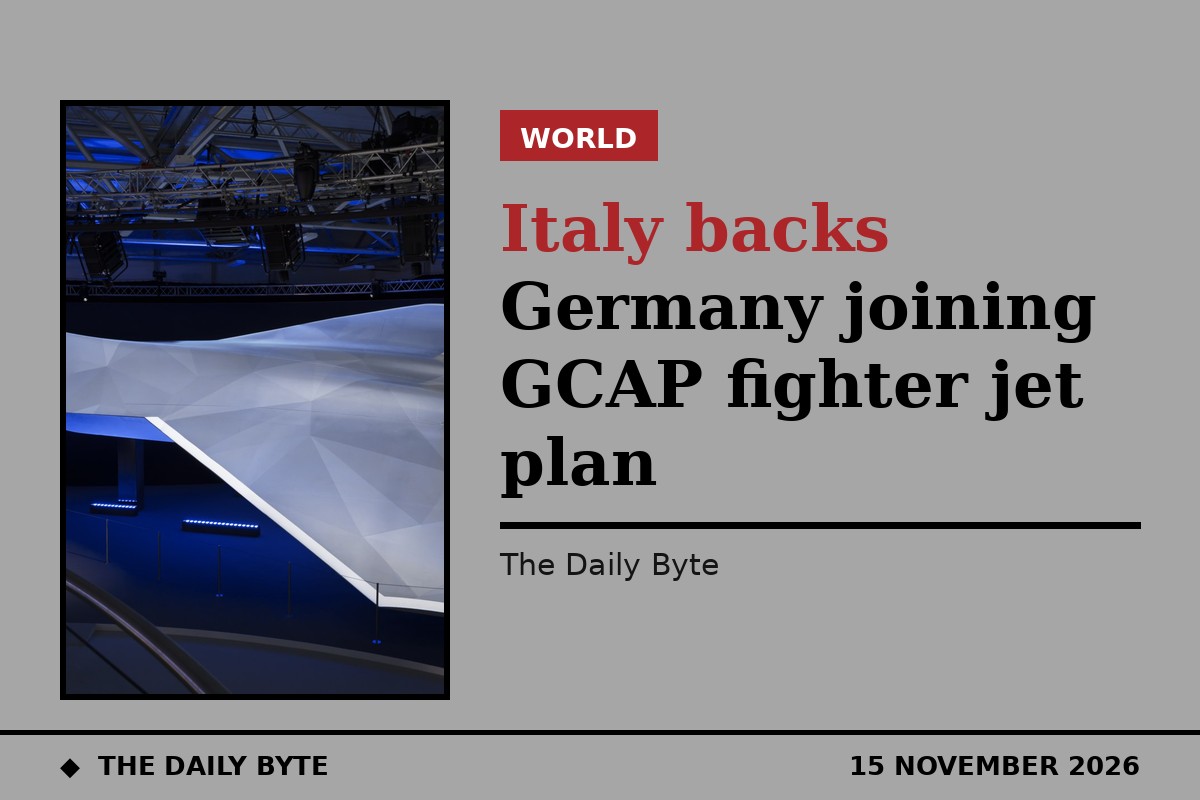
Italy has said it fully supports Germany joining the Global Combat Air Programme (GCAP), the British-Italian-Japanese project to build a next-generation fighter jet, and has proposed bringing Berlin in first as an observer on the way to full membership.
The Italian government set out its position in a statement on Saturday, 14 November, after the Financial Times reported that Rome had tried to block Germany from joining the programme as an equal partner. Italy called that report "entirely misleading" and said it did not reflect its longstanding position, Reuters reported.
What Rome said
Italy said it had always been willing to welcome Germany into GCAP and had proposed that Berlin initially join on an observer-only basis to facilitate information-sharing and speed its path towards full membership. Rome said the proposal was designed to accelerate Germany's involvement while protecting the programme's timetable and progress, and was not intended to restrict Berlin's future role.
Italy said it had repeated that position during the latest GCAP videoconference involving the programme's three partner nations, and that it viewed German participation as "a positive opportunity".
The Financial Times had reported that Italian Defence Minister Guido Crosetto used an online meeting with his British and Japanese counterparts this week to oppose giving Germany an equal role, and instead suggested observer status with no role in the aircraft's design or development. According to the newspaper, a German official described that offer as "unacceptable".
Why Germany wants in
Germany is looking for a new fighter jet programme after the Future Combat Air System (FCAS), its joint project with France and Spain, collapsed in June. German Defence Minister Boris Pistorius has said he wants a decision on Germany's fighter options by the end of March, and Berlin has been exploring alternatives including GCAP and possible cooperation with Spain and Sweden's Saab.
German Chancellor Friedrich Merz said in October that Berlin was examining whether it could take part in the British-Italian-Japanese programme. Pistorius has said that if the existing partners are open to Germany joining, any decision will depend on a reasonable balance between work share, timeline and Germany's share of the costs.
What observer status would mean
Observer status would give Germany access to information about the programme without, for now, a vote over the aircraft's design or a guaranteed share of manufacturing work. Italy has presented it as a first step rather than a final settlement, arguing that it would let technical sharing start immediately without reopening the project's existing arrangements.
There is a precedent: Canada was welcomed as an observer in July 2026, when the three partner countries' defence ministers agreed the arrangement in a joint statement. Germany, however, has made clear it wants full membership, with funding and a substantial share of industrial work in return.
What happens next
No final agreement on Germany's admission as a full partner has been announced, and no date has been set for a decision. Britain's Ministry of Defence said it was "fully committed to delivering GCAP at pace" and "open to exploring credible options for future participation by other nations, while keeping the programme on track", Clash Report reported.
GCAP brings together Italy, Britain and Japan to develop a next-generation fighter aircraft by 2035, with Leonardo, BAE Systems and Japan's Mitsubishi Heavy Industries leading the industrial effort. Whether Germany joins as an observer first, or holds out for full membership from the start, will shape who builds the aircraft and how quickly Europe's largest economy can replace its ageing fighter fleet.
Sources: Reuters; Clash Report.


