Italy General Strike Halts Cities Over Wages
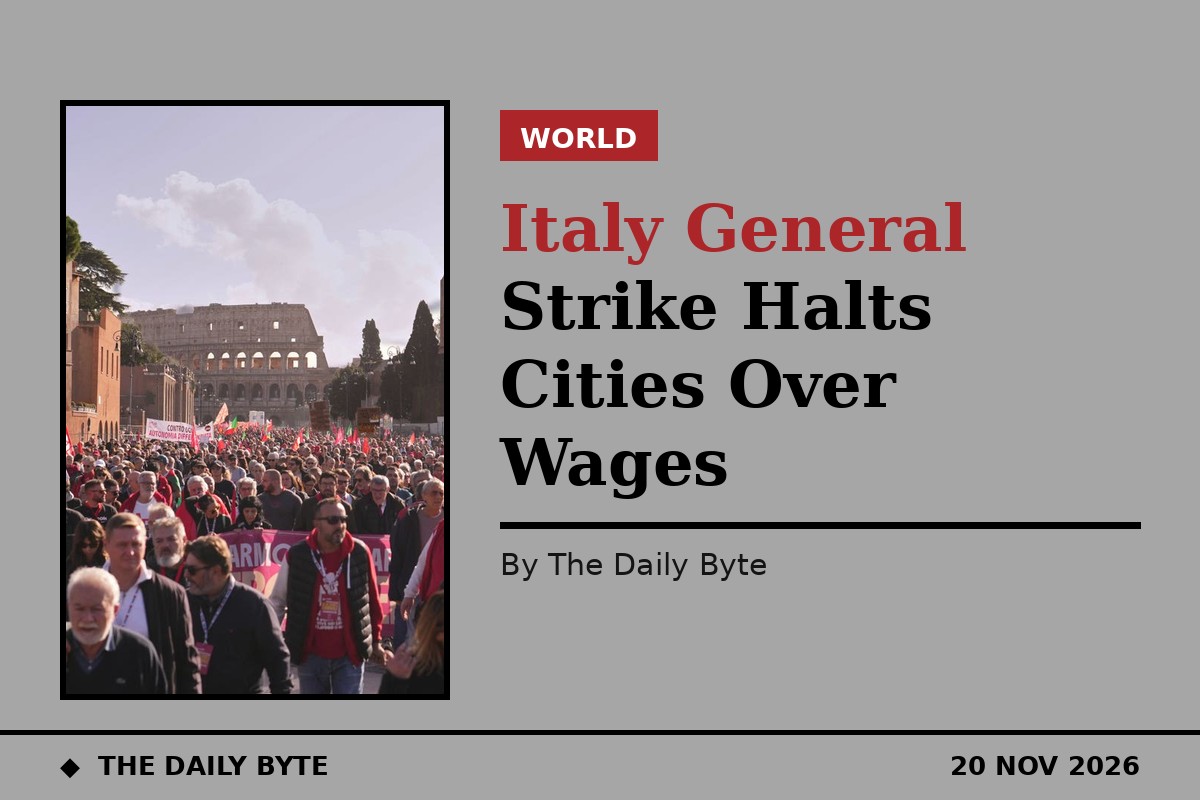
Tens of thousands of workers and students took to the streets across Italy on Friday as the country's largest trade union, CGIL, staged a general strike demanding higher wages and greater investment in public services.
The 24-hour stoppage brought demonstrations to more than 100 cities, from Milan and Turin in the north to Naples, Palermo and Rome, in a protest aimed at Prime Minister Giorgia Meloni's economic policies and her government's proposed budget for 2027. Schools, hospitals and local transport were disrupted, while air and rail services were excluded from the general strike.
Addressing a rally in Rome, CGIL leader Maurizio Landini said more than one million people had taken part in demonstrations across the country. The Interior Ministry said it was too early to provide its own estimate. In Rome, some student demonstrators threw objects towards police outside the Education Ministry, according to reports from the protest.
A protest over the 2027 budget
Parliament is examining Meloni's €26 billion budget for 2027, which CGIL says does not go far enough to support incomes and public services. The union is demanding wage increases and contract renewals to recover purchasing power lost to inflation, full indexation of pensions and measures to prevent a rise in the retirement age.
“People have very basic problems: they struggle to make ends meet and therefore need higher wages; they need a healthcare system that works; young people need schools that work,” Landini said. “This budget does not address a single one of them.”
Industry Minister Adolfo Urso described Friday's action as a pre-emptive strike, saying Landini had called it before he even knew the contents of the budget. Urso added that he had great respect for those demonstrating and for those who had tabled amendments in parliament, where the budget would then be improved.
A separate rail strike was due to begin at 9 p.m. on Friday and run until 8 p.m. on Saturday. Other unions, including the grassroots Cobas movement, called separate strike action, while student demonstrations were planned around the country.
Part of a wider European day of action
The Italian strike coincided with a broader wave of youth mobilisation across Europe, with student demonstrations also held in Germany, France, Britain, Austria, Belgium and Spain over rising living costs and military spending. “Today is also a very important day because young people are taking to the streets not just in Italy but across Europe,” Landini said.
Friday's demonstrations followed a nationwide mobilisation on 30 October, when thousands of students joined striking workers to demand more funding for education and relief from high living and housing costs. Student groups have since continued protests and occupations at schools and universities, with opposition to higher military spending also emerging as a rallying cry.
“We are living under a government that, piece by piece, is cutting healthcare and education, taking away our present and trying to rob us of our future,” said Laura Peritore, 24, a university student who joined the march in Rome. The protests come as Italy gears up for a parliamentary election due in 2027.
Sources: Reuters | Associated Press via Glasgow Times


