Italy hoax bomb emails hit 6,300 schools
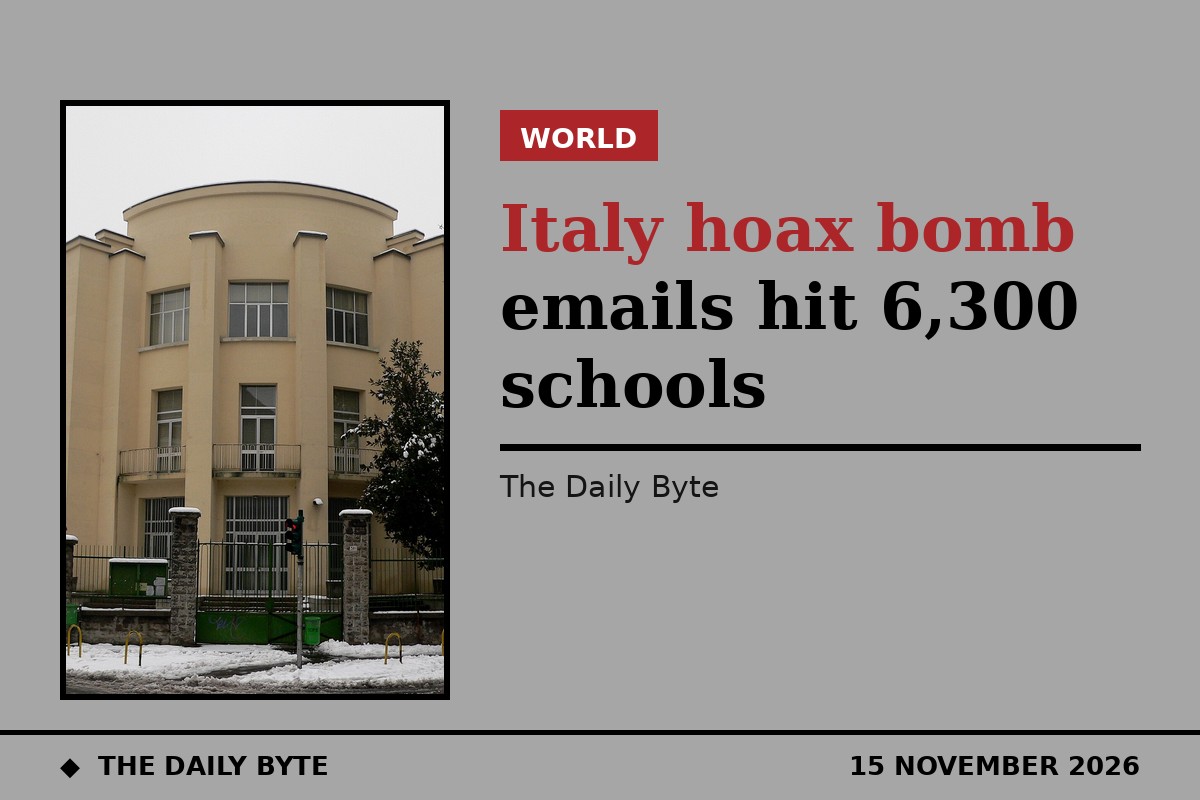
A single emailed bomb threat reached about 6,300 of Italy's 7,476 state schools on Wednesday 11 November, forcing hundreds of precautionary evacuations and disrupting lessons for millions of pupils, according to Italy's education ministry. Police searched school after school and found no explosives. The threats were a hoax.
The message, signed "Mikhail Andropov, leader of the Vilayat of Misoginistan", claimed a bomb had been placed in every school building. Copies reviewed by Italian media also carried a threat against Prime Minister Giorgia Meloni, saying a device had been placed in the engine of her car. Meloni said checks had found no concrete danger and described the campaign as an effort to spread fear.
Schools in Rome, Milan, Naples, Palermo, Bologna and other cities suspended lessons and evacuated pupils while police, bomb-disposal specialists and Italy's Postal Police, which handles online crime, carried out checks. Education Minister Giuseppe Valditara reported the scale of the mailing from the ministry's own IT count: about 84 per cent of the country's state schools received it. Private schools were not affected.
Second wave, new rules on evacuations
The threats did not stop after one day. On Thursday 12 November, a further 1,803 schools received hoax bomb warnings, again signed "Mikhail Andropov" and again including a threat to the prime minister. This time, however, many schools stayed open. Meloni's government had issued new advice overnight: public buildings should be cleared only where there is concrete evidence of danger, rather than on the receipt of a mass email alone.
"Buildings should not be evacuated in the absence of concrete elements beyond the mere receipt of a mass email that would suggest a genuine danger exists," the prime minister's office said. Hundreds of schools ignored the warnings or reopened quickly under the new guidance, and classes ran normally the following day.
Meloni summoned opposition leaders to her office for talks on how to handle similar incidents and announced plans for a standing protocol aimed at limiting their impact. Opposition leaders said it was up to the government to come forward with proposals, but criticised what they described as inadequate investment in cybersecurity. Former prime minister Matteo Renzi, leader of the centrist Italia Viva party, said: "How has the money been spent so far? Yesterday's alarm could have been dealt with using a good antivirus programme."
Threats spread beyond Italy
Italy was not the only country targeted. Authorities in Scotland, Northern Ireland and the Republic of Ireland said many schools had received similar threatening emails from abroad, but classified them as hoaxes and allowed classes to continue. Police Scotland said about 1,000 schools, from Dumfries and Galloway in the south to Aberdeenshire and Orkney in the north, received the messages. In Northern Ireland, around 300 schools were contacted.
The 11 November mailing was the third wave of threats against Italian schools in about a month, after messages on 19 October and 2 November, when about 280 schools were targeted. Investigators have not identified who sent the emails or charged anyone, and Italian officials have said there is no evidence so far to support claims of foreign state involvement. Some European officials have suggested Russia may be behind a campaign of disruption against countries supporting Ukraine; Russia denies involvement and has accused the West of a smear campaign. Russia's ambassador to Italy said on Thursday that the Russian authorities were ready to help their Italian counterparts track down whoever was behind the threats.
The episode fits a wider pattern of hoaxes and cyberattacks that have recently targeted supermarkets, blood banks, air traffic systems and broadcasters across Europe, as well as fake bomb warnings that forced the diversion of more than 20 commercial flights on 5 November. For Italy's schools, the government's message is now clear: the emails are to be reported, not obeyed, and children should be sent to school anyway. Sources: BBC News and Reuters.


