Italy Says EU Failed on Red Sea Security Pledge
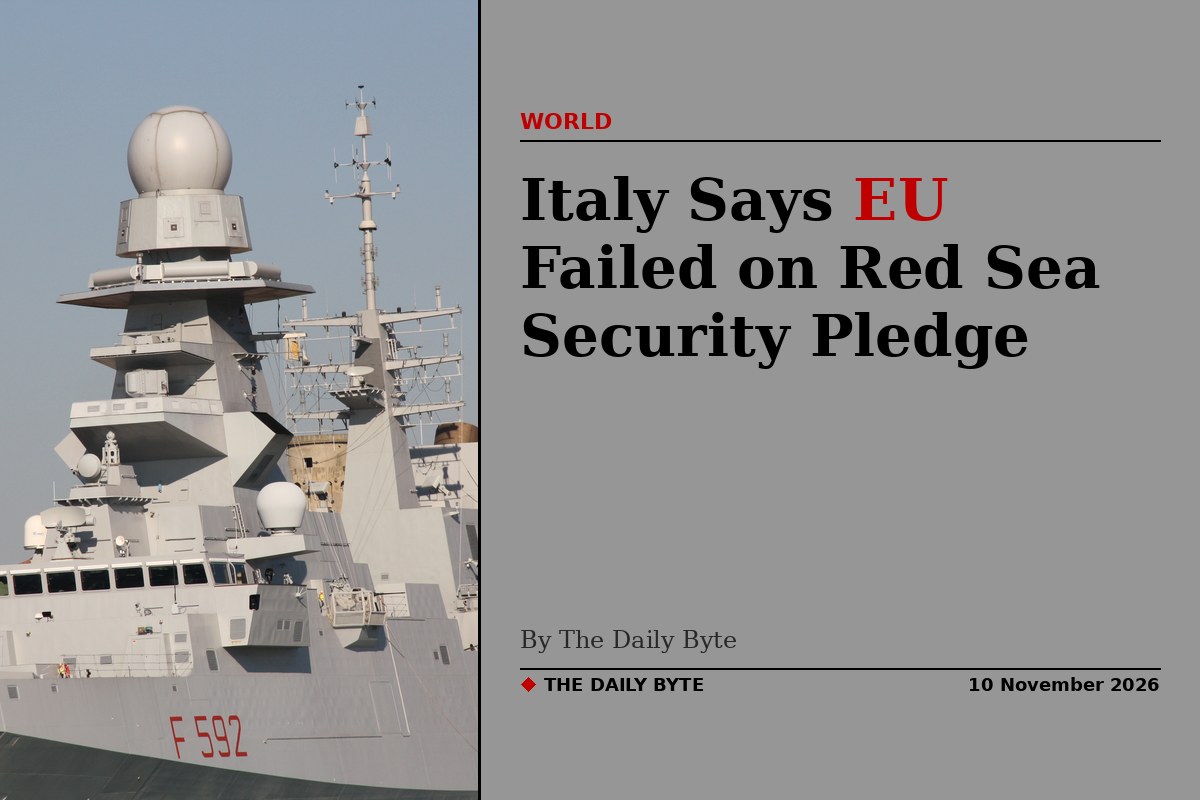
European nations have taken no concrete steps to strengthen shipping protection in the Red Sea, Italy's defence minister said on Tuesday, accusing fellow EU governments of failing to answer his calls to reinforce the bloc's naval mission in the area.
Guido Crosetto told Reuters that, two months after he first urged the European Union to bolster Operation Aspides, the mission launched in 2024 to protect commercial shipping from attacks by Yemen's Iran-aligned Houthis, little had changed. "I have yet to see anything concrete," he said, while adding that EU foreign policy chief Kaja Kallas had "fully understood" the importance of Italy's request.
Ten warships needed, too few offered
After Crosetto's appeal in September, Kallas wrote to the bloc's 27 member states urging them to increase their contributions, saying more than 10 warships would be needed for the mission to be truly effective. Italian daily Il Sole 24 Ore reported that talks among EU states on boosting contributions have so far been inconclusive, partly because of the reluctance of some members with limited resources to deploy assets.
The mission continues to operate with only around six warships, contributed mainly by Italy and Greece, with periodic contributions from Germany, France, Spain, the Netherlands and Belgium. The Netherlands has offered a frigate in a supporting role, while Belgium's frigate Leopold I has been delayed by technical problems and is not expected to join the mission until next year. Kallas has said commercial ships are waiting in a queue to receive an escort because the EU does not have enough frigates available.
Italy carries about a third of the effort
Crosetto, a senior member of Prime Minister Giorgia Meloni's government, said the burden was falling unevenly on Rome. "About one third of European operations depend on Italy's contribution. Other countries, far larger than us, contribute much, much less," he said, speaking after an event in Rome.
"If it is right to invest in missions, then it is right that everyone contributes," he added.
The stakes for Italy are high. According to Assarmatori, one of Italy's main shipowners' associations, around 40 per cent of the country's trade with the rest of the world passes through the Suez Canal at the northern end of the Red Sea. The US-Israel war on Iran has disrupted maritime routes that are vital for global trade and energy supplies, including the Bab el-Mandeb Strait and the Strait of Hormuz, contributing to higher shipping costs and adding to inflationary pressures.
Attacks continue as escorts run short
The Houthis have intensified attacks on commercial shipping and strategic infrastructure, while Saudi Arabia has also carried out strikes against Houthi targets in Yemen. In September, Crosetto said Italy would act on its own to escort Italian merchant ships through the Bab el-Mandeb Strait rather than wait for Aspides to decide whether ships could pass, a step he presented as filling a gap rather than leaving the mission.
For now, the EU's flagship Red Sea operation remains short of the ships its own foreign policy chief says it needs, and Rome's patience with its partners is wearing thin. The question facing Brussels is whether member states will now put warships behind the commitments they have already made on paper, or leave Italy and Greece to carry a mission that protects trade for the whole continent.


