ITU states agree AI, resilience and lunar rules in Doha
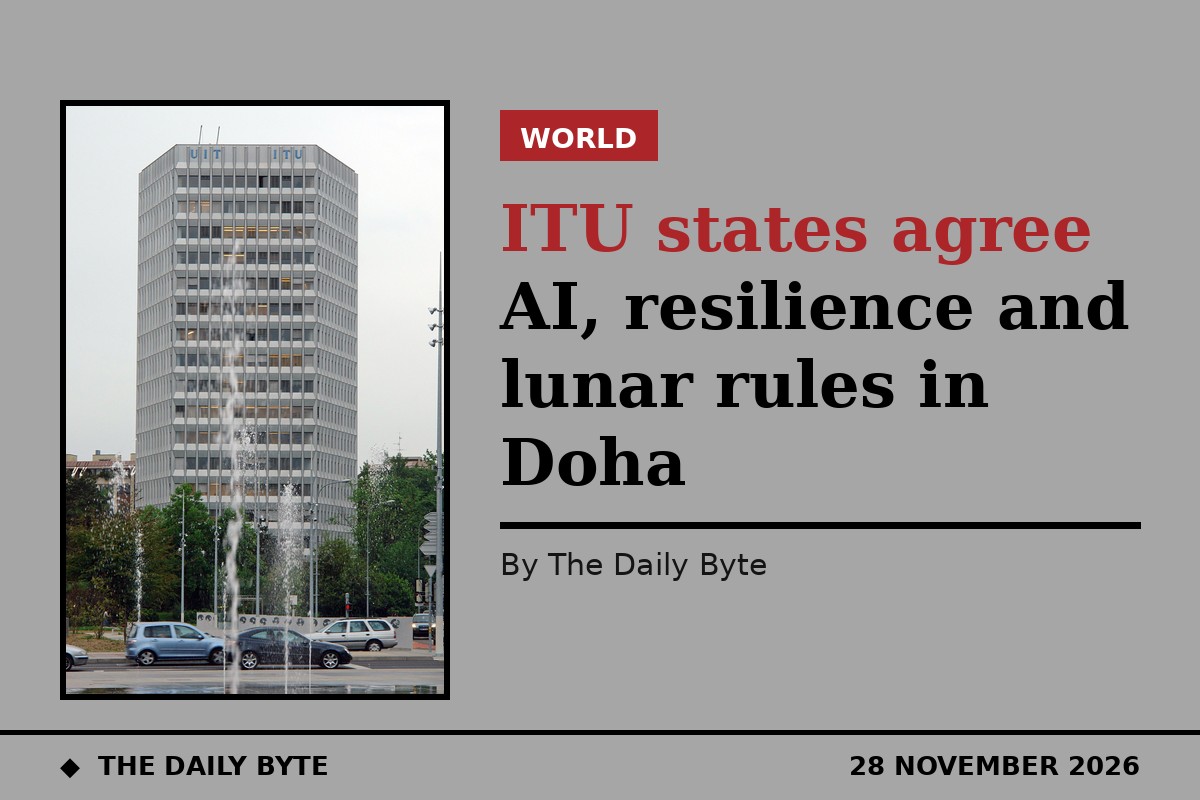
Governments from around the world have agreed a shared set of priorities for the future of digital technology, as the International Telecommunication Union (ITU) closed its highest policy-making conference in Doha, Qatar, on 27 November 2026.
The Plenipotentiary Conference, known as PP-26, ran for three weeks and brought together delegations from 179 member states, along with regulators, companies and international organisations. More than 3,000 delegates took part. The formal outcomes, known as the Final Acts, were signed by 158 member states, moving the decisions from negotiation into implementation across the ITU's work.
The agreed priorities cover some of the most contested questions in global technology policy. Delegates backed work to promote the secure and interoperable use of artificial intelligence, and to support the development of international AI standards and best practice. They also agreed to strengthen the resilience of digital infrastructure, including submarine cables, terrestrial networks and satellite systems, through international cooperation, technical assistance and emerging technologies.
Connectivity was a central theme. The conference committed to advancing universal, meaningful and affordable connectivity, helping countries close coverage and usage gaps and put enabling rules in place. Delegates also agreed to develop resilient emergency and disaster communication systems, and to identify urgent connectivity needs for humanitarian assistance.
One of the most notable outcomes concerns the Moon. Member states adopted the ITU's first resolution dedicated to spectrum management for lunar exploration, directing the organisation to consider innovative uses of radio spectrum and associated orbits as missions to and around the Moon become more frequent. The decision strengthens the ITU's role in radiocommunications beyond Earth, at a time when lunar exploration, scientific research and commercial investment are all expanding.
Other agreed priorities include promoting the safe use of telecommunications and information technologies by children in several languages, addressing the effect of those technologies on climate change through energy efficiency and sustainable design, and advancing the Internet of Things, digital twins and AI-enabled smart cities, towns and villages in urban, rural and remote areas.
The conference also completed the ITU's leadership elections and approved its strategic and financial plans for 2028 to 2031. Doreen Bogdan-Martin was re-elected as Secretary-General, and member states elected two women to the leadership team for the first time in the organisation's history.
"The decisions taken in Doha strengthen ITU's foundation, so that we can deliver across some of the defining issues of our time amid rapid technological change," Bogdan-Martin said. "Our task now is to transform these decisions into action as we seek to bring 2 billion people online, while ensuring technology benefits everyone, everywhere."
Engineer Ahmad bin Abdulla AlMuslemani, chair of PP-26 and president of Qatar's Communications Regulatory Authority, said the three weeks of talks had brought member states together in constructive dialogue. "Over the past three weeks, PP-26 successfully brought Member States together in constructive dialogue and cooperation, culminating in consensus on strategic decisions that will guide the Union's direction for the years ahead," he said.
The Plenipotentiary Conference meets every four years and sets the ITU's direction, elects its leadership and approves its plans. The conference also accepted India's proposal to host the next gathering, PP-30, in 2030. The ITU is the United Nations agency for digital technologies, with 194 member states and more than 1,000 companies, universities and other organisations in its membership.


