Japan Turns to ASEAN on Critical Minerals Pact
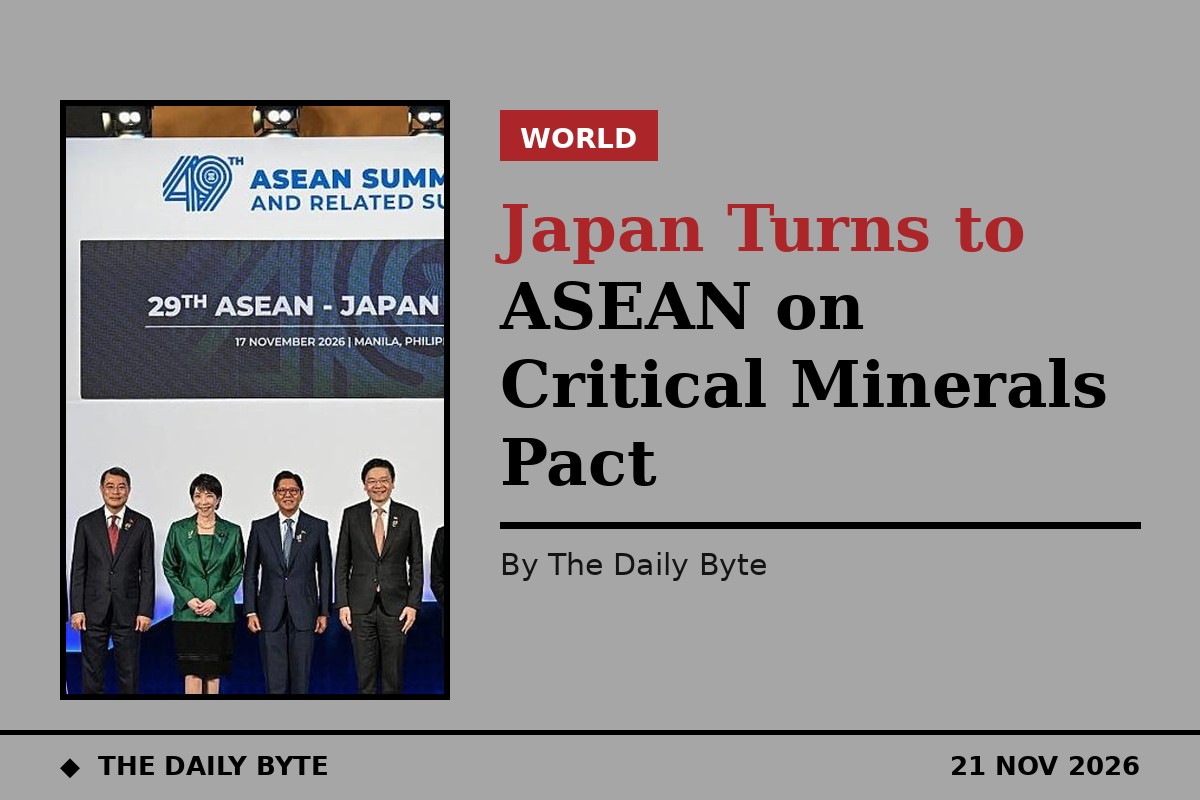
Japan is stepping up cooperation with Southeast Asian nations on critical minerals, energy security and supply chains as Tokyo seeks to reduce its exposure to Chinese export restrictions amid prolonged tensions with Beijing. Prime Minister Sanae Takaichi and leaders of the Association of Southeast Asian Nations adopted a joint statement on regional economic resilience during their summit in Manila on 17 November, and a Reuters analysis published on 20 November described the move as part of a wider effort by middle powers to diversify economic relationships.
The agreement calls for stronger supply chains for critical minerals, greater energy cooperation, investment in advanced technologies and closer coordination on economic security. Japan's foreign ministry said that under the Partnership on Wide Energy and Resources Resilience Asia, known as POWERR Asia, Japan will promote economic and energy resilience and strengthen regional supply chains, including critical minerals, to address challenges such as arbitrary export restrictions.
Why Tokyo is diversifying
The push comes as Japan faces pressure on two fronts. China dominates important segments of global rare-earth processing and has imposed restrictions affecting supplies to Japanese companies amid a diplomatic dispute over Taiwan. The tensions intensified after Takaichi suggested in November 2025 that a Chinese attack on Taiwan could prompt a Japanese military response if Japan's survival were threatened. Beijing demanded that she retract the remarks and subsequently maintained restrictions on certain dual-use exports to Japan.
Reuters reported that shortages of Chinese critical minerals have already affected Japanese industries, adding urgency to Tokyo's efforts to develop alternative suppliers and production networks. The materials matter far beyond one sector: they are essential for electric vehicles, semiconductors, industrial equipment and defence manufacturing.
What the Manila agreement covers
The joint statement also covers energy security, with Japan proposing closer coordination on emergency oil stockpiles and supply releases, including potential use of spare Japanese storage capacity by Southeast Asian partners. The initiative reflects concerns over disruptions to energy shipments from the Middle East, particularly through the Strait of Hormuz.
Japan and ASEAN also agreed to advance cooperation on artificial intelligence safety, digital technologies and infrastructure under a newly launched Japan-ASEAN AI Safety and Security Partnership. The two sides welcomed a review of their Comprehensive Economic Partnership Agreement, including potential improvements in supply chain resilience, connectivity and access to critical minerals, and the joint statement outlines plans for a Japan-ASEAN Economic Security Leadership Program scheduled to launch in 2027.
A framework, not a replacement
Tokyo's strategy does not signal a break with China, which remains a major trading partner. It represents an effort to reduce dependence on concentrated sources of strategic materials at a time when Japan also faces uncertainty over the future of United States trade policy. The ASEAN-Japan agreement establishes a framework for cooperation rather than a completed replacement for Chinese mineral supplies, and the scale of new investment, specific supply contracts and implementation timelines have yet to be fully detailed.