Japan proposes Asia oil security task force to share stockpiles in emergencies at ASEAN summit in Manila
By aminah
·18 Nov 2026
·4 min read
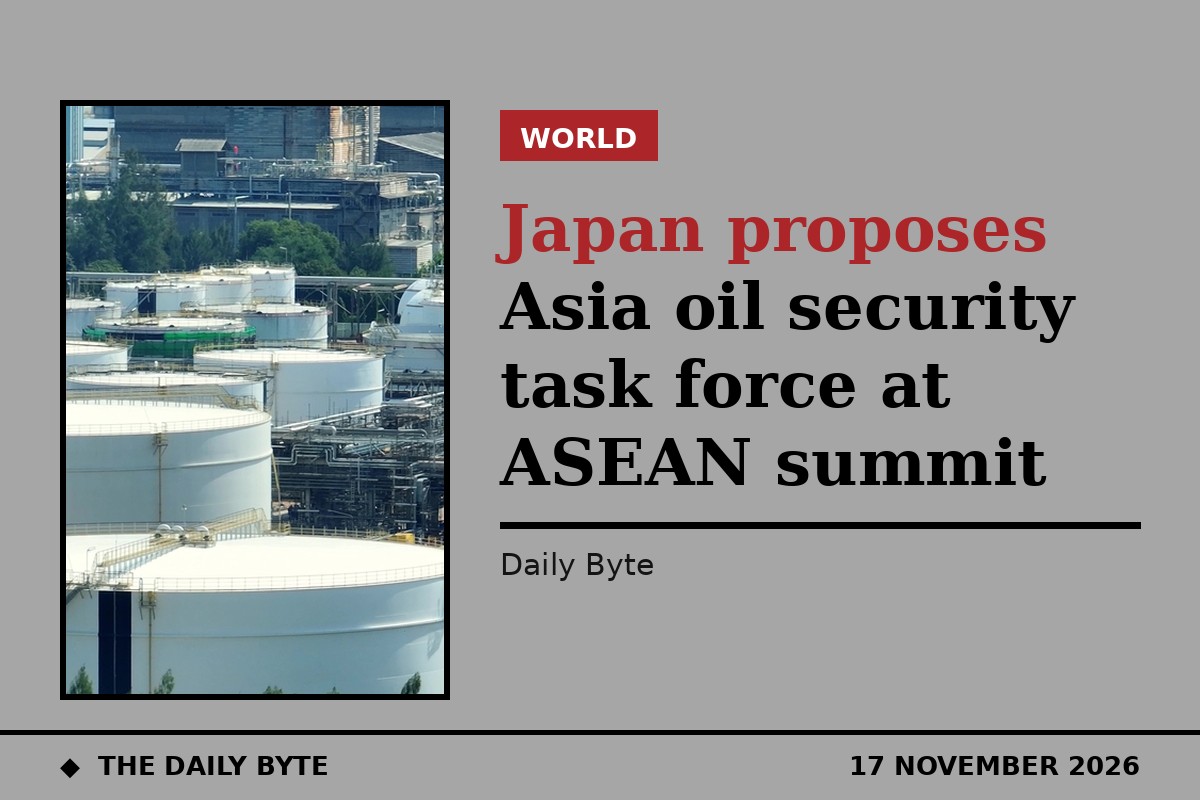
Japan has proposed creating an Asia Oil Security Task Force to coordinate oil stockpiling and emergency supply releases across Asia, offering neighbouring countries access to idle oil storage capacity in Japan.
Prime Minister Sanae Takaichi put the plan to Southeast Asian leaders at the fourth Asia Zero Emission Community (AZEC) leaders' meeting in Manila on Tuesday, 17 November, held on the sidelines of the 49th ASEAN Summit. "We intend to promote it as an equivalent of an Asian version of the International Energy Agency," she said.
The task force would coordinate emergency oil releases and transfers among participating countries, with a hub in Tokyo serving as its operational centre. It would work alongside a Philippine-led joint oil stockpiling scheme already in motion, and with the Paris-based International Energy Agency (IEA) and the Jakarta-based Economic Research Institute for ASEAN and East Asia.
## Why Asia wants its own oil safety net
Asian countries are seeking to strengthen energy security after the Iran war exposed their vulnerability to disruptions in Middle Eastern oil and gas supplies passing through the Strait of Hormuz. About 90 per cent of the crude oil going through the waterway is destined for Asia, according to Japan's Agency for Natural Resources and Energy, as reported by Reuters via BusinessWorld.
Compared with Japan, Southeast Asian countries hold smaller oil stockpiles, and supplies of crude and petroleum products such as naphtha, a key feedstock for plastics, have become very tight. A disruption in Southeast Asian production has also fuelled anxiety among Japanese healthcare providers that rely on Asia for critical supplies such as containers, tubes and gloves.
Takaichi also proposed a "Power Gulf Initiative" aimed at strengthening cooperation between Middle Eastern oil producers and Asian energy-consuming countries, bridging the two sides of the region's energy trade.
## Marcos backs the plan and pushes nuclear power
Philippine President Ferdinand R. Marcos Jr., who co-chaired the AZEC meeting with Takaichi, renewed his push for nuclear power and a diversified energy mix. "No single nation can insulate itself from shocks of this magnitude by acting alone," he said, citing Asia's vulnerability to disruptions along critical energy supply routes, including the Strait of Hormuz.
Marcos said the Philippines was advancing a strategic petroleum reserve and seeking investment in renewable energy, grid modernisation, energy storage, natural gas and emerging technologies. The country is laying the groundwork for nuclear power as a reliable, low-carbon energy source, alongside liquefied natural gas, biofuels, hydrogen, ammonia and carbon capture, and is targeting at least 25 gigawatts of renewable energy capacity by 2035, rising to a 50 per cent share of power generation by 2040.
"Sustainable and enduring energy security demands that oil-consuming and oil-producing nations act in unison. We must deepen information sharing and practical storage arrangements, as well as commit to upholding international law to keep sea lanes open and maintain fair, transparent markets," Marcos said, according to the Philippine News Agency.
On the same day, the Philippines and Japan signed a memorandum of cooperation to advance the development of the Philippines' strategic petroleum reserves. Energy Secretary Sharon S. Garin and Japan's Minister of Economy, Trade and Industry Ryosei Akazawa signed the pact on the sidelines of the ASEAN Summit, creating a framework for establishing, managing and releasing strategic petroleum reserves based on the Philippines' fuel needs, market conditions and emergency response requirements. The pact will span three years.
## Who is involved
AZEC is a Japan-led initiative that seeks to advance decarbonisation while maintaining economic growth and energy security, allowing participating countries to pursue pathways suited to their national circumstances. Its 11 members are Australia, Brunei, Cambodia, Indonesia, Japan, Laos, Malaysia, the Philippines, Singapore, Thailand and Vietnam.
The IEA, founded in 1974, has 32 member countries and 13 association countries, including Japan, accounting for about 75 per cent of global energy demand. Whether Takaichi's proposed task force grows into a full Asian equivalent, or remains a coordination forum, will depend on how many neighbours sign up and whether Gulf producers join the Power Gulf Initiative.
## Frequently asked questions
**What is the Asia Oil Security Task Force?**
A proposed regional mechanism, put forward by Japan on 17 November 2026, to coordinate oil stockpiling and emergency releases and transfers across Asia, with a hub in Tokyo.
**Which countries are involved?**
The proposal was made at the Asia Zero Emission Community meeting, whose 11 members are Australia, Brunei, Cambodia, Indonesia, Japan, Laos, Malaysia, the Philippines, Singapore, Thailand and Vietnam.
**Why is Asia worried about oil supplies?**
About 90 per cent of crude oil passing through the Strait of Hormuz is destined for Asia, and the Iran war exposed how vulnerable the region is to disruption of Middle Eastern supplies.
Sources: Philippine News Agency ([PNA](https://www.pna.gov.ph/article/marcos-backs-nuclear-power-as-japan-pitches-asian-energy-body)); Reuters via [BusinessWorld](https://bworldonline.com/world/2026/11/17/794450/japan-proposes-asia-oil-security-task-force-at-asean-summit/).
Source
Philippine News Agency — https://www.pna.gov.ph/article/marcos-backs-nuclear-power-as-japan-pitches-asian-energy-body 

