Japan Bird Flu: 80,000 Hens to Be Culled in Aichi
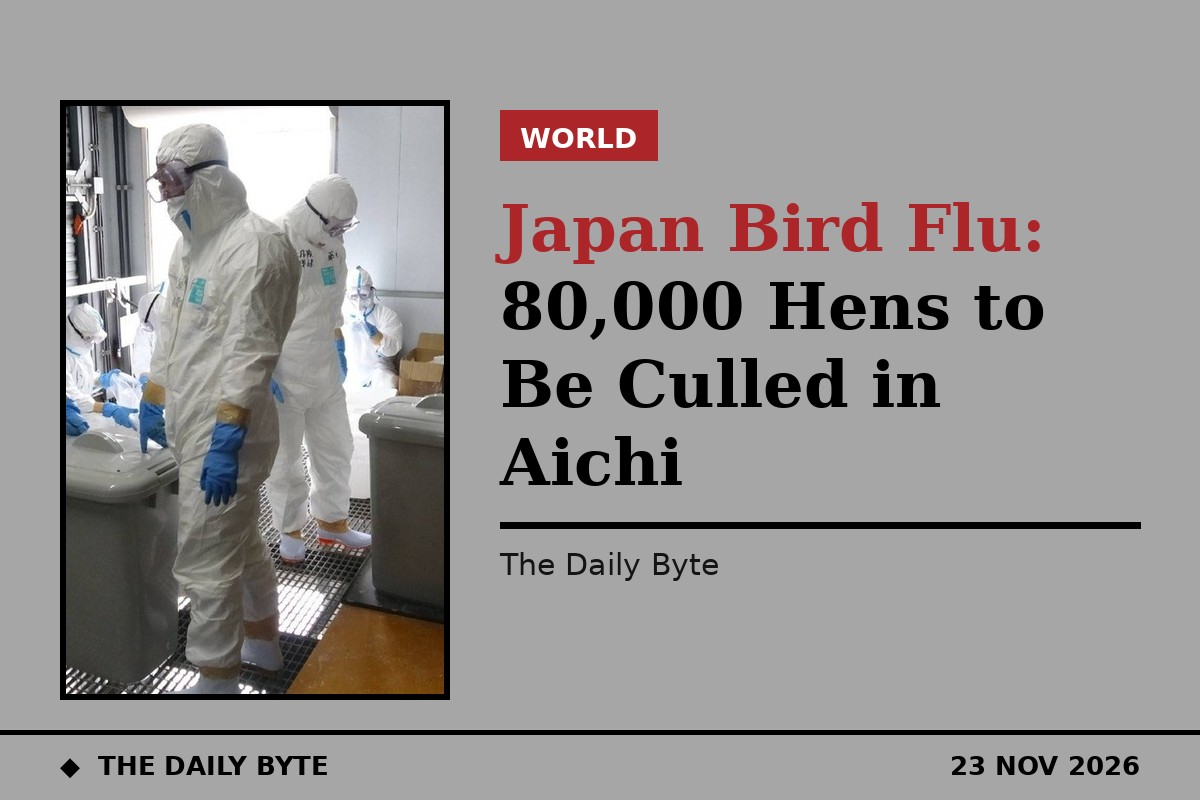
Japan will cull about 80,000 laying hens at an egg farm in Toyohashi, Aichi Prefecture, after a suspected bird flu case was confirmed on Monday, 23 November 2026. Aichi Prefecture said on Sunday evening that it had confirmed a suspected case at the farm, and by Monday morning the national agriculture ministry had confirmed the designation that triggers culling under Japanese law. It is Japan's third poultry case of the season, in the third prefecture in eleven days.
The farm telephoned the Eastern Mikawa Livestock Hygiene Service Centre in Toyohashi at around 11:55 a.m. on Sunday to report that its chickens were dying in rising numbers. Rapid tests on dead birds came back positive, three of the eight carcasses sampled and one of two chickens sampled nearby, and gene testing detected virus genes consistent with the highly pathogenic form, according to Global 1 News, citing Aichi Prefecture releases from 22 and 23 November. Particle News also reported the suspected highly pathogenic avian influenza finding at the large egg farm in Toyohashi, and that Aichi had ordered poultry and egg movement suspended within a 3-kilometre control zone.
Restrictions around the farm
The culling plan covers the roughly 80,000 laying hens on the affected farm. Inside three kilometres, three farms holding about 30,000 birds are under a movement restriction, meaning no chickens may be moved. Between three and ten kilometres, 32 farms holding about 2.78 million birds are under a shipment restriction, so the eggs and the birds stay where they are. Both counts are preliminary.
The Ministry of the Environment has also designated the ten-kilometre radius a wild-bird monitoring priority zone, covering parts of Toyohashi and neighbouring Tahara. Its national response level now stands at Level 3, the setting used when outbreaks are confirmed in more than one place in the country. Aichi convened its emergency disease meeting at 9:30 a.m. on Monday, a public holiday, chaired by Governor Hideaki Omura.
Third case in eleven days
Kyoto went first. A farm in Kameoka City reported rising deaths on 11 November, was confirmed on 12 November, and about 184,000 hens were culled. Chiba followed the next day, with a farm in Asahi City confirmed on 13 November and about 41,500 birds destroyed. The subtype named in those first two cases is H5N9. Aichi's own subtype has not yet been published, and the national reference laboratory has not yet reported its characterisation of this farm's virus.
Aichi's last confirmed case came in January 2025, at a farm in Tokoname. The agriculture ministry has said eating chicken meat or eggs is not considered a route by which a person can be infected with avian influenza virus, and Aichi has asked residents not to be thrown by unfounded rumours. The ministry's food price survey, published on 27 October, put the national average retail price of a ten-egg pack at 312 yen, the highest figure recorded since the survey began in August 2003. Agriculture Minister Arata Takebe has said the ministry will thoroughly implement measures to prevent a spread so as not to affect supply and demand.
FAQ
How many hens will be culled in Aichi? About 80,000 laying hens at the affected farm in Toyohashi.
What restrictions apply nearby? A movement restriction within three kilometres covers three farms holding about 30,000 birds, and a shipment restriction between three and ten kilometres covers 32 farms holding about 2.78 million birds.
Is this Japan's first bird flu case this season? No. It is the third, after Kyoto on 12 November and Chiba on 13 November. The first two cases were confirmed as the H5N9 subtype; Aichi's subtype has not yet been published.
Is it safe to eat chicken and eggs? The agriculture ministry's messaging, cited by Aichi Prefecture, is that under conditions in Japan, eating chicken meat or eggs is not considered a route by which a person can be infected with avian influenza virus.


