Japan to Fire Long-Range Missiles at Indian Ranges
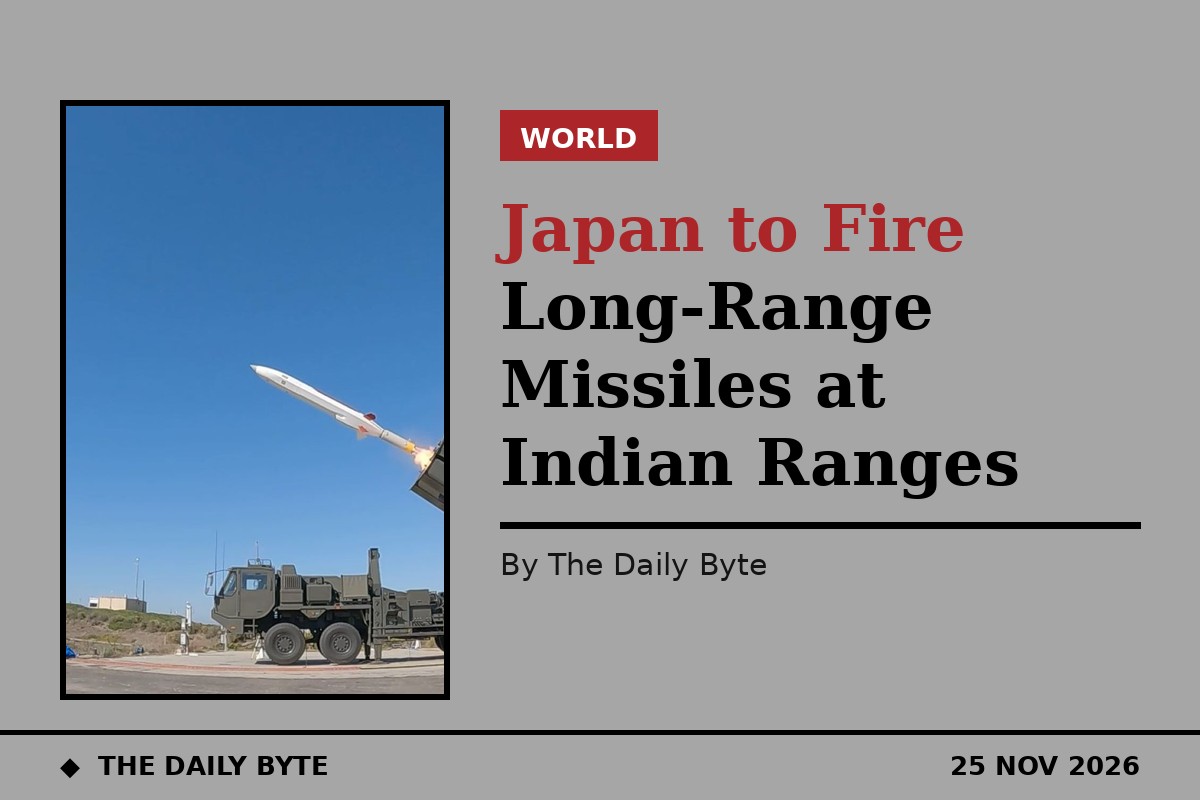
India will allow Japanese troops to conduct live-fire missile training at its firing ranges for the first time, under an agreement announced after the two countries' foreign and defence ministers met in Tokyo on 19 November. The deal gives Japan somewhere to test long-range missiles that it cannot test at home.
The signing of a letter of intent on the use of the Indian ranges was announced after the fourth India-Japan 2+2 Foreign and Defence Ministerial Meeting. Japan's Foreign Minister Toshimitsu Motegi and Defence Minister Shinjiro Koizumi met India's External Affairs Minister S. Jaishankar and Defence Minister Rajnath Singh at the talks.
A joint statement issued after the meeting welcomed the signing of the letter of intent, under which Japan's Self-Defense Forces would, for the first time, conduct live-fire training, including training involving surface-to-ship missiles, at firing ranges in India. The two sides agreed to speed up coordination between their defence authorities so the training can happen soon, and Koizumi has said Japanese forces would use an Indian range next year.
Why Japan needs ranges abroad
Japan has limited space at home for long-range live-fire exercises, and that has become a growing problem as it builds up its stand-off missile capability. Japanese officials visited India in October to assess whether its ranges could handle training with anti-ship missiles and smaller attack drones.
General Masayoshi Arai, chief of staff of the Japan Ground Self-Defense Force, told reporters in Tokyo last month that the visit aimed to work out how to train with the full reach of Japan's Type-25 surface-to-ship missile, which has a range of roughly 1,000 kilometres. He described that as a major challenge.
Japan began deploying long-range missiles on the southern island of Kyushu this year, as part of its effort to strengthen deterrence amid concern over China's military activity in the region. The move is part of a wider shift in Japan's post-war security posture towards longer-range strike and stand-off defence capabilities, which need large, controlled ranges where flight paths can be tracked and shipping and civilians kept clear.
More than missile ranges
The Tokyo meeting covered more than training. The ministers agreed to accelerate negotiations towards a first-ever defence technology cooperation initiative, under which India and Japan would jointly develop and manufacture advanced integrated communication antenna systems for Indian Navy warships.
The system at the centre of that work is Japan's Unified Complex Radio Antenna, known as UNICORN, which is designed to reduce the radar signature of naval vessels. Under the proposed arrangement, a state-run Indian company would work with Japanese defence firms to co-produce the mast for future Indian Navy warships. The joint statement said the ministers expected India's Acceptance of Necessity for the UNICORN arrangements by February 2027.
The two sides also welcomed the first visit by Japan Air Self-Defense Force fighter aircraft to India, when F-2A fighters took part in the Veer Guardian 2026 exercise in Jodhpur in September. They agreed to make future exercises more complex, to bring in unmanned systems, and to hold bilateral and multilateral exercises at short notice.
A deepening defence partnership
Koizumi said the firing-range arrangement was significant not only for expanding the scope of training for Japanese forces but also as a demonstration of a new phase in Japan-India cooperation. It was the third meeting between the Indian and Japanese defence ministers in four months.
Singh said after the talks that potential areas for collaboration included naval shipbuilding, unmanned and autonomous systems and advanced defence technologies. The ministers also reaffirmed their commitment to a free and open Indo-Pacific and to opposing unilateral attempts to change the status quo by force or coercion.
No date has been announced for the first Japanese live-fire training in India, and the ranges to be used have not been named in the joint statement. Defence officials in both countries are now working on the practical arrangements, including scheduling, safety zones and tracking, before Japanese units travel for the first firing.


