Japan to hold first live-fire drills in India
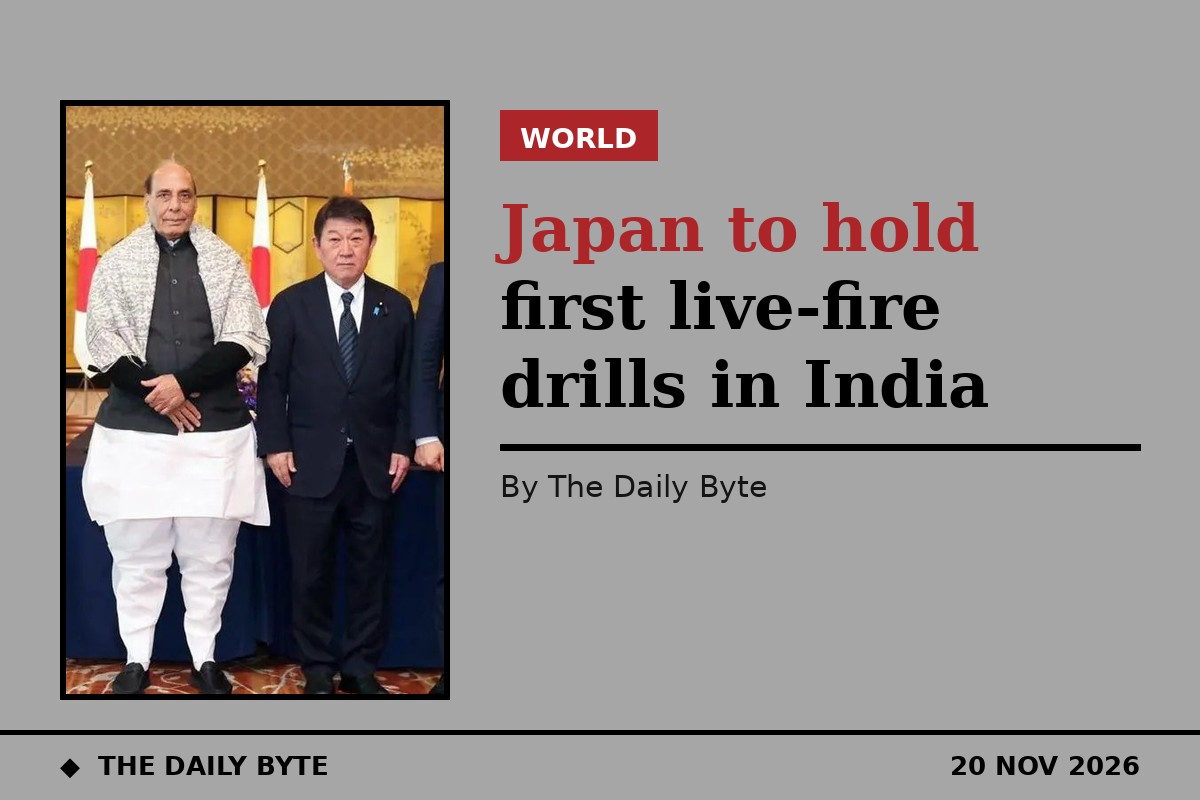
Japan's Self-Defence Forces will conduct live-fire training on Indian firing ranges for the first time, under a landmark defence agreement signed at the fourth India-Japan "2+2" ministerial meeting in Tokyo on Thursday, 19 November.
The letter of intent was welcomed in the joint statement issued after the talks, which brought together India's Defence Minister Rajnath Singh and External Affairs Minister S. Jaishankar with Japan's Defence Minister Shinjiro Koizumi and Foreign Minister Toshimitsu Motegi. The training will include surface-to-ship missile firings, and the two defence authorities agreed to speed up the arrangements needed to put it into practice.
Why Japan needs Indian ranges
As an island nation with limited space to test weapons safely, Japan has long needed partners that can provide facilities for the live-fire drills essential to improving its missile capability. It struck a similar arrangement with Australia earlier this year, and the Indian deal gives Tokyo a second large training ground in the Indo-Pacific.
Japanese Defence Minister Koizumi said after the talks that the Self-Defence Forces would use an Indian firing range for the first time next year, calling it a major strategic step. In late October, Japan's ground forces chief confirmed that Japanese officials had already visited India to inspect possible sites, with reports suggesting the facilities were being assessed for training with long-range surface-to-ship missiles and attack drones.
Japan has been fortifying its defences in its south-western islands to deter China's growing military activity, and this year began deploying long-range missiles, including Type-12 surface-to-ship missiles in Kumamoto. It has also significantly relaxed its post-war pacifist principles in recent years, lifting a ban on lethal weapons exports.
Naval technology at the centre
The ministers also agreed to accelerate negotiations on transferring the UNICORN naval radio antenna to India, Japan's first major military equipment sale to New Delhi. The system, a stealth mast that combines communications antennas into a single structure, would upgrade Indian Navy vessels, and the ministers said they expected India's Acceptance of Necessity for the deal by February 2027.
The cooperation will proceed under the framework of "Design with Japan, Make in India", Singh said after the talks, with the two sides exploring joint development in naval shipbuilding and design. On Wednesday, before the ministerial meeting, Singh toured the Japan Maritime Self-Defence Force base at Yokosuka with Koizumi and inspected the Mogami-class frigate JS Natori, which carries the UNICORN system.
Exercises keep expanding
The ministers welcomed the expansion of bilateral exercises, including the first-ever visit to India by Japan Air Self-Defence Force fighter aircraft for the exercise Veer Guardian 26, and agreed to deepen them further, adding unmanned systems and the ability to arrange exercises at short notice. The two navies also sailed together in Japan this month for the Malabar 2026 exercise, alongside their American and Australian counterparts, and for the bilateral JAIMEX26 drill.
On maritime security, the two sides welcomed the recently signed Memorandum of Arrangement on Maritime Security Cooperation and agreed to move swiftly to concrete outcomes between the Indian Navy and the Japan Maritime Self-Defence Force, covering maritime and air domain awareness, search and rescue, and humanitarian assistance and disaster relief. They also agreed to strengthen mine countermeasure capabilities, which protect the undersea cables that carry global communications.
A wider strategic bargain
The talks went well beyond the military. The ministers raised concerns about economic coercion, including arbitrary export restrictions, and agreed to promote concrete, project-based cooperation in semiconductors, critical minerals, information and communication technology, clean energy and pharmaceuticals. They also affirmed that India and Japan are strategic research and development partners in artificial intelligence, and agreed to deepen cooperation under the Japan-India AI Cooperation Initiative.
"Through our cooperation, we hope to serve as the anchor for the Indo-Pacific region," Motegi told a joint news conference after the talks. India and Japan are both members of the Quad grouping with the United States and Australia, which aims to counter China's influence in the region.
The two sides also agreed to celebrate the 75th anniversary of the establishment of diplomatic relations in 2027 as the India-Japan Year of Shared Horizons, and to hold the next 2+2 ministerial meeting in India. The fifth Coast Guard Global Summit will also be held in India in February 2027.
Sources: New Kerala (IANS) and Associated Press.


