Japan to Help ASEAN Build Joint Oil Stockpile by 2027
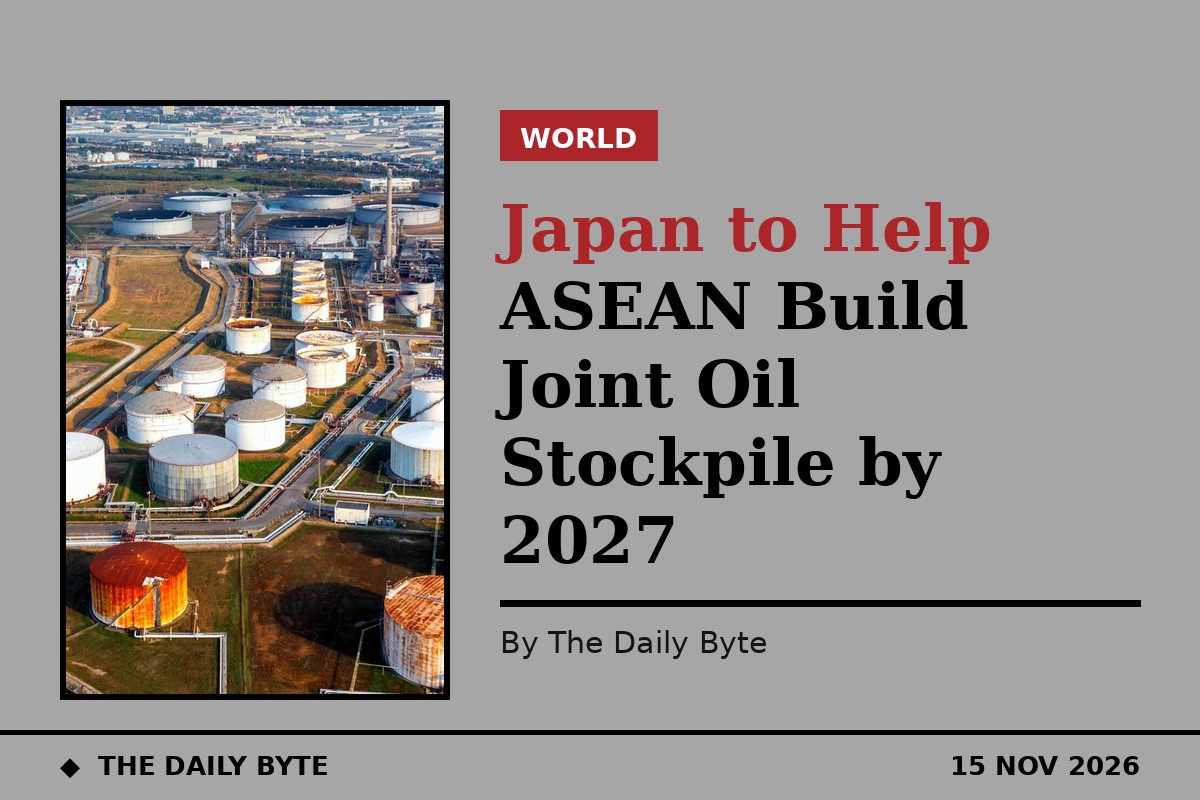
Japan plans to help the Association of Southeast Asian Nations (ASEAN) jointly stockpile petroleum products, with storage bases in Indonesia and Thailand under consideration as early as 2027, the Philippine News Agency reported on 14 November. The scheme would let member states draw on fuel stored abroad during supply emergencies, a vulnerability exposed by the disruption of Middle East shipping this year.
The initiative is being led by the Economic Research Institute for ASEAN and East Asia (ERIA), an international research centre established in Indonesia by Japan's Ministry of Economy, Trade and Industry. Under the plan, storage facilities in Indonesia and Thailand would hold diesel and petrol that other ASEAN members could buy when their own supplies are disrupted.
Ticket system for emergency access
The scheme is built around an “oil ticket” mechanism, under which a participating country or company pays an upfront fee for the right to buy a set quantity of fuel stored in another country during an emergency. It does not require governments to own a common reserve: the fuel stays in commercial storage and is only released to ticket holders when a supply crisis is declared.
A practical track for the plan took shape on 14 November, when ERIA and the Indonesian Business Council signed letters of intent with energy companies to explore emergency oil supply for the Philippines through existing facilities in Indonesia and Thailand. The Philippines–Indonesia track involves PNOC-EC, an affiliate of the Philippine National Oil Company, and PT Interport Mandiri Utama, while the Philippines–Thailand track pairs PNOC-EC with Shell Thailand. ERIA said using existing facilities could spare governments the cost of building new installations and buying extra inventories in advance.
Why the region is exposed
The case for shared storage is stark. Southeast Asia's dependence on crude imports reached about 66 percent in 2024, according to ERIA, and the Philippines imports 99 percent of the crude it needs, compared with 94 percent for Thailand. Low inventories temporarily made it difficult for member states to buy crude after the effective disruption of the Strait of Hormuz, the agency said.
Japan's own experience is part of the pitch. In May, Japan's Ministry of Economy and the Philippine Department of Energy issued a joint statement on cooperation over the Philippines' national strategic petroleum reserve programme and ASEAN-wide shared storage, with Tokyo offering expertise from a system it has maintained for more than 50 years since the oil crises of the 1970s.
In a paper published in November, ERIA said the priority should be voluntary pilot projects and public-private partnerships rather than a single unified ASEAN reserve. Its model put the region's oil demand at 5.0 million barrels a day and estimated a cooperative scenario costing $2.19 billion a year against net benefits of $6.41 billion, a benefit-cost ratio of 3.93. Raising the share of shared inventory from 10 to 30 days, it estimated, could cut annual carrying costs from $2.80 billion to $2.19 billion, saving about $610 million a year.
Announcement expected at Manila summit
Laos and Timor-Leste are also considering joining the arrangement, and the scheme could later be extended to the rest of ASEAN, with crude oil added at a later stage. Japanese Prime Minister Sanae Takaichi is expected to announce the cooperation at the Asia Zero Emission Community summit in Manila on 17 November, and ERIA's roadmap for shared storage was scheduled to be presented at the ASEAN summit and the community's leaders' meeting this autumn.
For the Philippines, which would be the first country to test the system, the arrangement offers a faster route to supply security than building a national reserve from scratch. For the region, it marks a shift from isolated national stockpiles towards a shared safety net for fuel.


