Japan-India live-fire missile training deal agreed
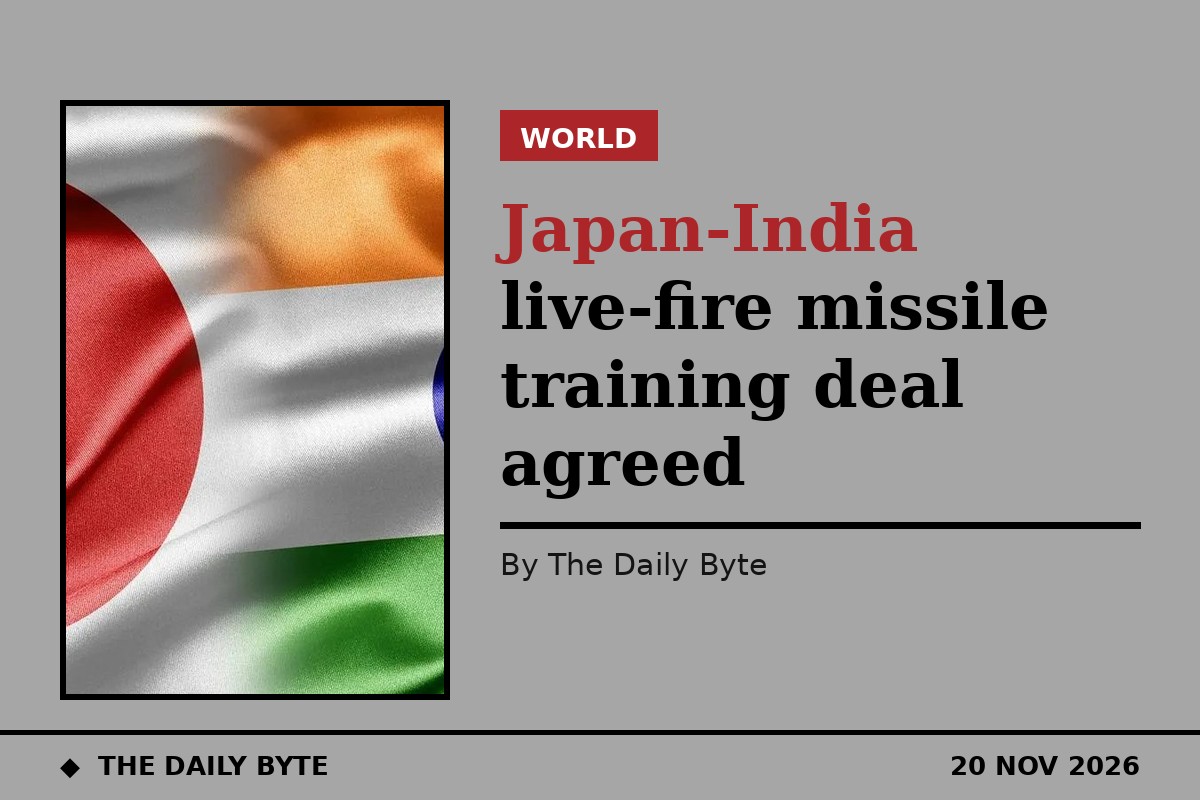
Japan's Self-Defence Forces will conduct live-fire training at firing ranges in India for the first time, under a deal agreed at the fourth India-Japan 2+2 Foreign and Defence Ministerial Meeting in Tokyo on 19 November 2026. The two sides signed a Letter of Intent covering the use of Indian ranges, including training involving surface-to-ship missiles, and agreed to speed up work between their defence authorities so the training can happen soon.
The agreement was announced in a joint statement issued after the meeting, which brought together India's External Affairs Minister S. Jaishankar and Defence Minister Rajnath Singh with Japan's Foreign Minister Toshimitsu Motegi and Defence Minister Shinjiro Koizumi. It is the clearest new operational step from a dialogue that has become the main forum for coordinating the two countries' diplomacy and defence policy.
A first for Japanese forces in India
The joint statement welcomed the signing of the Letter of Intent "toward the utilisation of firing ranges in India, whereby Japan Self-Defence Forces would, for the first time, conduct live-fire training etc., including those involving surface-to-ship missiles, at firing ranges in India", according to reporting of the statement. The ministers agreed to accelerate coordination between the two defence authorities toward its early realisation.
The move gives Japan access to larger training areas for long-range missile drills than it has at home, and it deepens a military relationship that has already expanded through joint exercises. The ministers noted the first-ever visit to India by Japan Air Self-Defence Force fighter aircraft during the India-Japan air force exercise Veer Guardian 26, and agreed to deepen exercises further, including more complex scenarios and the integration of unmanned systems. The day before the talks, Singh inspected the Mogami-class stealth frigate JS Natori at Yokosuka naval base with Koizumi.
UNICORN naval mast and maritime cooperation
The ministers also pushed forward defence-industrial cooperation, expressing their expectation that arrangements for the UNICORN naval communications mast would be formulated early and that India would grant its Acceptance of Necessity by February 2027. The project, which involves co-developing a unified complex radio antenna to improve the stealth and communications of Indian Navy ships, is being pursued under the "Design with Japan, Make in India" framework.
On maritime security, the two sides welcomed a recently signed Memorandum of Arrangement on Maritime Security Cooperation and agreed to move quickly on practical outcomes between the Indian Navy and the Japan Maritime Self-Defence Force, including maritime and air domain awareness, search and rescue, and humanitarian assistance and disaster relief. They also committed to strengthening mine countermeasure capabilities, exploring joint development in naval shipbuilding and design, and expanding cooperation in space, including space situational awareness and the use of space for maritime domain awareness. India will host the fifth Coast Guard Global Summit in February 2027.
Supply chains, AI and economic security
Beyond defence, the ministers voiced grave concern about economic coercion, including arbitrary export restrictions and non-market policies that create overcapacity and disrupt global supply chains in critical industries. They agreed to promote concrete, project-based cooperation in semiconductors, critical minerals, information and communication technology, clean energy and pharmaceuticals, building on the Joint Declaration on Economic Security Cooperation adopted at the two leaders' summit in July 2026.
Speaking after the meeting, Jaishankar warned about the growing tendency to weaponise connectivity, resources, services, supply chains and market shares, saying many of these had direct implications for national security. He added that concerns about connectivity and chokepoints had grown in light of experiences in the Gulf, and that ensuring maritime trade functioned smoothly was imperative. The ministers also affirmed that India and Japan are strategic research and development partners in artificial intelligence and agreed to deepen work under the Japan-India AI Cooperation Initiative.
The two sides decided to hold the next 2+2 meeting in India and to celebrate the 75th anniversary of the establishment of diplomatic relations in 2027 as the India-Japan Year of Shared Horizons. Taken together, the Tokyo meeting turned a broad strategic partnership into a set of dated deliverables, with the live-fire training and the February 2027 UNICORN milestone as the nearest tests of whether the commitments will be delivered.
Sources: The Hindu BusinessLine and New Kerala (IANS).


