Japan team builds record Milky Way simulation
A Japanese-led team of researchers has built the most detailed simulation of the Milky Way ever made, modelling our galaxy star by star with up to 5.4 trillion computational particles. The work, called PHEASANT, was presented on 18 November 2026 at SC26, the international supercomputing conference in Chicago, and reported by Phys.org on 22 November.
The team, including researchers from the University of Tokyo and RIKEN, simulated the whole galaxy down to the level of individual stars. Earlier simulations of this kind had generally been limited to about a billion particles, according to the University of Tokyo, so the new model is roughly 10,000 times more detailed than the state of the art. The particle count is a measure of the model's resolution, not a count of newly discovered stars.
How the simulation works
The hardest part of modelling a galaxy is what happens around exploding stars. Gas around a supernova changes so fast that a direct calculation needs time steps of about 100 years. Keiya Hirashima, a postdoctoral researcher at RIKEN, developed an artificial intelligence model that predicts how that gas will be distributed after 100,000 years, so the main simulation can skip the many small steps in between. According to the researchers, that makes the work around 20 times faster than calculating the process directly.
Professor Michiko Fujii, from the University of Tokyo's Department of Astronomy, said the team had overcome the problem by using the AI model to predict how gas around supernova explosions evolves, allowing a level of detail at which individual stars can be represented.
Three supercomputers, three chip makers
The team also adapted the software to run efficiently on three different exascale supercomputers: Aurora at Argonne National Laboratory and Frontier at Oak Ridge National Laboratory in the United States, and JUPITER at the Juelich Supercomputing Centre in Germany. Each machine uses graphics processors from a different maker, Intel, AMD and NVIDIA, and making the code run well on all three required specific optimisations.
In the largest reported run, on Aurora, the code processed 144 billion particles per second using 60,236 graphics processors, according to the team's paper, Architecture-Agnostic Exascale Star-by-Star Simulation of Our Galaxy. The researchers say a calculation about 100 times larger than the previous class of simulation could now be completed in less than 20 days.
Why it matters
The point of the exercise is not the record itself but what the model can teach astronomers about how galaxies form and evolve. The team has already checked the simulation against the real Milky Way and confirmed that it produces a star formation rate similar to the one estimated from observations, which supports its reliability.
Star-by-star resolution matters because the life and death of individual stars, through supernova explosions and the gas they throw out, shapes the whole galaxy. A model that follows those processes directly, rather than averaging them away, should give a clearer picture of how the Milky Way grew into the galaxy we see today. The paper was submitted as a Gordon Bell Prize entry at SC26, the supercomputing field's most prestigious award.
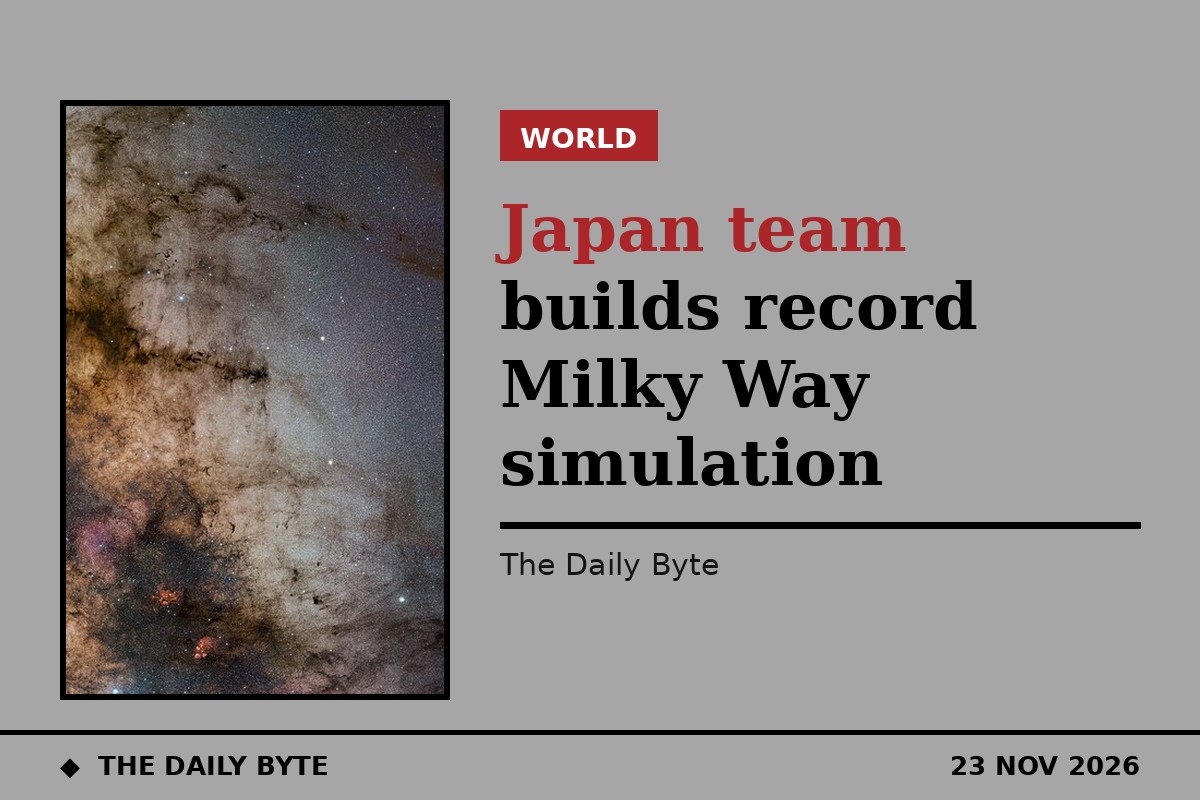
The photograph with this article shows the real Milky Way, not the simulation.
FAQ
What is PHEASANT? It is the name of the star-by-star Milky Way simulation built by a team led by researchers from the University of Tokyo and RIKEN, using an AI model to handle the physics around supernova explosions.
How detailed is the simulation? Its largest run used up to 5.4 trillion computational particles, about 10,000 times more than earlier simulations of this kind, which were generally limited to about a billion particles.
Did the team discover 5.4 trillion stars? No. The particles are computational units in the model. At this resolution one particle is roughly the mass of one star, which is what makes the simulation star-by-star.
Which supercomputers ran it? Aurora at Argonne and Frontier at Oak Ridge in the United States, and JUPITER in Juelich, Germany, each using graphics processors from a different manufacturer.


