Japan Draft Seeks Early Nuclear Submarine Decision
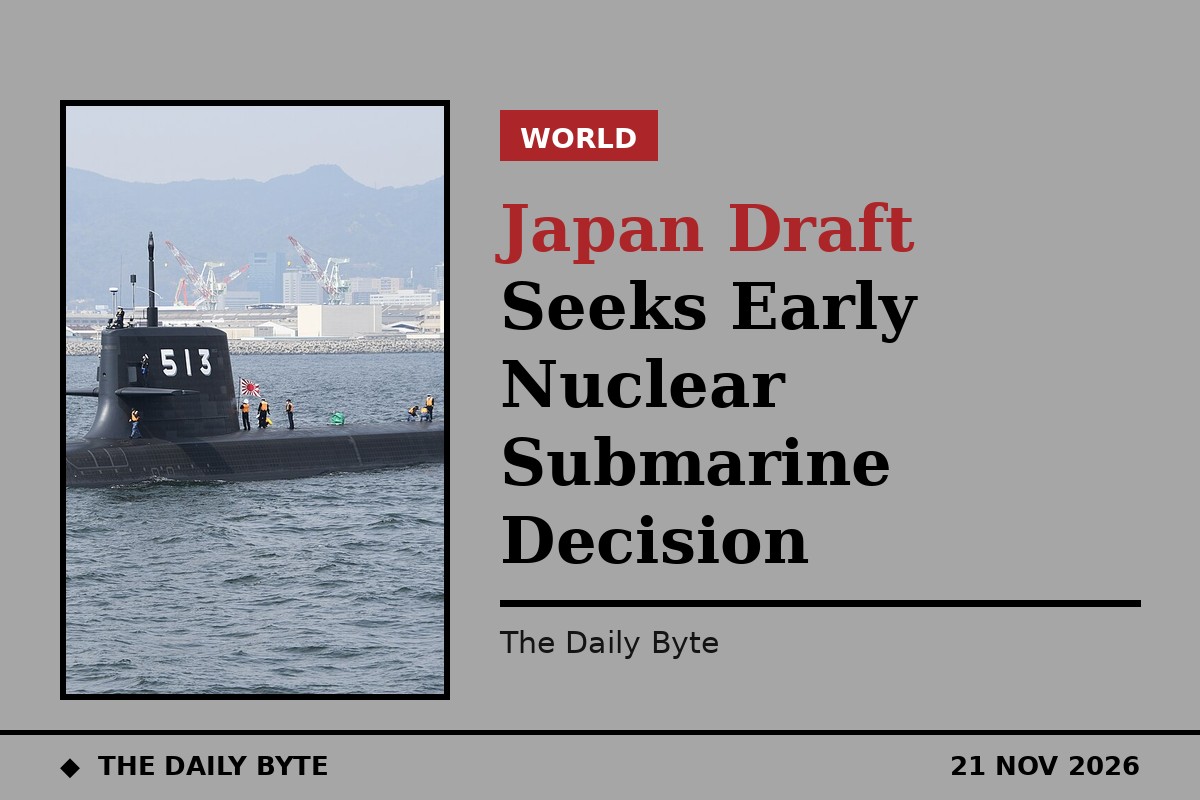
Japan's government plans to write an "early" decision on nuclear-powered submarines into its revised security documents, opening a debate that could reshape the country's post-war defence posture.
Sources familiar with the drafting process told Kyodo News on Friday that the draft of the three key security documents says the government will "launch consideration" of nuclear-powered submarines and "will reach a conclusion at an early stage". The documents, the National Security Strategy, the National Defense Strategy and the Defense Buildup Program, are due to be revised by the end of December through a Cabinet decision.
The project would begin in the early years of the five-year period starting in fiscal 2027 next April, with money earmarked as "research and study" expenses rather than an immediate purchase. Construction costs could reach roughly 1 trillion yen, about $6.3 billion, for each submarine.
Supporters say nuclear-powered submarines could strengthen deterrence against China's growing maritime activity because they can stay underwater for long periods, operate at high speed without resurfacing, and travel far without resupply. Proponents have also argued they could be fitted with vertical missile launch systems capable of striking enemy bases, a capability they say would improve crew safety.
A sensitive question for the only atomic-bombed nation
The issue is sensitive in Japan, the only country to have suffered nuclear attacks. The government has long maintained that acquiring nuclear-powered submarines would be difficult because the country's atomic energy law limits the use of nuclear power to peaceful purposes. Critics say such submarines would enable offensive operations on the high seas and run counter to Japan's exclusively defence-oriented policy.
The wording in the draft reflects the position of the Japan Innovation Party, the Liberal Democratic Party's junior ruling coalition partner, which has pushed for the introduction of nuclear submarines and a review of Japan's non-nuclear weapons principles. The LDP itself remains cautious, but key members of Prime Minister Sanae Takaichi's government have grown supportive as China's military buildup expands across the Pacific.
Defence Minister Shinjiro Koizumi has repeatedly said the government will "not rule out any options" in its discussions. In a briefing on 17 November, he listed long underwater operations, extended activity without resupply and high underwater speed among the vessels' features. In October, Takaichi told parliament that Tokyo would hold "concrete and realistic discussions" on the prospect of the Self-Defense Forces acquiring nuclear-powered vessels.
An exception to the Three Non-Nuclear Principles
The submarine debate is unfolding alongside a separate proposal that touches Japan's Three Non-Nuclear Principles, which say the country will not possess, produce or permit the introduction of nuclear weapons. The government plans to maintain the principles but explicitly provide for an exception in the updated security documents that would allow nuclear weapons to be brought into Japan in an emergency.
The proposed exception reflects a position outlined by a foreign minister in parliament in 2010 and endorsed by successive governments, including Takaichi's. Critics warn that the third principle, which bars bringing nuclear weapons into the country, complicates port calls by nuclear-armed United States vessels and weakens the credibility of American nuclear deterrence in a contingency.
Opposition is already organised. On Friday, Japanese civic groups submitted a petition bearing 47,000 signatures to the Defence Ministry, calling on the government to abandon the submarine plan. The petition, launched by several civil society organisations including the Citizens' Nuclear Information Center and collected over about one month, said that acquiring nuclear-powered submarines would betray Japan's responsibility to promote nuclear disarmament as the only country to have suffered atomic bombings.
Representatives of the groups warned at a press conference that weighing nuclear-powered submarines alongside exceptions to the ban on introducing nuclear weapons could fundamentally alter the country's status as a non-nuclear-weapon state.
The ruling parties will discuss both questions further at working-level meetings, and the government is expected to receive a report from an expert panel of former senior defence and foreign affairs officials, academics and media and business leaders before the Cabinet settles the revised documents by the end of December. The draft opens a policy process; the final choice, the design and the timing all remain unsettled.