JCB Academy Sends 40% of Leavers into Apprenticeships
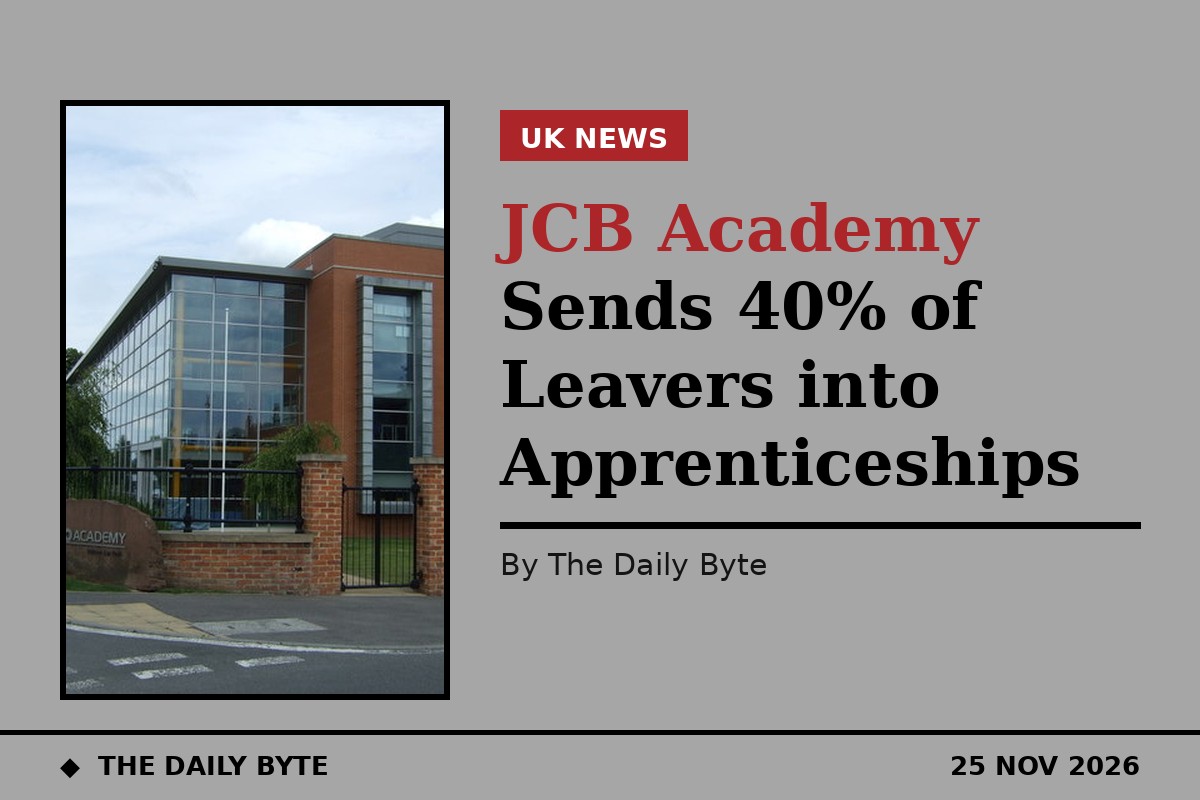
The JCB Academy in Staffordshire sends 40 per cent of its sixth formers into apprenticeships when they leave at 18, against a national average of 6 per cent. A further 30 per cent go on to university and the remaining 30 per cent move straight into employment, according to figures reported this week.
At 16, the picture is also strong: 82 per cent of the school's GCSE pupils go on to further study, compared with a national average of 55 per cent. The figures land as ministers look for ways to cut the number of young people not in education, employment or training. Official figures from the Office for National Statistics estimated that 981,000 people aged 16 to 24 in the UK were in that position in April to June 2026, and the prime minister has called for a renewed pivot towards technical education.
A school built around engineering
The JCB Academy is a state-funded, non-selective university technical college for 14 to 19-year-olds in Rocester, Staffordshire. It was created in 2010 by Lord Bamford, chairman of the construction equipment maker JCB, and others concerned at the decline of technical and vocational education. It occupies a converted and extended Arkwright mill across the village from JCB's global headquarters. JCB employs 8,000 people in the UK.
Principal Jim Bailey said the academy is funded by the state, not by JCB, and receives the same funding per pupil as any other state secondary. It draws applicants from a 20-mile radius taking in Derby, Stafford and Stoke, and is up to three times oversubscribed for a cohort of 184. Places are allocated at random, weighted by fair-banded assessments to secure an intake of all abilities, and under government admissions policy children of JCB staff receive no preferential treatment.
More than 300 applicants aged 13 and 14 are turned away each year. Lord Bamford is understood to believe there can only be one JCB Academy and that the model should not be stretched, and expansion on the current site is restricted. Bailey said he receives letters and emails from parents and children asking to join almost every other day and has to turn them away.
Destinations, not grades, as the measure
Outside English and maths, the curriculum is weighted towards science, technology, engineering and maths. Sixth formers take A-levels, T-levels or Btec diplomas. Music, drama, art, history and foreign languages are not taught, while physical education is. Bailey said employers wanted young people with GCSEs but placed more weight on punctuality, trustworthiness, resilience and problem-solving, and argued that schools should listen to industry because employers are their end users.
The academy is also an on-site provider of industrial apprenticeship training, in areas including welding, lathe work and hydraulics, for employers such as JCB, Rolls-Royce, Toyota and Bosch. The state income from trainees takes its annual budget to £10 million, and the extra money is spent on school facilities.
Official destination data supports the school's own figures. For the 2023/24 leaver cohort, 37 per cent of the academy's 16 to 18-year-olds went into apprenticeships, against 6 per cent across England, and 91 per cent were in sustained education, an apprenticeship or employment, against 86 per cent nationally.
The academy is not without challenges. The gender split is 70-30 male to female, which the school says reflects a shortfall in female applicants, and its overwhelmingly white British intake reflects the local area. It recorded eight suspensions in the past half term, down from a high of 46, and the last permanent exclusion was three years ago. Bailey welcomed the debate on technical education but cautioned against repeating past mistakes, arguing the measure of success should change to destinations and warning against recreating an academic versus vocational split. Engineering, he said, is not just for children who are not academic.