Jordan Launches 6.6bn Aqaba-Amman Water Project
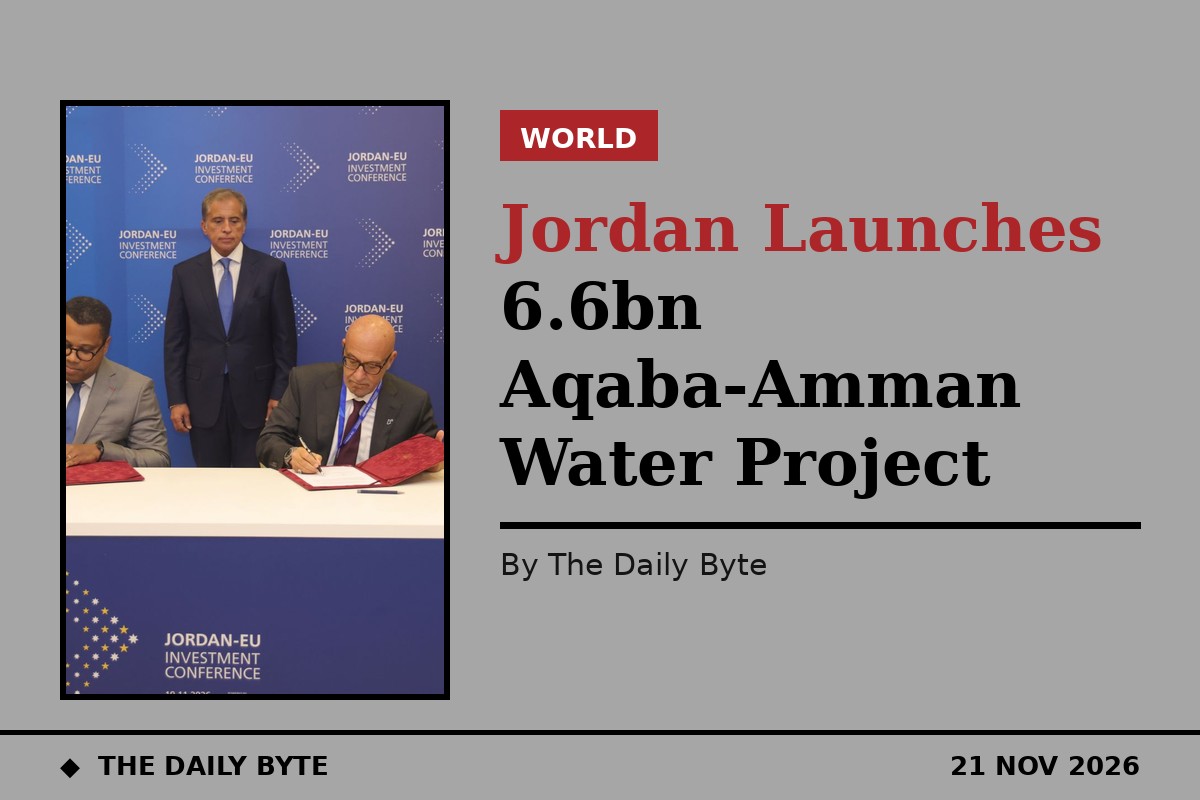
Jordan has signed a 6.6 billion dollar agreement to desalinate seawater at Aqaba and carry it to Amman, in the largest strategic investment in the kingdom's history. The deal to launch executive works on the Aqaba-Amman Water Desalination and Conveyance Project was signed on Thursday 19 November during the Jordan-EU Investment Conference at the Dead Sea.
The agreement was witnessed by Prime Minister Jafar Hassan and signed by Minister of Water and Irrigation Raed Abu Soud and Thierry Déau, the chief executive of French infrastructure firm Meridiam, in the presence of Minister of Planning and International Cooperation Zeina Toukan. It followed a cornerstone ceremony held on Wednesday under royal patronage. The project was formally launched in Aqaba on Wednesday 18 November by Prince Faisal bin Al Hussein, with Mafalda Duarte, executive director of the Green Climate Fund, attending the ceremony.
Once complete, the carrier will supply 300 million cubic metres of desalinated drinking water a year from the Gulf of Aqaba, covering roughly 40 per cent of Jordan's drinking water demand. Pumping is scheduled to begin by the end of 2030. The scheme will deliver drinking water to more than five million people, providing about 100 litres per person per day, and is expected to create more than 35,000 jobs directly and indirectly.
The largest investment in Jordan's history
The project is financed through a broad national and international partnership bringing together the government, the private sector, Jordanian banks, international financial institutions and donors. It is being developed under a public-private partnership by the National Carrier Project Company, owned by Meridiam, Suez International and the Jordanian Social Security Investment Fund. Meridiam leads the consortium, with global water group Suez as technical and operational partner.
The Green Climate Fund is providing 295 million dollars in concessional loans and grants, its largest commitment for a single country. The fund said the project is backed by 6.664 billion dollars in financing, mobilised through the International Finance Corporation and more than 20 development finance institutions, commercial banks and impact funds. Its concessional terms are intended to help keep water affordable for Jordanian households.
The infrastructure includes a 417-kilometre pipeline from Aqaba to Amman, with pumping systems lifting water up to 1,100 metres above sea level. Solar power facilities of 300 megawatts will generate around 30 per cent of the project's electricity needs. Earlier estimates had put the cost at 5.8 billion dollars including financing; the agreement signed this week values the project at 6.6 billion dollars.
One of the world's most water-scarce countries
Jordan is among the most water-scarce countries in the world, with only 61 cubic metres of available water per person per year, far below the absolute scarcity threshold of 500 cubic metres. The Green Climate Fund describes it as the second most water-scarce country in the world, with climate change and population growth placing further pressure on already limited supplies.
Speaking after the launch, Duarte said the fund's investment would improve water security for 40 per cent of the population. Once operational, the project will raise annual per capita water availability from 60 to 110 cubic metres and triple weekly water supply across governorates from one day to three days, according to the Jordan News Agency, Petra.
What happens next
With the agreement signed, executive works can now begin on the desalination plant, the pipeline and the solar facilities. The first water is due to flow by the end of 2030, giving Jordan a new source of drinking water that does not depend on its shrinking groundwater and limited rainfall. For a country where taps in many areas run only once a week, the carrier is presented by the government as a generational answer to its water crisis, and as a test of whether a project of this scale can be delivered through private finance on concessional terms.


