Jordan Trade Deficit Narrows 7.6% as Exports Rise
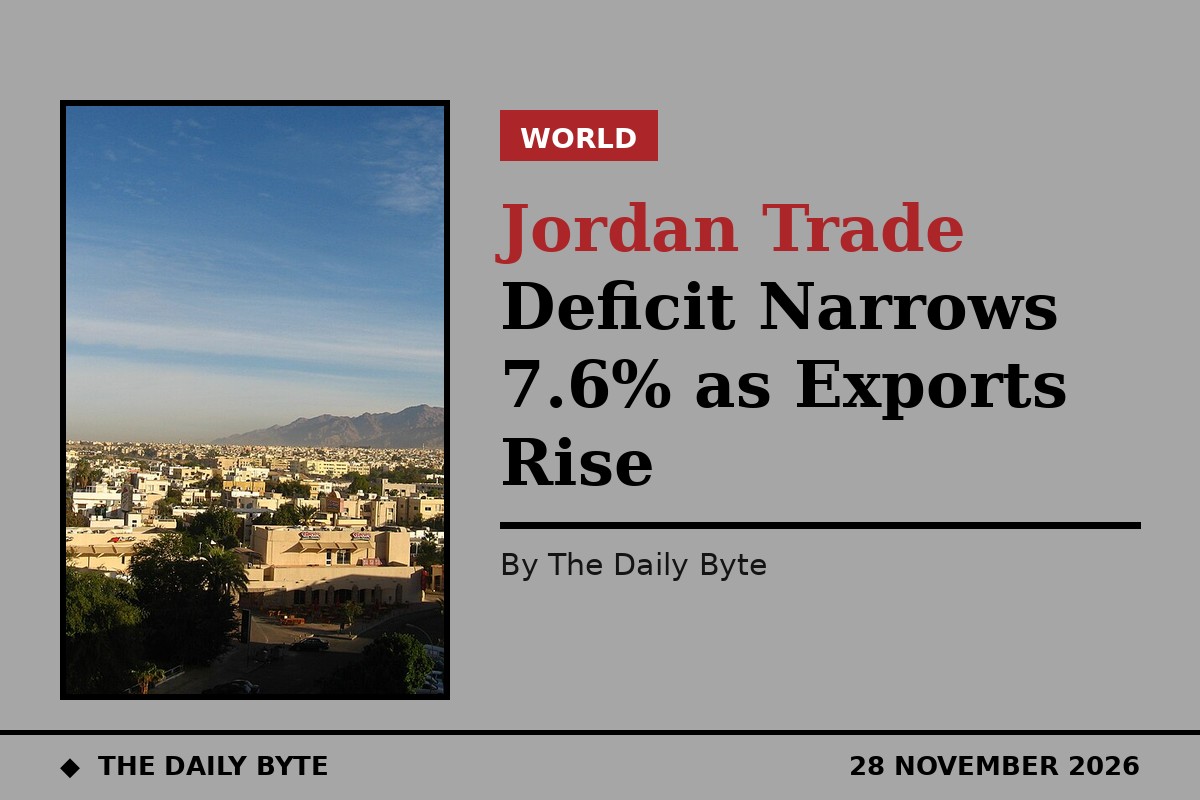
Jordan's trade deficit narrowed by 7.6 per cent to JD 6.738 billion in the first nine months of 2026, as exports grew much faster than imports, the Department of Statistics said on Saturday.
The figures, published by the Jordan News Agency on 28 November, compare January to September 2026 with the same months of 2025. Total exports rose 10.8 per cent to JD 8.520 billion, while imports rose only 1.8 per cent to JD 15.258 billion. The gap between the two left a deficit JD 558 million smaller than a year earlier, when it stood at JD 7.296 billion.
The improvement came from both sides of the export ledger. National exports, the goods made in Jordan, rose 5.7 per cent to JD 7.399 billion. Re-exports, foreign goods that pass through Jordan and are sold on, jumped 61.8 per cent to JD 1.121 billion, supplying just over half of the JD 830 million rise in total exports. Re-exports were 13.2 per cent of total exports, up from 9.0 per cent a year earlier.
Total exports covered 56 per cent of imports, against 51 per cent a year earlier, the department said. The figures are preliminary.
Potash and fertilisers lead export growth
Gains in national exports were concentrated in a small number of goods. Crude potash grew fastest, up 17.2 per cent to JD 483 million, followed by nitrogen and chemical fertilisers at 11.5 per cent to JD 901 million. Knitted clothing and accessories rose 5.5 per cent to JD 1.303 billion, pharmaceutical preparations rose 3.0 per cent to JD 484 million, and vegetables and fruit rose 4.2 per cent to JD 395 million. Exports of precious jewellery and ornaments fell 23.6 per cent to JD 450 million, taking JD 139 million off the total.
On the import side, the picture was dominated by oil. Imports of crude oil, its derivatives and mineral oils rose 42.3 per cent to JD 2.770 billion, adding JD 824 million against a JD 272 million rise in all imports. Oil was 18.2 per cent of total imports, up from 13.0 per cent a year earlier. The department does not say whether the increase reflects higher prices, larger volumes or both. Imports of cereals rose 9.3 per cent, while imports of vehicles and cycles fell 32.3 per cent, precious jewellery and ornaments fell 26.2 per cent, and machine tools fell 22.2 per cent.
Iraq, Syria and China buy more; US sales fall
The department attributed the rise in national exports to higher sales to Iraq and Syria, to non-Arab Asian countries including China, and to European Union countries including the Netherlands. National exports to Iraq rose 24.2 per cent to JD 843 million, and to Syria by 25.3 per cent to JD 218 million. Exports to China almost doubled, up 88.8 per cent to JD 321 million, and exports to Switzerland rose 183.6 per cent to JD 173 million.
The largest single-country fall was in the United States, Jordan's biggest national-export market in the table, where sales fell 13.3 per cent to JD 1.439 billion. National exports to Saudi Arabia fell 12.1 per cent, while imports from Saudi Arabia rose 23.7 per cent, widening the gap between the two to JD 1.902 billion from JD 1.261 million a year earlier.
September on its own was less encouraging. Total exports in the month were JD 1.056 billion, of which JD 121 million were re-exports, and imports were JD 1.964 billion, leaving a deficit of JD 908 million. That was about 21 per cent above the nine-month monthly average of JD 749 million. The department prints no year-earlier comparison for the month.
The trade figures sit alongside a wider economic picture presented to parliament this week. Finance Minister Abdulhakim Shibli told the Lower House on Monday that the government expects the economy to expand by 3.1 per cent in 2027, with real GDP having grown by 3 per cent in the second quarter of 2026. He said the merchandise trade deficit had narrowed by about 9.6 per cent despite the higher oil import bill, and that foreign exchange reserves reached nearly $28 billion at the end of October, enough to cover about nine months of imports.


