30 Journalists Attacked Covering Latin America Protests
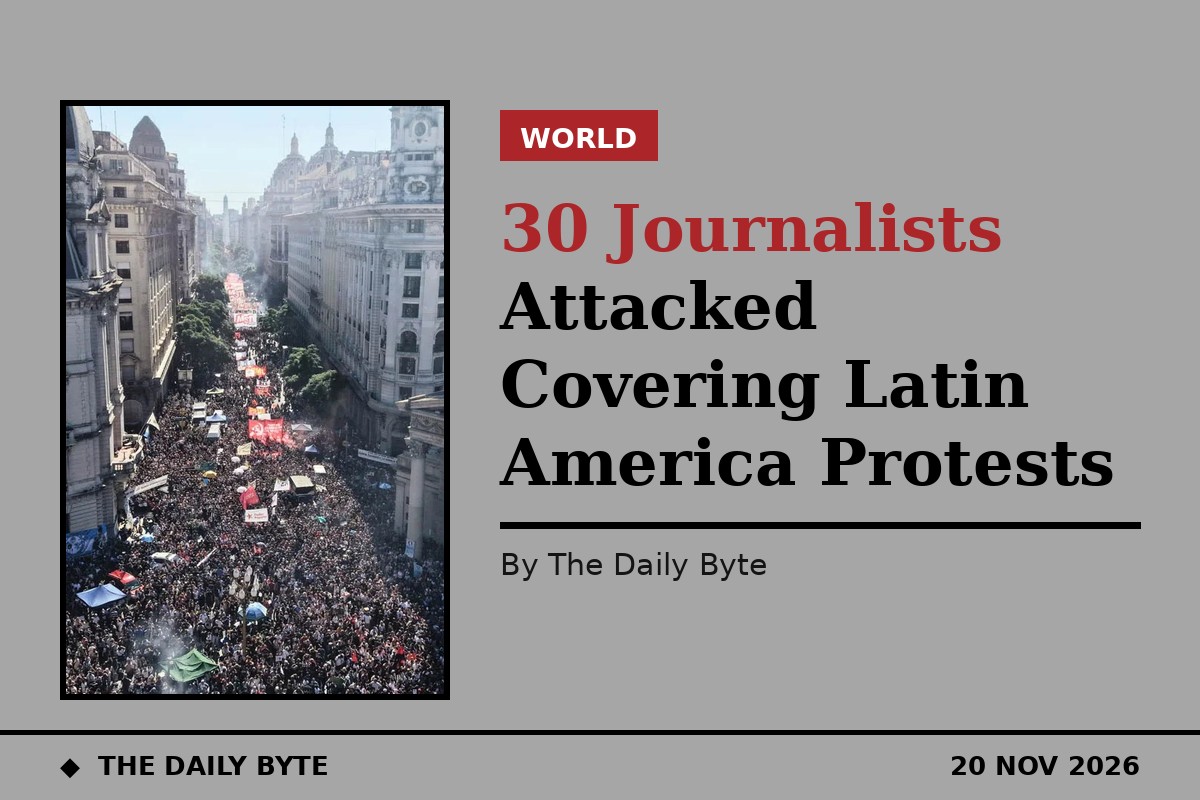
At least 30 journalists across eight Latin American countries were obstructed, assaulted or detained while covering demonstrations between August and October, according to figures gathered by Reporters Without Borders (RSF).
The cases tracked by RSF cover Argentina, Chile, Colombia, Ecuador, Guatemala, Mexico, Peru and Venezuela. They range from rubber-bullet fire and stun grenades to assaults, intimidation, equipment confiscations and arrests, and the violence came from security forces, demonstrators and unidentified individuals.
Artur Romeu, director of RSF’s Latin America bureau, said: “Reporting on a protest or covering a demonstration does not make a journalist an instigator, a protester, a suspect or an enemy of the state.” RSF has called for independent investigations into the attacks and for security measures to be applied in a way that respects the safeguards afforded to the press.
Argentina and Colombia
In Argentina, at least eight journalists reporting for outlets including Página/12, Radio Gráfica and El Grito del Sur were struck by rubber bullets while covering a student demonstration in Buenos Aires on 15 October, according to the Buenos Aires Press Union (SiPreBA) and the Argentine Association of Photojournalists (ARGRA).
In Colombia, five journalists reported police violence while covering protests in October. On 14 October in Medellín, two journalists from Cofradía para el Cambio, wearing helmets and vests marked “press”, were targeted with a stun grenade that injured one of them. RSF also received accounts of gas and marking rounds being used against media workers during protests in Antioquia, as well as police restrictions on access to operational areas and hostility from demonstrators in Cauca.
A new protocol governing police operations during demonstrations in Colombia, in effect since 13 October, has raised concerns about insufficient protection against abuses by security forces, including disproportionate use of force or obstruction targeting journalists.
Ecuador, Mexico and Chile
In Ecuador, four journalists working for teleSUR, Wambra and La Barra Espaciadora told Fundamedios, an organisation defending freedom of expression, that police officers had struck them while they covered a student demonstration in Quito on 10 October. RSF separately condemned violence against at least 55 journalists during national protests in Ecuador, including an episode on 12 October in Quito in which at least six journalists were assaulted by police officers.
In Mexico, two journalists reported attacks while covering demonstrations in Mexico City on 2 October. In Chile, photographer Juan González, who works with the Reuters news agency, suffered a fracture requiring hospital treatment after allegedly being pushed by a police officer while covering a student demonstration on 3 September. On 6 September, Benjamín Lillo, a reporter and director of community outlet Señal 3 La Victoria, was arrested while filming a march commemorating victims of the dictatorship and held for about nine hours.
Peru and Venezuela
In Peru, Néstor Paiva and Mery Ramírez of Radio Stereo 100 told RSF they had been assaulted by unidentified individuals while covering a demonstration against rising fuel prices in Pucallpa, in east-central Peru, on 13 August. In Venezuela, Reynaldo Mozo Zambrano of Efecto Cocuyo was forced to leave an opposition gathering he was covering in Caracas on 22 October.
RSF warned that new laws in several countries, including Colombia, Chile, Ecuador and Peru, have increased the risk to reporters covering protests. The organisation has also been supplying protective equipment: in Argentina it provided ARGRA with 20 protective kits, and in Venezuela it distributed 40 press vests in March 2026 with support from the National College of Journalists.
Sources: Reuters Institute for the Study of Journalism and RSF via ecoi.net.


