JPMorgan Puts Bitcoin Mining Cost at 86,000
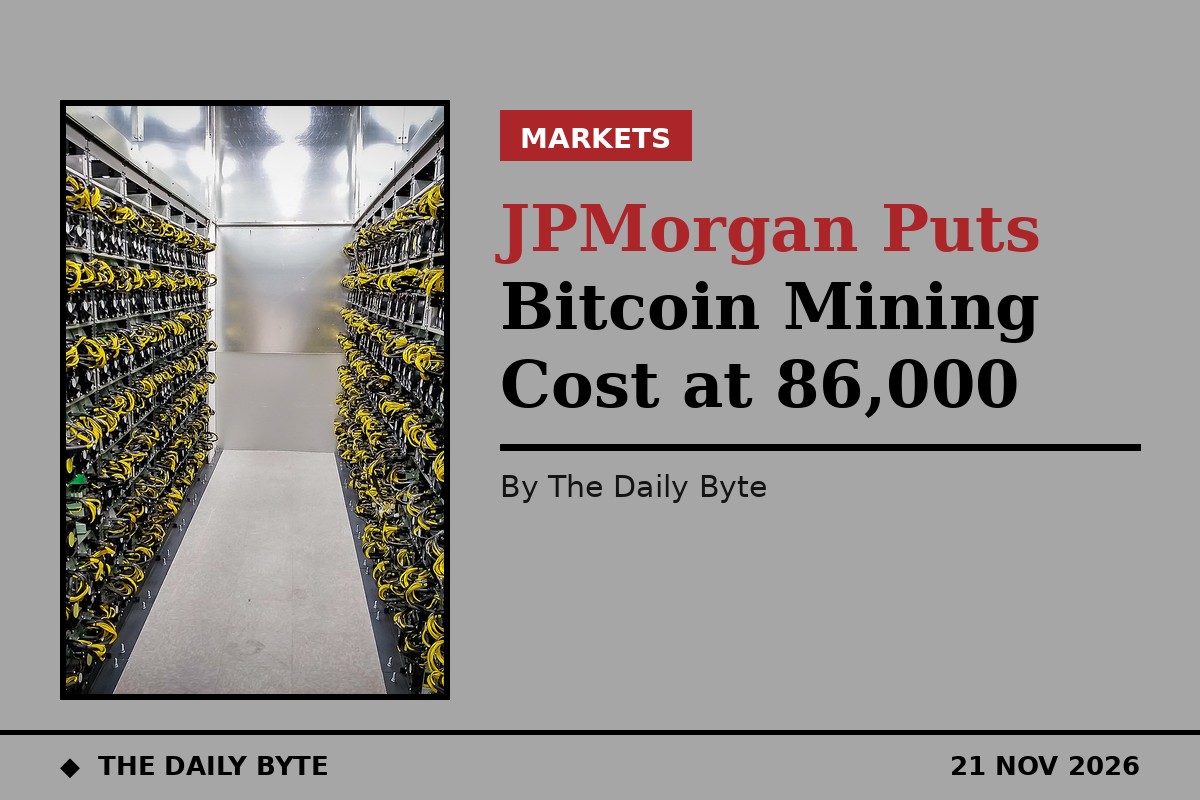
Bitcoin's slide below $60,000 has left the market price more than $26,000 below what JPMorgan estimates it costs to mine a single coin, putting the industry's weakest operators under pressure to sell the bitcoin they hold in reserve.
JPMorgan analysts led by Nikolaos Panigirtzoglou put the central estimate of bitcoin's production cost at $86,000 in a report published on Wednesday. When the note came out, bitcoin was trading near $65,000, leaving a shortfall of about $21,000 between what a coin fetched and what it cost, on average, to produce. Two days later, bitcoin fell below $60,000 on Friday for the first time since July, stretching that gap past $26,000.
The estimate has been drifting upwards all year. Earlier JPMorgan estimates in 2026 ranged from $77,000 to $85,000 before landing at the current $86,000. That means the bar for profitability has been rising even as the price has been falling, squeezing miners from both directions.
Why the gap matters
For miners, the electricity bills and hardware costs do not pause when prices fall. The coins they mine are worth less, but the inputs cost the same. JPMorgan's analysts said miners likely added to the selling as the gap widened, with higher-cost operators selling bitcoin from their reserves to raise cash, keep operating or fund a move into other businesses, including artificial intelligence.
That selling lands on a market already under strain. Mining shares fell harder than bitcoin itself on Friday, with Hut 8 plunging nearly 15 percent to about $47.61, according to CoinDesk, while Core Scientific and Bitdeer each lost more than 13 percent. The pattern has repeated throughout the recent slide: the miners, many of which have rebuilt themselves as AI data-centre operators, are now exposed on both sides of the trade at once.
A soft floor, not a guarantee
Analysts watch production cost closely because it has historically tended to act as a soft floor for bitcoin's price. When the price falls well below cost, the least efficient miners shut off their machines. Fewer machines means less total computing power securing the network, a measure called hashrate, and bitcoin then adjusts its mining difficulty to match. When fewer miners compete, the puzzle gets easier and the remaining miners earn coins more cheaply.
"That said, we believe the gap could narrow as the hashrate declines and mining difficulty adjusts as unprofitable miners exit the network," the analysts wrote.
Note the word soft. A soft floor is not a guarantee: price can trade below production cost for extended periods, and it often does during bear phases. The $86,000 figure is also a model estimate, not a universal electricity bill. Firms with cheap power and newer hardware can still mine profitably well below the average, while those near the top of the cost curve face harder choices: sell coins, cut operations or change business models entirely.
ETF outflows deepen
JPMorgan tied part of the selloff to broader forces. Spot bitcoin and ether exchange-traded funds, along with leveraged ETFs linked to Michael Saylor's Strategy, saw large outflows in both October and November, similar to May and June, and weekly data showed the outflows were heavier in the latest two weeks than in the previous four weeks. Equity ETFs, by contrast, saw inflows.
The analysts said retail investors likely drove most of the crypto ETF outflows, rotating out of crypto funds and into stock funds to buy the dip in equities. Institutional positioning in futures markets largely held up: the bank's CME futures positioning proxies suggest bitcoin positioning declined modestly, while ethereum positioning remained relatively elevated. The analysts also pointed to a decline in stablecoin market capitalisation as a sign that "some capital has also left the crypto market altogether."
Bitcoin traded around $58,800 to $59,200 on Saturday morning, after touching $57,778 on Binance on Friday. Prices are readings from a market that trades around the clock; no single daily close applies.


