Judge rules Rollins' Easter emails unconstitutional
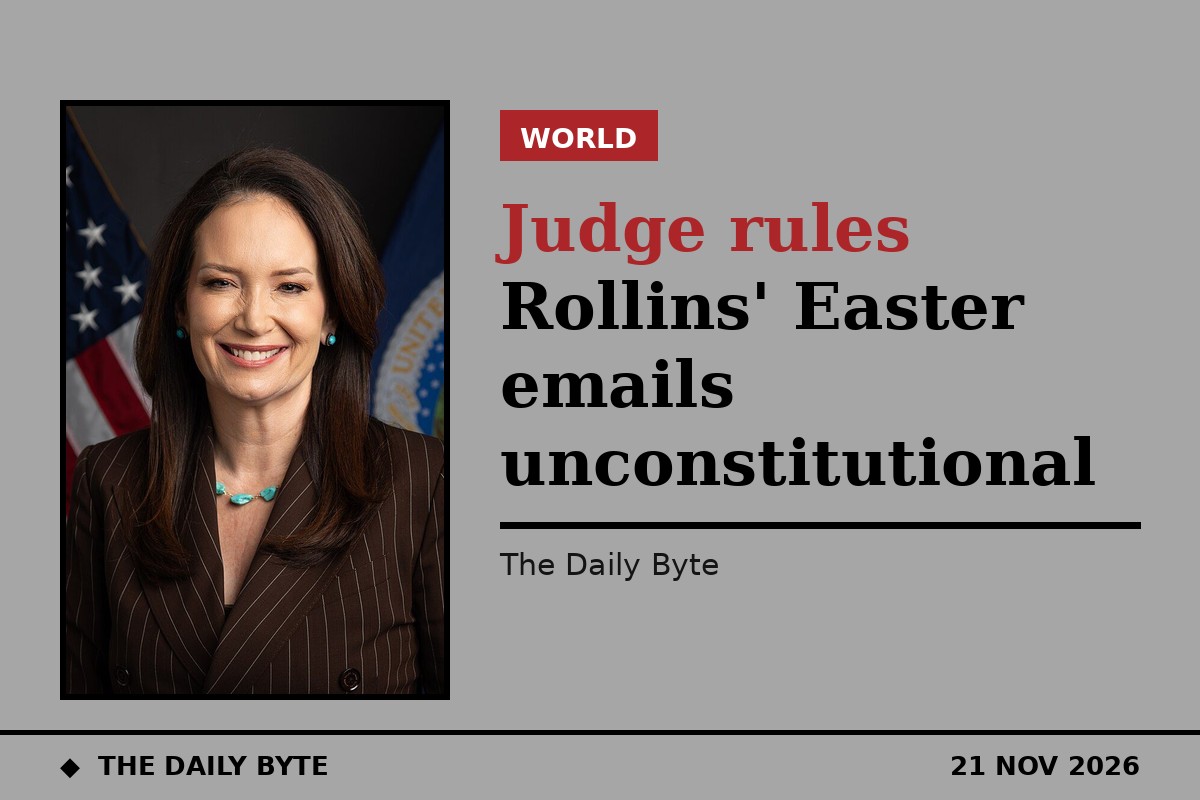
A federal judge in California has barred United States Agriculture Secretary Brooke Rollins from sending religious messages to the department's roughly 100,000 employees, ruling that her Easter and Christmas emails went too far and breached the First Amendment.
US District Judge Trina Thompson, sitting in San Francisco, issued the ruling on Thursday 19 November in a 21-page order granting a preliminary injunction while the underlying lawsuit continues. The judge found that the messages were "sufficient to raise an Establishment Clause violation" and ordered Rollins to respect boundaries when communicating religious content to her workforce.
The case centres on emails Rollins sent from her official Agriculture Department account on Christian holidays. In an Easter message on 5 April, she told staff: "Team USDA, Happy Easter - He is Risen indeed!" and compared department workers to "the very first disciples to encounter our risen Lord in the Upper Room almost two thousand years ago". A Christmas message on 23 December 2025 included a video in which she said "the spirit of generosity flows from the very first Christmas when God gave us the greatest gift possible, the gift of his Son and our Savior Jesus Christ". Similar messages were sent around Independence Day and Thanksgiving.
Coercive pressure, judge finds
Judge Thompson pointed to three features of the messages that, taken together, crossed the constitutional line. Rollins holds authority over the recipients, the emails went out department-wide from an official account, and the language suggested that Christianity was the shared faith of the workforce. The judge took particular issue with the repeated use of "we", "us" and "our" in the messages, and noted that Rollins sent no comparable messages recognising the holidays of other religions.
The court also rejected the government's argument that employees could simply ignore the emails. Staff cannot realistically choose which of the secretary's messages to read and which to skip, the judge said, and evidence showed that at least one employee had been prevented from opting out of receiving them. The ruling concluded that the emails "suggest acquiescence that amounts to coercive pressure; a pressure of conformity sufficient to raise an Establishment Clause violation".
Thompson added that the messages also ran against the Agriculture Department's own guidance on religious expression in the workplace, issued by Rollins's own office in 2025. That guidance said officials must stop if a colleague asks them to, must not create a hostile work environment through persistent unwelcome advances, and must not use official authority to pressure subordinates.
The lawsuit and its limits
The lawsuit was filed in May by six Agriculture Department employees and the National Federation of Federal Employees, a union representing about 19,000 department workers. The employees are represented by Americans United for Separation of Church and State, Democracy Forward and Bryan Schwartz Law. The six named plaintiffs are Lanette Dietrich, Thomas MaGee, Ashley Miller, Anne Poopatanapong, Ethan Roberts and Jennifer Wolfe.
The injunction does not stop Rollins from talking about her faith altogether. She may still discuss her beliefs in a personal capacity, share them with interested colleagues, invite co-workers to religious services and express religious views in appropriate conversations. What the order requires is that she follow her own department's rules when addressing staff as secretary - stopping if a colleague asks her to, avoiding persistent unwelcome religious advances and not using her position to pressure subordinates.
The judge also dismissed the plaintiffs' claims under the Administrative Procedure Act, holding that the emails did not amount to an official agency rule or order.
Department signals an appeal
The Agriculture Department criticised the ruling in sharp terms, calling it "a completely unprecedented attempt to muzzle a Cabinet secretary" and saying it was evaluating all options, including a prompt appeal. The department has not said when any appeal would be filed.
Judge Thompson was careful to stress that the order was not a judgment on religious belief itself. "This Court's judgment says nothing about the value of prayer or those who believe in its power," she wrote. "Precisely because the tradition of worship and prayer is so personal and so cherished, protecting private devotion and spiritual reflection from government influence comes to the fore."
Because the order is a preliminary injunction, the case will continue in the Northern District of California, and a higher court may yet be asked to weigh in. For now, though, the ruling draws a clear line for senior officials across the federal government: a Cabinet secretary's holiday message to the entire workforce is official speech, and it must not carry the weight of the office behind one faith alone.
Sources: CNN; USA Today; Nextgov.


