Who Is Kataib Hezbollah? Iraq's Iran-Backed Militia in Oil Smuggling Standoff
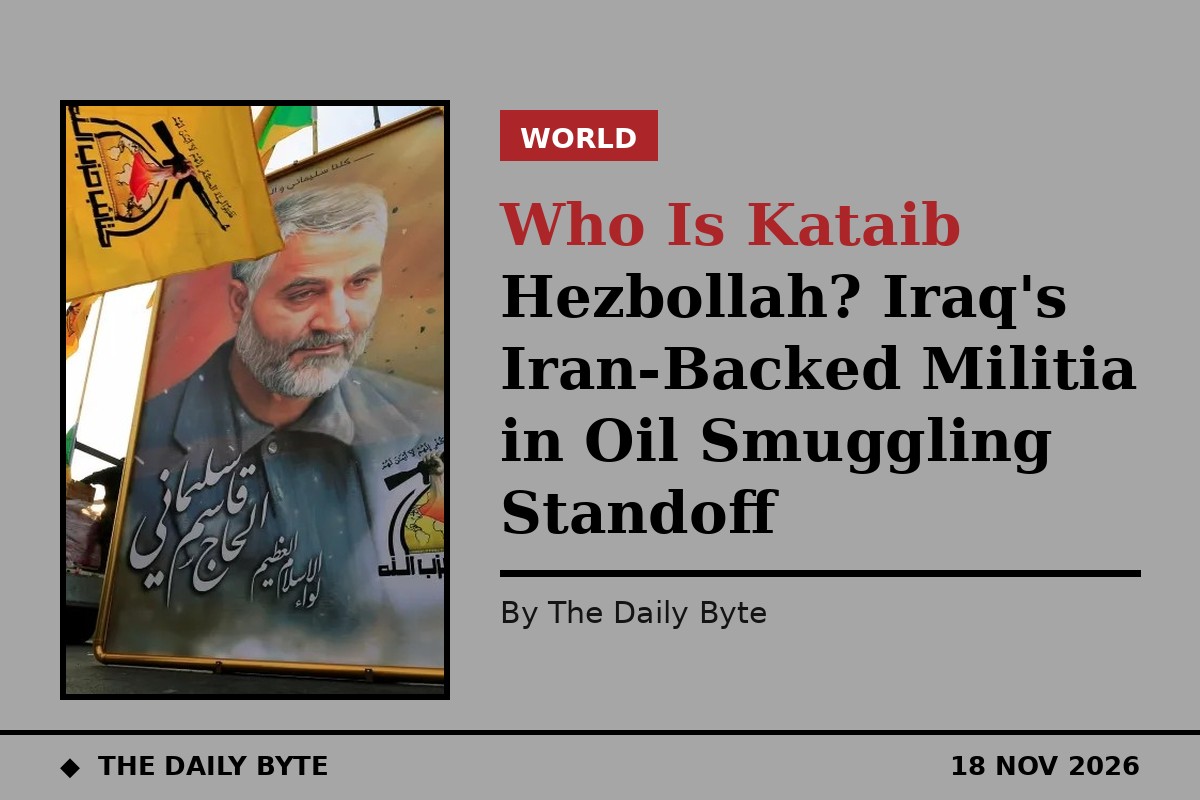
Iraq's prime minister has taken on the country's most powerful Iran-aligned militia in a confrontation over alleged oil smuggling that could become the defining test of his government. Prime Minister Ali al-Zaidi has ordered security forces to prepare to move on Kataib Hezbollah, a heavily armed Shi'ite group accused of running a smuggling network that Iraqi officials say siphoned off hundreds of millions of dollars' worth of state-owned oil.
The standoff centres on Jurf al-Sakhar, a town in Babil province about 50 kilometres south of Baghdad that has long been a Kataib Hezbollah stronghold. A government investigation committee confirmed oil smuggling in the area, and on 14 November al-Zaidi dismissed nine senior security and oil officials and ordered suspects to be referred to the courts. Troops have since been deployed around the town, and a deadline has been set for the faction to leave, with a security source telling AFP the deadline was Friday.
Kataib Hezbollah has rejected the findings outright, calling the accusations fabricated and describing the investigation as blackmail designed to force it to give up its weapons. The group says the committee that visited the area found no violations of the oil pipelines running through it. No court has ruled on the smuggling allegations, and the government has not announced charges against named individuals.
What the investigation found at Jurf al-Sakhar
The case began with a leaked report from Iraq's Federal Intelligence and Investigations Agency, which alleged organised oil theft near Jurf al-Sakhar going back to 2021. Satellite images and details from the investigation were published on 9 November by Al-Hurra, the US-funded broadcaster, and the prime minister then set up a committee to examine the claims.
According to Reuters, investigators who visited the area found evidence that smugglers had punctured a crude oil pipeline and siphoned crude into makeshift storage pits dug into the ground. The 26-inch pipeline carries at least 200,000 barrels of crude a day, according to an Iraqi Oil Ministry document reviewed by Reuters. The government committee said it had confirmed the intelligence agency's findings on smuggling operations and the existence of illegal refineries in the area.
The dismissals that followed were sweeping. Among those removed were the Babil province police chief, the province's intelligence and security commanders, and the director general of the state-run Oil Pipelines Company. Eight of the nine officials dismissed were from the security services and one was an oil official. The prime minister's office said all suspects would be referred to the judiciary, although its statement did not name Kataib Hezbollah or say how many people were implicated.
What is Kataib Hezbollah's status in Iraq?
Kataib Hezbollah, whose name means Battalions of the Party of God, is one of dozens of heavily armed pro-Iranian groups that hold semi-official status in Iraq. It forms several battalions in the Popular Mobilization Forces (PMF), a grouping of armed factions originally set up to fight Islamic State in 2014 that was subsequently recognised as an official security force.
That status gives the group an unusual position. Its fighters receive state salaries, and Kataib Hezbollah members, including some designated as terrorists by the United States, hold senior positions in the PMF. While it is technically under the command of Iraq's prime minister as part of the PMF, the group often operates outside the chain of command and has defied government statements calling for an end to attacks on US forces.
Critics say the semi-official standing encourages the militias to act with impunity. Kataib Hezbollah has its own political party, called Huquq, or Rights, which holds five seats in parliament. An Iraqi official report said the group also generates cash through businesses such as construction, housing, trade, tourism and currency exchange, though the group denies this and says it is dedicated to security.
Where did Kataib Hezbollah come from?
Kataib Hezbollah was founded in the aftermath of the 2003 US-led invasion of Iraq and quickly developed a reputation for deadly attacks against military and diplomatic targets during the counterinsurgency war and sectarian conflict of the 2000s, using snipers, rockets, mortars and roadside bombs. The United States designated it as a terrorist organisation in 2009.
It is among the most influential members of the Islamic Resistance in Iraq, an umbrella group of hardline Shi'ite armed organisations supported by Iran. Like other Shi'ite armed groups, Kataib Hezbollah reports directly to Iran's Revolutionary Guards. It was led by dual Iraqi-Iranian citizen Abu Mahdi al-Muhandis until he was killed in a US drone strike in 2020 along with the commander of the Revolutionary Guards' Quds Force, Qassem Soleimani, at Baghdad's international airport.
The group fought alongside other Shi'ite militias against mostly Sunni rebels during Syria's 2011-2024 civil war. It holds a transnational Shi'ite ideology that views the borders between Iraq, Syria and Lebanon as Western constructs, and it was long opposed to the presence of US troops in Iraq, which formally ended in September.
Why the confrontation matters now
The Iran-backed groups have claimed more than 150 attacks on US forces since the Gaza war erupted in 2023, and more recently they have targeted American troops in solidarity with Iran since the United States and Israel launched a war against the Islamic Republic in February. The armed groups have resisted pressure by al-Zaidi and US President Donald Trump to hand over their weapons to the state.
Iraqi security officials say the militias' arsenals include assault rifles, machineguns, anti-tank guided missiles, mortars, precision-guided rockets, armed drones and some short-range ballistic and cruise missile capabilities. That firepower is why the order to enter Jurf al-Sakhar carries such risk: a government advance into the town could bring troops into direct confrontation with hardened fighters.
For al-Zaidi, who came to power six months ago, the crackdown is his riskiest move yet. Taking on the most powerful Iran-aligned group tests whether the Iraqi state can enforce its authority over a militia that draws a state salary, holds parliamentary seats and answers, in practice, to Tehran as well as Baghdad. For Kataib Hezbollah, the investigation is, in its own words, an attempt to strip it of its weapons. With the deadline for the group to leave Jurf al-Sakhar reported to fall on Friday, the next test is whether the faction withdraws, or government forces go in.
Reporting: Reuters published an explainer on Kataib Hezbollah on 18 November 2026 (Reuters). The smuggling investigation and the troop deployment were also reported by the Long War Journal (Long War Journal).
Frequently asked questions
What is Kataib Hezbollah? Kataib Hezbollah is an Iran-aligned Shi'ite militia in Iraq, founded after the 2003 US-led invasion. It forms several battalions of the Popular Mobilization Forces and has thousands of fighters, its own political party, and a history of attacks on US forces.
Why is Iraq's prime minister confronting Kataib Hezbollah? Prime Minister Ali al-Zaidi ordered a crackdown after a government investigation alleged the group ran an oil smuggling network at Jurf al-Sakhar that siphoned off hundreds of millions of dollars' worth of state-owned oil. The group denies the allegations.
Where is Jurf al-Sakhar? Jurf al-Sakhar, also known as Jurf al-Nasr, is a town in Babil province about 50 to 60 kilometres south-west of Baghdad. It has long been a Kataib Hezbollah stronghold.


