Kazatomprom Posts Accounts Without Auditor Report
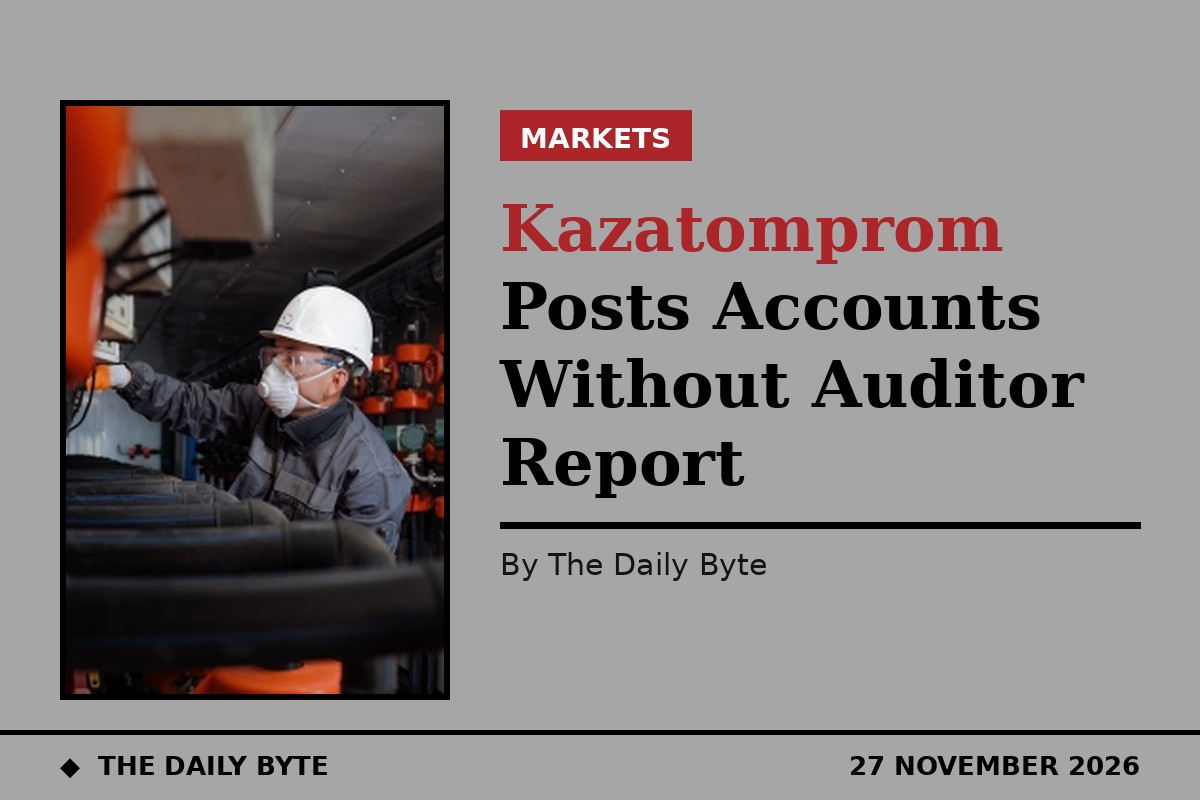
Kazatomprom, the world's largest uranium producer, has published its third-quarter and nine-month financial statements without an independent auditor's report, as a corruption investigation involving its former executives continues.
The London-listed company said on Friday that its unaudited condensed interim consolidated financial statements for the three and nine months ended 30 September 2026 were now available on its website. The statements were published without the auditor's report because management and the auditor need more time to assess the impact of an internal investigation and an investigation started by law enforcement into the group's operations.
The board of directors approved the statements on 26 November. The company said that, based on the information available to date, the board and management were not aware of any facts that would require adjustments to the statements. It said it was fully cooperating with the independent auditor and the competent authorities, and that it plans to publish the auditor's report with the financial statements package once the review is complete. No timing has been given.
The company's operating and financial guidance for 2026 remains unchanged.
Three executives leave within days
The reporting uncertainty comes alongside a rapid shake-up at the top of the company. The board said the departure of three members of the management board within a few days, and the detention of one of them on suspicion of corruption, may worry investors, employees and partners, and that it does not underestimate the seriousness of the situation.
On 24 November the board removed chief commercial officer Vladislav Baiguzhin and chief operating officer Kuanysh Omarbekov from the management board ahead of schedule. The same day, Kazakhstan's Anti-Corruption Service detained Omarbekov on suspicion of involvement in a corruption scheme which, according to the National Security Committee, was organised by the former management of Samruk-Kazyna, the state fund that holds a controlling 75% stake in Kazatomprom.
Two days later, chief procurement and general affairs officer Darkhan Sagindykov stepped down at his own request on 26 November, and the board ended his management board powers early. The company has not linked his departure to the investigation.
The board said operations were unaffected, the management board still had a quorum, duties had been redistributed, and permanent appointments would be announced later. It promised to remedy weaknesses in internal controls if an independent review or the investigation identifies them, and not to draw conclusions about anyone's personal responsibility until court proceedings are complete. The allegations remain the subject of a pre-trial investigation and are not findings of guilt.
The case reaches beyond Kazatomprom. The National Security Committee detained Samruk-Kazyna chief executive Nurlan Zhakupov on 11 November, and on 13 November Air Astana, also part of the fund's group, reported the detention of the chairman of its board of directors.
Revenue up, profit down
The unaudited figures themselves show revenue growth and lower profit. Nine-month revenue rose by 16.4% to 1.39 trillion tenge, while profit fell by 10.2% to 478.7 billion tenge. The average realised uranium price rose by 17% to 73.51 US dollars per pound, and group sales volumes grew by 10%.
Profit was weighed down by a higher cost of sales, driven by differentiated mineral extraction tax rates as uranium became more expensive, and by a foreign exchange loss of 48.8 billion tenge.
Operationally, the company is still delivering. In its 3 November trading update it reported nine-month production of 20,508 tonnes on a 100% basis, up 10%, and attributable production of 10,969 tonnes, up 12%. Group sales rose 10% to 14,030 tonnes. The same update retained 2026 production guidance of 27,500 to 29,000 tonnes on a 100% basis and consolidated revenue guidance of 2,100 to 2,200 billion tenge.
Kazatomprom is the world's largest producer of uranium, with attributable production representing about 20% of global primary uranium production in 2025. Its securities are listed on the London Stock Exchange and the Astana International Exchange, and all of its mining operations are in Kazakhstan.
For investors, the picture is now split. The mines are producing, sales are growing and guidance is unchanged. But until the auditor's report is published, the market cannot be sure the investigation will leave the accounts untouched, and that uncertainty is likely to hang over the shares until the review is complete.


