Kenya Backs 0.2% Import Levy to Fund African Union
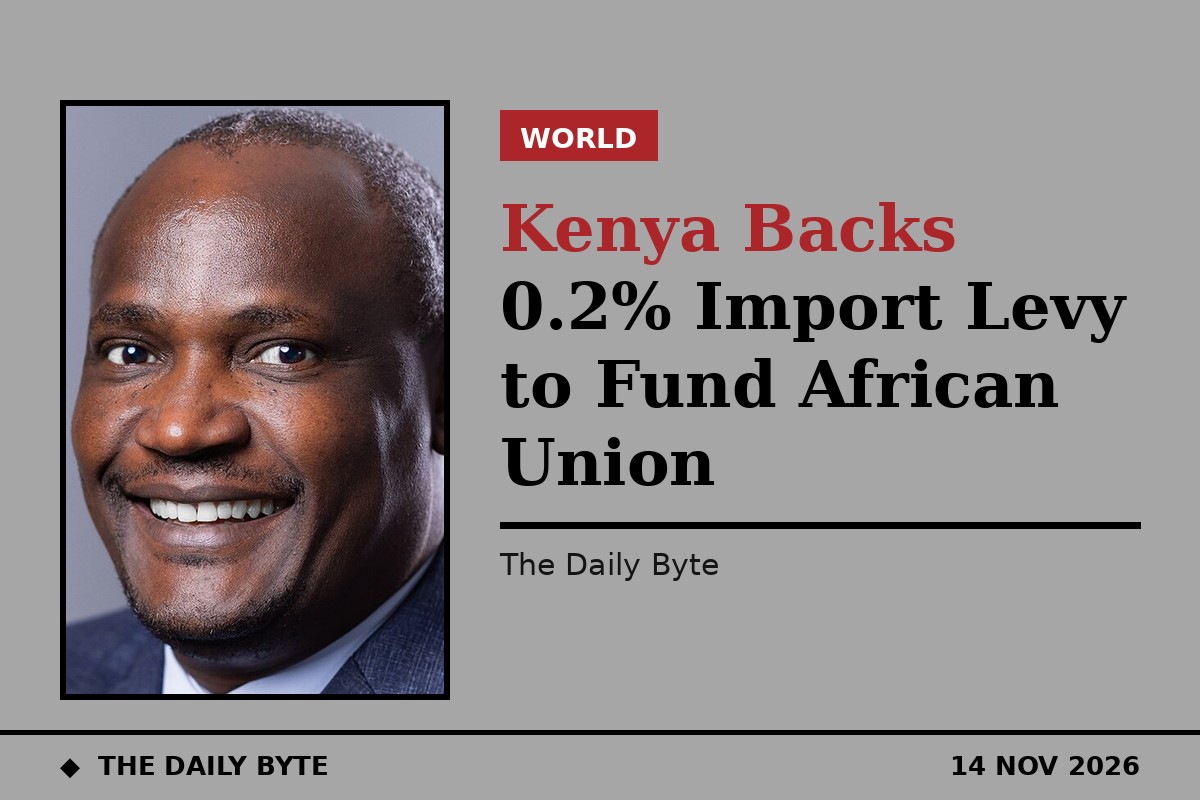
Kenya has backed a plan to fund the African Union through a 0.2 per cent levy on eligible imports, a model the National Treasury says could raise about 1.2 billion US dollars, or 155.4 billion Kenyan shillings, every year for the continental body.
National Treasury Cabinet Secretary John Mbadi set out the proposal at an extraordinary joint session of the African Union Executive Council and ministers of finance in Accra, Ghana, where leaders discussed how to reduce the organisation's reliance on external development financing.
The proposal forms part of the implementation of the Kigali Decision on Financing the Union, which aims to strengthen the African Union's financial independence by increasing contributions from African countries themselves.
According to the National Treasury on Friday, 13 November, Mbadi reaffirmed Kenya's commitment to the decision, saying member states needed to strengthen domestic resource mobilisation and improve accountability in the management of the organisation's finances.
"Full implementation across Member States could generate an estimated US$1.2 billion annually, significantly strengthening the Union's revenue base," the Treasury stated, summarising Mbadi's position.
Pressure to find reliable funding
The push comes as African institutions face growing pressure to find sustainable sources of funding, with external development financing becoming less predictable. Mbadi also called for prudent financial management, programme-based budgeting and a stronger Medium-Term Expenditure Framework, so that resources are directed towards the African Union's strategic priorities.
He further emphasised the need for measurable development outcomes and greater transparency in how funds are used.
Beyond the import levy, Kenya called for innovative financing arrangements involving African investors, financial institutions and private-sector players. The Treasury also pointed to stronger cooperation between the African Union and African multilateral financial institutions to mobilise domestic capital and strengthen home-grown financing institutions.
Option C and the Peace Fund
Kenya also supported a proposed financing framework known as Option C, built around four main pillars. These include a high-value programme aligned with the African Union's Agenda 2063, a unified results-based budget, financial autonomy through the 0.2 per cent levy and a one billion US dollar Peace Fund endowment.
The framework also proposes institutional rationalisation to remove duplication and improve efficiency within the continental organisation. On the African Union Peace Fund, Mbadi called for predictable financing, prudent investment management and transparent accountability.
Mudavadi leads Kenyan delegation
Prime Cabinet Secretary and Foreign Affairs Cabinet Secretary Musalia Mudavadi, who led the Kenyan delegation, restated the country's commitment to reforms championed by President William Ruto in his capacity as the African Union Champion for Institutional Reforms.
Mudavadi argued that sustainable financing was essential to the organisation's independence and its ability to fulfil its continental responsibilities.
"The Prime Cabinet Secretary emphasised that sustainable financing is fundamental to the Union's institutional independence, credibility and capacity to fulfil its continental mandate," the National Treasury stated.
Kenya's position received recognition from Ghana's Foreign Affairs Minister, Samuel Okudzeto Ablakwa, and other speakers, who acknowledged Ruto's role in advancing the African Union's institutional reform and financing agenda.
Mahama urges states to pay up
Ghana's President John Dramani Mahama separately urged African Union member states to fully implement the 0.2 per cent levy, arguing that Africa must mobilise its own resources to finance continental development and reduce dependence on external funding.
Mahama made the call when the Chairperson of the African Union Commission, Mahmoud Ali Youssouf, led a high-level delegation to pay a courtesy call on him in Accra on Friday, 13 November, ahead of Mahama assuming the African Union chairmanship in January 2027.
Drawing lessons from the Economic Community of West African States, which operates a 0.5 per cent community levy to finance its activities, the president urged member states to turn the African Union's existing levy framework into full implementation.
"It's not government money to the AU; it's the people's money. Government is only a collecting agency," President Mahama said.
Ghana also proposed hosting an Extraordinary Summit on African Financial Institutions in 2027, an initiative welcomed by the Kenyan delegation. For more detail, see People Daily and Kumasi Mail.


