Kenya's KSh5.2trn Budget Forecasts Too Rosy, Warns IPF
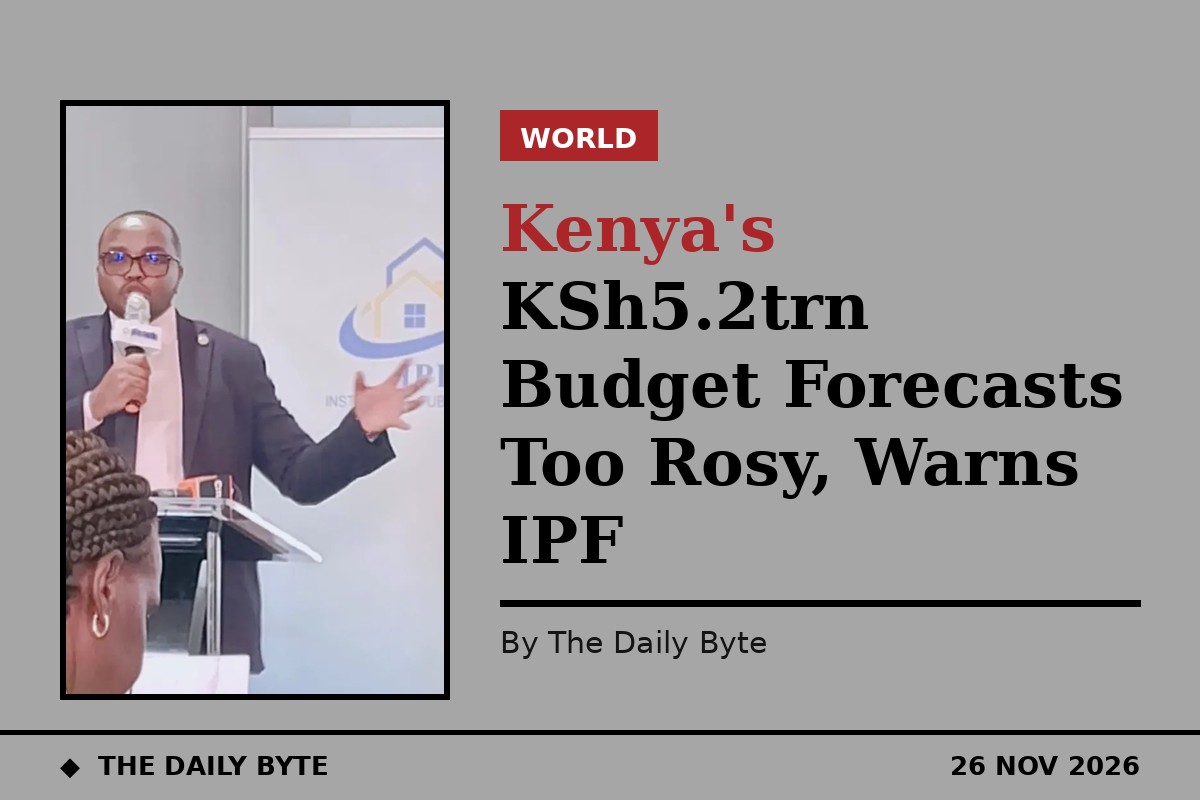
Kenya's proposed KSh5.236 trillion budget for the 2027/28 financial year rests on economic growth and revenue forecasts that are too optimistic, the Institute of Public Finance (IPF) has warned in its latest shadow budget.
The institute released its seventh Annual National Shadow Budget on 25 November 2026. It argues that the National Treasury's Budget Policy Statement overstates both growth and tax collection, and that approving spending on those assumptions would put public services at risk ahead of the August 2027 general election.
The Treasury projects the economy will grow by 5.1 per cent in 2027 and that it will collect KSh3.923 trillion in ordinary revenue, including KSh3.139 trillion in tax. IPF says growth should be assumed at between 4.4 and 4.7 per cent, in line with World Bank and African Development Bank estimates, and that tax revenue should be set at about KSh2.9 trillion.
On the institute's figures, holding tax collection to the average growth rate of the past decade would raise roughly KSh2.9 trillion, leaving a shortfall of about KSh235 billion against the Treasury's target.
Debt takes about 40 shillings in every 100 collected
Public debt stood at KSh13.1 trillion, or 70.4 per cent of GDP, in June 2026, and has since risen to about KSh13.5 trillion, according to the Central Bank of Kenya. The Treasury projects interest payments of KSh1.32 trillion in 2027/28, equal to about 40 per cent of ordinary revenue, so roughly KSh40 in every KSh100 collected would go to servicing debt.
IPF also criticised the balance of spending. Recurrent spending now accounts for more than 70 per cent of the national budget, while development spending is projected at roughly 18 per cent, below the statutory minimum of 30 per cent. The institute says the budget should focus more on completing existing projects than starting new ones.
The Auditor-General reported 219 stalled, incomplete or delayed national projects worth about KSh291 billion in 2024/25, up from 188 projects valued at KSh240.5 billion the year before. IPF pointed to the Thwake Dam project, which it said incurred KSh569 million in avoidable interest costs and saw its overall cost rise by about 32 per cent.
Health, education and safety nets under pressure
The shadow budget says funding gaps are visible across public services. Claims under the Social Health Insurance Fund exceeded contributions by 59 per cent in 2024/25, while the Health Insurance Subsidy Programme received only KSh310 million against an estimated need of between KSh37 billion and KSh39 billion.
Education funding fell from KSh155.4 billion in 2023/24 to KSh132.7 billion in 2025/26, and the institute estimates that capitation per learner would need to rise from KSh1,420 to about KSh1,833 by 2027/28 to preserve 2022/23 purchasing power. The allocation for the National Safety Net Programme is projected to fall to KSh27.9 billion in 2027/28, from KSh42.7 billion in 2022/23, and climate-related funding covers only 49.6 per cent of identified needs.
"Kenya's budget challenge is fundamentally one of credibility, prioritisation and accountability," said Gladys Wachira, a research analyst at IPF. The institute's chief executive, Daniel Ndirangu, warned that approving spending based on assumptions above independent forecasts was a risk MPs should not accept without hard questions.
The Treasury has defended its framework, presenting the 2027 Budget Policy Statement, approved by Cabinet and submitted to Parliament on 13 November, as anchored on the Bottom-Up Economic Transformation Agenda. It says it plans to cut borrowing costs, tighten spending and keep debt sustainable. Parliament will now examine the statement before the budget process concludes ahead of the election.


