Kioxia shares soar 21% after Nvidia SSD memory test
Shares in Japanese memory maker Kioxia Holdings extended their rebound in Tokyo on Friday, rising to 8,284 yen in early afternoon trade, up 6.7 percent from Thursday's close, after reaching 8,562 yen earlier in the session.
From Wednesday's close of 6,895 yen, the two-session gain stood at about 20 percent at that point in the day, and about 24 percent at Friday's high. The move capped a volatile week for the stock, which had gained nearly 10 percent on Tuesday, fallen 14.18 percent on Wednesday, and then jumped 12.57 percent on Thursday to close at 7,762 yen, touching 7,895 yen during that session.
The rally followed a proof-of-concept test in which Nvidia demonstrated Kioxia's solid-state drives working as extended memory for its artificial intelligence systems, alongside a large dividend from Kioxia's operating subsidiary that raised hopes of shareholder payouts.
What Nvidia and Kioxia tested
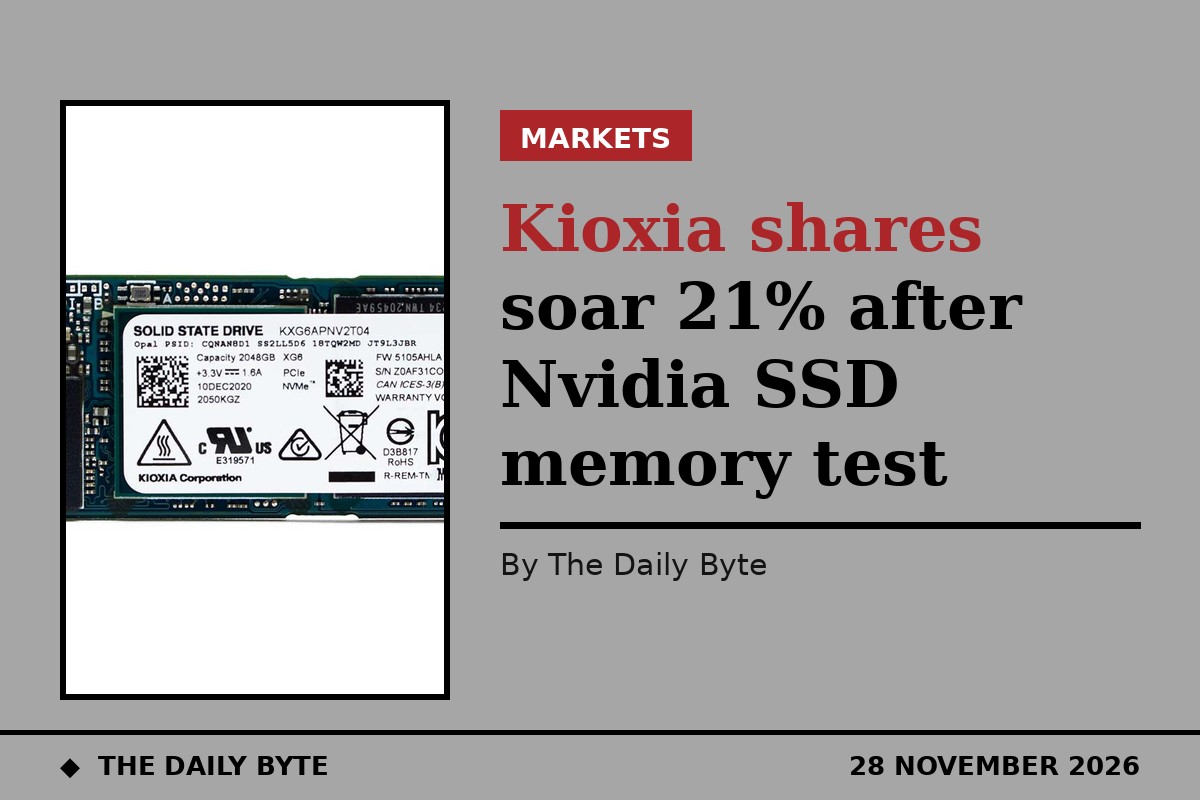
Kioxia said the two companies were evaluating the technical feasibility and performance of using its NVMe solid-state drives with Nvidia's SCADA software, short for Scaled Accelerated Data Access, and Nvidia's Storage-Next architecture to extend effective GPU memory capacity to petabyte scale.
The demonstration ran on an Nvidia GB200 NVL72 rack-scale system with 18 server nodes. Kioxia fitted 144 of its XD8 Series 7.68 terabyte drives, eight per node, giving about 1.1 petabytes of raw flash capacity, or nearly 60 terabytes of extended memory per node. Kioxia said the setup had the potential to process a database of 2 trillion vectors.
The idea is that relatively cheap flash storage could share the workload of high-bandwidth memory, the expensive and capacity-limited memory that feeds AI chips, allowing larger AI datasets to be used than high-bandwidth memory alone would allow. The approach targets vector databases and graph datasets that are too large for GPU memory.
Still a test, not a product
For now, the collaboration remains a proof of concept. Kioxia gave no throughput or latency figures for the test, and the companies are still evaluating whether the architecture works well enough to use more widely. The company plans to ship samples of an improved SSD for use with graphics processing units next year and to double processing performance, so any revenue effect is quarters away.
Even so, Nvidia putting its name to the experiment moved the stock. It places Kioxia inside the AI hardware conversation alongside the South Korean makers that dominate high-bandwidth memory, and it opens the possibility that Kioxia's drives could expand from storage-only use into products that support AI computing itself.
Dividend adds fuel to the rally
A second announcement landed within hours of the Nvidia test. Kioxia Holdings received roughly 2.2 trillion yen from its wholly owned operating subsidiary, with payment due on Friday, 27 November.
Cash moving from a subsidiary to its parent does not make the group any richer, and it will not change consolidated results. But it can clear the way for shareholder payouts, and Citi responded by saying it now considered a share buyback announcement within 2026 possible, calling the news positive for a market that had taken a negative view of delayed shareholder returns.
Kioxia listed on the Tokyo Stock Exchange in December 2024 at a market value of 750 billion yen, and by June 2026 it had become Japan's largest company by market value. Market estimates put its fiscal 2026 operating profit at roughly 4 trillion yen, about four times the previous year, although memory chips have historically been among the most cyclical parts of the semiconductor market.
Chip shares remain vulnerable to sharp swings tied to concerns about AI infrastructure spending and trade policy, and Kioxia's week showed both sides of that in the space of three sessions. For now, though, the Nvidia test and the dividend have given investors two concrete reasons to buy back in.


