KP unveils faceless terror courts in Rs70bn security plan
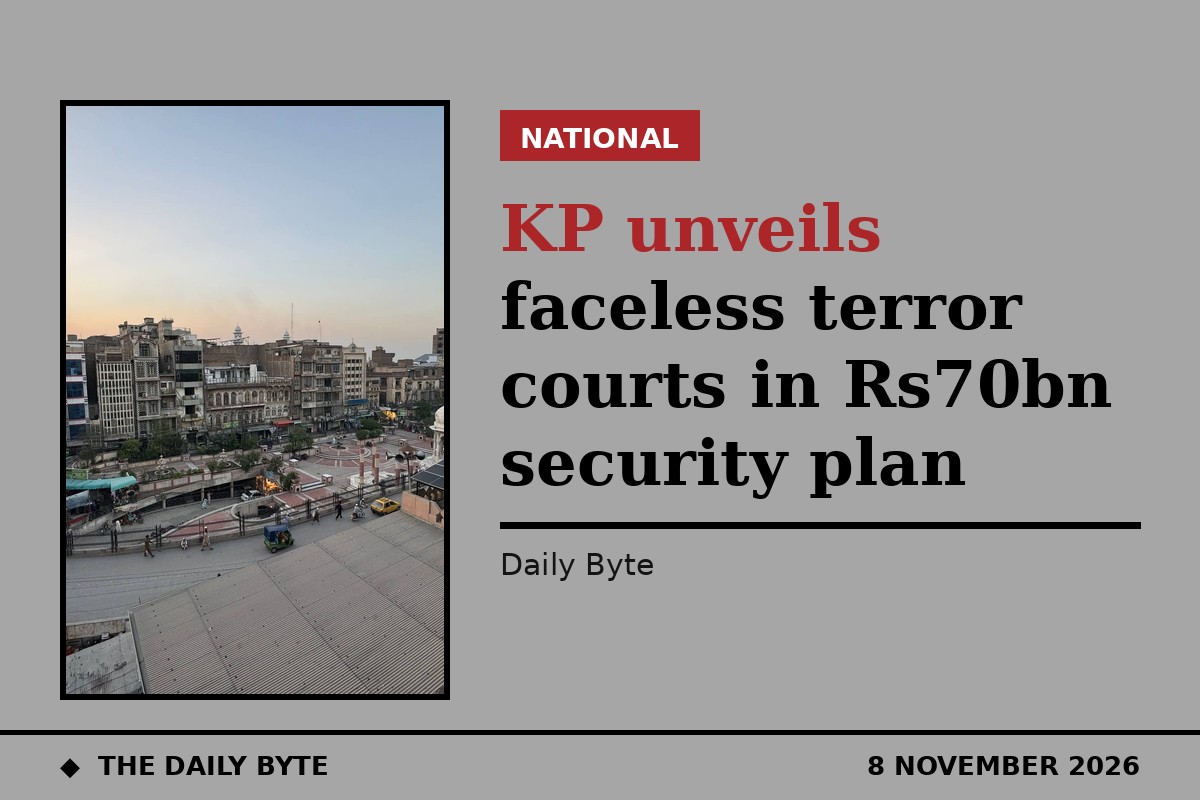
The Khyber-Pakhtunkhwa government has announced a sweeping security plan that includes faceless anti-terrorism courts, the filling of 17,000 vacant police posts and spending of about Rs70 billion on the police and the Counter-Terrorism Department (CTD). The plan was presented at a high-level Home Department briefing in Peshawar on Sunday, according to The News.
Under the plan, Rs59.8 billion will go to police infrastructure and Rs10.3 billion to the CTD. The government aims to raise the CTD's operational capacity from 12 per cent to 37 per cent and overall police capacity to 75 per cent, while filling the thousands of empty posts that have left the force short of manpower.
The centrepiece is the creation of faceless Anti-Terrorism Courts for the trial of terrorism suspects. Under the proposed system, the identities of judges, witnesses, police personnel and others involved in terrorism cases will remain confidential during hearings, to protect them from threats from terrorists and their networks. Legislation is being introduced for this purpose, and the parties concerned will keep the right to appeal against a decision before the High Court.
The briefing laid out why the province says the overhaul is needed. Only 3.2 per cent of the provincial budget had previously been allocated to the police, which officials said was far too little given the terrorism threat. The CTD has a total staff strength of just 638, and of Rs6.4 billion approved for the department only Rs1 billion was released. An allocation of Rs12 billion announced for improving police infrastructure was likewise never released, the briefing heard. Police drone protection capability stands at only 12 per cent, while the availability of operational transport is 36 per cent.
The human cost set out at the briefing was stark. Over the past two years, 1,003 military personnel, 627 police personnel and 808 civilians have been killed in the province, while security forces killed 3,788 terrorists during operations in the same period.
The plan also promises to convert several cities, including Dera Ismail Khan, Bannu and Lakki Marwat, into Safe Cities with modern surveillance and anti-drone technology, to establish special centres in 10 districts, and to accelerate intelligence-based operations. Facilitation centres and 400 police facilitation smart desks are planned to make it easier for citizens to access police services, while Dispute Resolution Councils and liaison committees in tribal areas are to be strengthened and the jirga system promoted. The Rapid Response Force will be modernised, police training improved and action taken against illegal weapons, alongside an improved welfare package for police personnel.
Addressing the briefing, Khyber-Pakhtunkhwa Governor Faisal Karim Kundi promised that the police would be given what they need and said the gaps between the federal and provincial governments on security had been eliminated. He said the federal and provincial governments would follow a joint policy against terrorism, with the political leadership taking full ownership of the fight, and that there would be no negotiations or dialogue with terrorists and no leniency in action against them. Intelligence-based operations, he said, were unavoidable but would be conducted on the basis of credible intelligence.
The faceless courts are not yet in operation: the legislation to create them is still being introduced. The proposal follows similar moves in Punjab and Balochistan, and its success will depend on whether the promised funding, recruitment and laws actually follow the announcement.