Kushner: Europe Has No Convincing Peace Plan
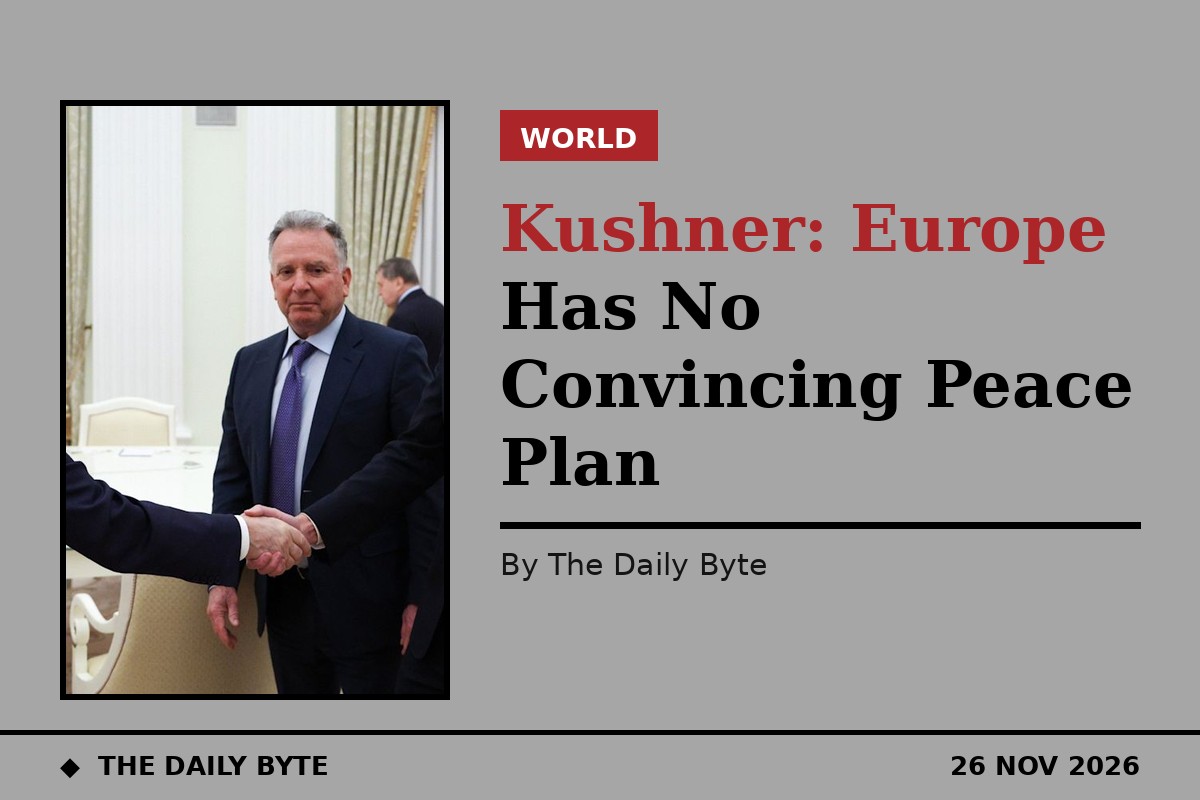
Europe has yet to come up with a convincing plan to end the war in Ukraine, Jared Kushner has said, challenging NATO allies to offer an alternative to his own efforts to broker a deal.
Kushner, Donald Trump's son-in-law and one of his leading envoys, made the comments in a podcast interview with Mathias Dopfner, the chief executive of Axel Springer, which owns The Telegraph.
He said he had pushed Vladimir Putin "very hard" on the European position that there must be a ceasefire in Ukraine before any wider talks on European security, but added that the Russian leader "doesn't seem that interested".
"We've asked the Europeans or the Ukrainians if they have a better idea on how to get there, but nobody has presented us with one so far," he said.
Focus on the post-war order
Kushner argued that negotiators should focus on the post-war relationship between Ukraine and Russia first, saying that would make the dispute over territory easier to resolve.
"What we should do is focus on the post-war period, which again, I think makes sense for us because you want to get to a peace that's going to last," he said.
"I think once we're able to define that post-war relationship, I think the issue of territory will become much easier to resolve, because right now there's no way to bridge that last issue," he added.
He said he had met Putin four times this year, and praised the Russian leader as a "grand master of politics" and a "historic figure". He also praised Putin's national security adviser Yuri Ushakov and his US envoy Kirill Dmitriev, calling the latter "an incredible friend of mine".
Kushner insisted he was a "mediator" balancing the interests of "two sides that have two different perspectives on how to end the war". He said his assessment was that Putin "does not only want peace, he wants to try and change the relationship with America".
Ceasefire-first position under pressure
His comments are likely to cause concern among leaders in Europe and Ukraine, who insist a ceasefire must come before any negotiations on post-war arrangements. They have repeatedly warned that Putin is trying to use the Ukraine peace process to redraw the continent's security arrangements in his favour.
Recent Russian demands include NATO withdrawing troops from Eastern Europe. Kushner and fellow US envoy Steve Witkoff have, in recent weeks, supported broadening the talks to cover European security architecture, post-war security guarantees and economic recovery packages.
Kushner also repeated a Kremlin claim that an alleged Ukrainian attack on Putin's Valdai residence was to blame for a breakdown in the peace talks earlier this year. "Then there was the attack the Ukrainian did on Putin's house at the end of December, which I think pushed him back," he said.
At the time, Moscow claimed the attack was an effort by Kyiv to scupper intensifying negotiations. A week later, Trump told reporters that US intelligence had determined that Ukrainian drones had not targeted the residence.
Security guarantees and energy claims
Recent negotiations between the US and Ukraine have focused on the possibility of an "Article 5-like" system for Ukraine that matches the NATO pledge that an attack on one is an attack on all. Zelensky has complained he has not received concrete information on the proposals, which Kushner believes have been accepted, in principle, by Putin.
"The Article 5 language is the gold standard, and if you're able to get that from other countries even without being in NATO, that's a pretty substantial development," Kushner said. He added that the US would not be able to give more specific guarantees than what NATO member states get from each other.
Kushner dismissed accusations that the White House had tried to pressure Kyiv into submission by cutting off intelligence or weapons supplies. "That's not the approach we've taken ... I think that's a lot of misinformation," he said, adding that America had been Ukraine's biggest donor in the war.
He also claimed Europe had purchased more than 250 billion dollars in energy from Russian sources since the outbreak of the war. "I think Europe has actually paid more money to Russia than they've given to Ukraine during this conflict, if the data that I'm seeing is correct," he said.
Kushner reiterated Trump's calls for elections in Ukraine, and warned the war had effectively become a "proxy war" in which Europe was funding and arming Ukraine against Russia. "We're living in an incredibly dangerous time," he said, warning it would not take much miscalculation for the conflict to escalate massively.


