Lablup AI:GO 2.0 runs AI agents locally on your PC
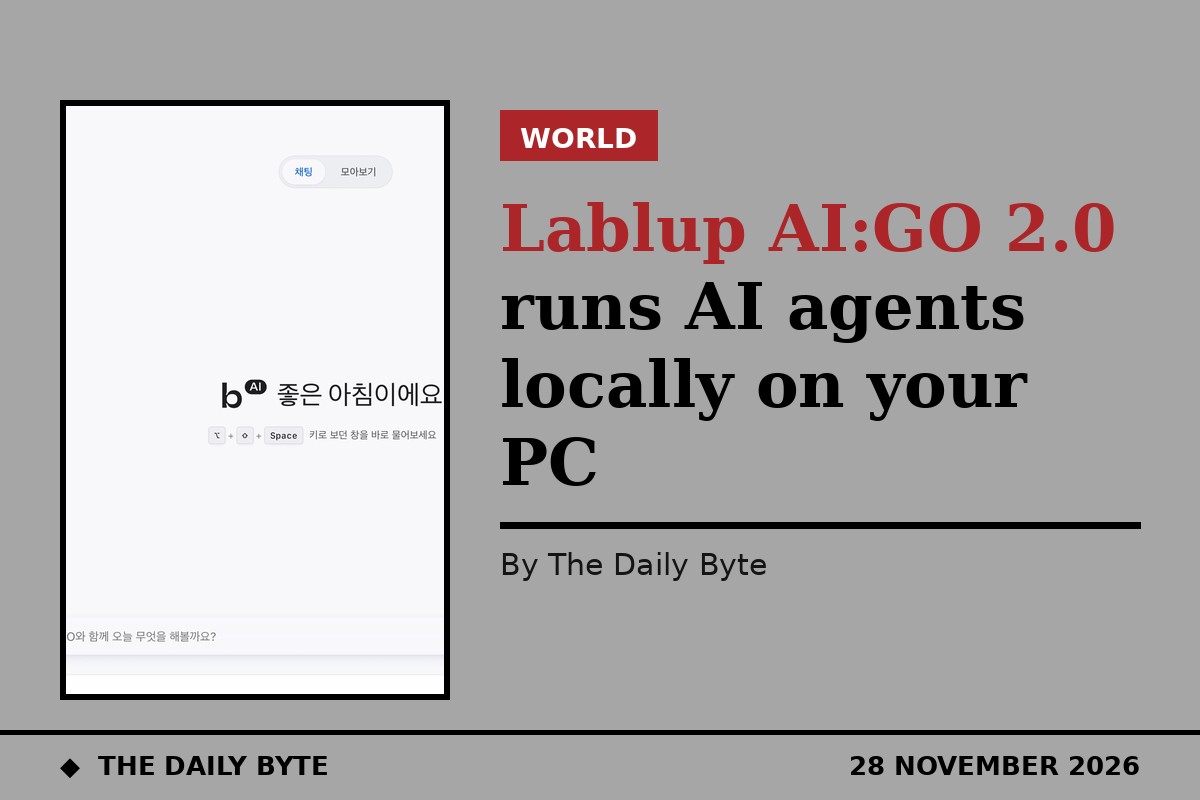
South Korean AI infrastructure company Lablup has launched AI:GO 2.0, a free desktop app that runs language, vision, image and speech AI models directly on a personal computer, with no reliance on external cloud services. The company announced the release from Seoul on 27 November 2026.
The launch responds to growing demand for running AI models and agents on personal PCs rather than in the cloud. Lablup, listed on the KOSDAQ exchange and led by chief executive Jeongkyu Shin, says the app has been redesigned as an agent workspace that works with real files, tools and schedules, while sensitive files stay on the user's own PC.
One chat window for text, images and speech
AI:GO 2.0 is built around a chat-centric home screen, where a single chat window handles text conversations, image generation, speech transcription and real-time document translation. A built-in benchmark lets users measure how fast each model runs on their own PC and pick the best model based on the results, and settings can be tuned automatically for each use case, such as chat, long documents or agents.
The release's headline feature is Cowork, an agent built to take action on files. It starts as soon as the user attaches a working folder in the chat window, then reads and edits files directly within the permitted folder. Lablup says this lets it take on time-consuming work such as organising large numbers of files, restructuring code and analysing data. For more complex work, a feature called Squad groups role-specific agents into a team that tackles tasks together.
A consistent tool approval policy applies across every execution path, including chat, agents, automations and external tool connections. Sensitive actions such as payments, orders, sending and deletion require the user's approval every time, the company says.
Sandboxed by Microsoft Execution Containers
Safety is also the reason for the release's other main change: an operating-system sandbox built on Microsoft Execution Containers, known as MXC, which Microsoft released. For Python code and shell command execution, AI:GO 2.0 natively integrates the sandbox, so code run by agents can read and write files only within a designated sandbox folder. Access to any other folder, apart from the system tools needed for execution, is blocked by default, and so are network connections. Because MXC brings each operating system's process isolation features together under a single security policy, it works without separate Docker containers or virtual machines on supported environments, including macOS, Linux and recent versions of Windows.
The app is available as a free download from the official website and can be used straight away, with no sign-up or login required. It supports macOS 15 or later on Apple Silicon, Windows 10 and 11 in 64-bit, and Linux. For enterprises and research institutions, Lablup offers AI:GO Enterprise, a commercial edition that supports organisation-wide policy deployment, device registration and air-gapped operation. When needed, users can connect to inference sessions on Backend.AI Enterprise, Lablup's platform for operating large-scale GPU clusters, and continue working with very large models from the same screen.
Lablup first showed the product as Backend.AI:GO at CES 2026 in January, and with this version it has settled on AI:GO as the product name. Demand for running AI directly on personal PCs without the cloud is growing rapidly among both individuals and enterprises, said Shin. "As AI is put to work as agents that handle real work files and tools, data sovereignty, OS-level execution safety, and a predictable cost structure have become more important than ever," he said. "With AI:GO 2.0, we will deliver a single, consistent, local-first AI experience that extends from one personal laptop to a team's workstations and an enterprise's GPU clusters."


