Lagarde Urges Europe to Act Early in Final ECB Speech
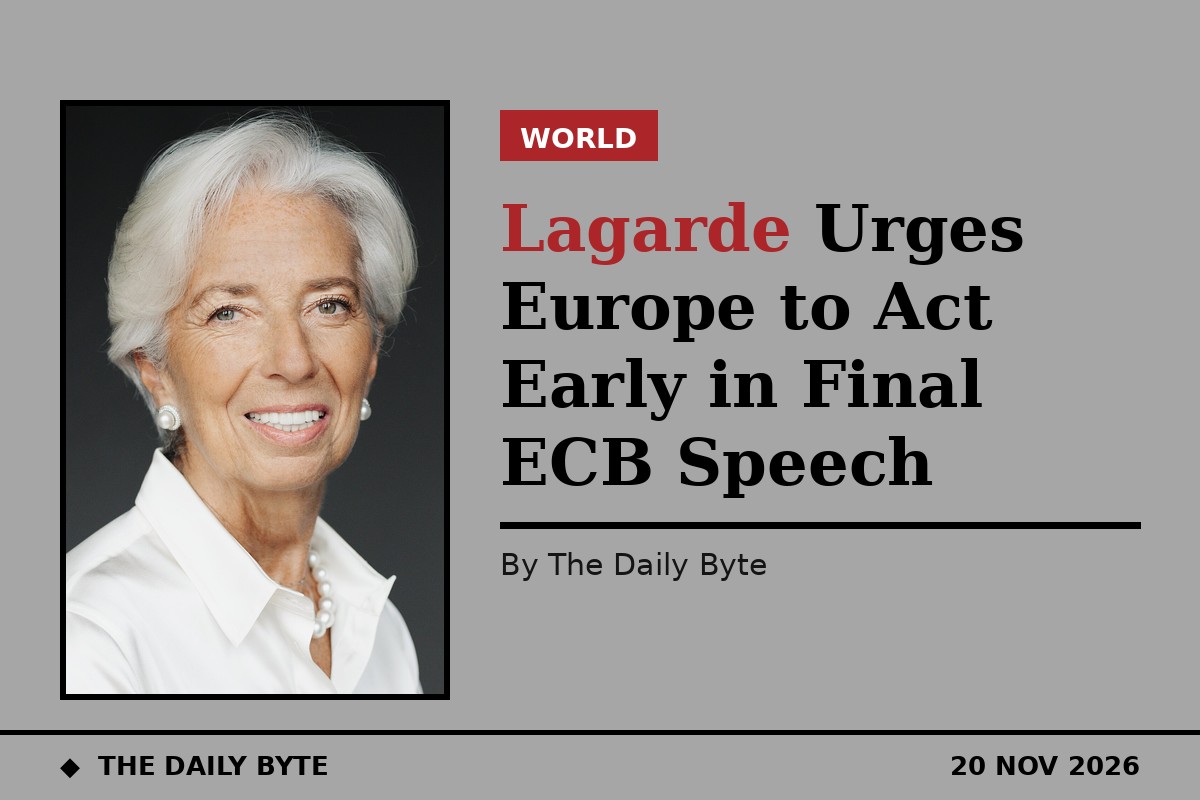
Christine Lagarde has used her final speech as president of the European Central Bank to warn Europe that it must learn to act on slow-moving risks before they turn into crises, rather than waiting until the cost of inaction becomes impossible to ignore.
Ms Lagarde delivered the keynote speech, titled Acting in time, at the 36th Frankfurt European Banking Congress on Friday 20 November. It was her eighth appearance at the congress and, she said, her last as ECB president. She will leave the post on 7 February 2027, nine months before her term was due to end, after announcing her departure in October so that she can speak freely on matters beyond monetary policy.
Her central argument was that Europe responds decisively when a crisis makes the price of doing nothing plain, as it did during the pandemic and after Russia's invasion of Ukraine, but hesitates over problems whose cost builds gradually. Borrowing from Machiavelli, she compared the problems of states to a fever that at the start is easy to cure but difficult to detect, and in time becomes easy to detect but difficult to cure.
Acting early, before the case is obvious, is one of the hardest things a policymaker has to do, she said, because it means paying a price up front for a distant pay-off. She told the congress that when events convince us that the world has changed, we act, but our difficulties arise when a crisis moves slowly.
Ms Lagarde pointed to three areas where the ECB had sought to prepare ahead of an immediate crisis: retail payments, tokenised financial markets and the international role of the euro. She presented the digital euro and related work as examples of acting in time, designed to pay off in every future rather than only in the crisis that prompted them.
She was blunt about Europe's economic record, telling the audience that the continent had not lived up to its ambitions for the single market. Growth had become overly dependent on external demand, she said, while competitiveness had gradually deteriorated. Dependencies once regarded as a normal part of an open economy, from critical raw materials to technologies, can now be used against Europe, making economic sovereignty a challenge in its own right.
Ms Lagarde also criticised EU governments' proposal for strengthening capital market supervision, arguing that the Council's negotiating position weakens the European supervisor's ability to take effective decisions and includes too many carve-outs. She said the ECB was working to make its international swap lines more accessible, so that Europe is better placed to confront economic vulnerabilities before crises force its hand.
She closed by reflecting on the institution she hoped to leave behind, saying she hoped to leave an ECB that had helped give Europe more integration and more sovereignty than it had when she arrived. Ms Lagarde has led the central bank since 2019, steering it through the pandemic, the energy crisis and the return of inflation, and her early departure has set off a contest over who will succeed her.
Sources: European Central Bank; Bloomberg Law; LaPresse.


